2 Days in Cappadocia: A Private Itinerary Beyond the Balloon Ride
Most Cappadocia itineraries read like a checklist: balloon, Open Air Museum, pottery demo, done. Two days on a group bus with forty strangers and a megaphone. You see everything and experience nothing.
This is the other version. A private, unhurried two days built around what actually makes Cappadocia worth the trip — walking through valleys carved by volcanic eruptions three million years ago, standing inside churches painted by monks who never expected visitors, and eating lunch at a family table where the bread came out of the oven ten minutes ago.
Here’s what two days look like when someone who knows the region plans them around you.
Day 1: The North — Göreme, Paşabağ, and the View from Uçhisar
Your guide meets you at your cave hotel in the morning. No set departure time — you decide when the day starts.
Göreme Open Air Museum
This is the reason UNESCO put Cappadocia on the World Heritage list. A cluster of rock-cut monasteries and churches dating to the 10th and 11th centuries, their interiors covered in Byzantine frescoes that survived because the soft tuff rock sealed them from light and air.
Most groups spend 40 minutes here. You’ll have as long as you want. The Dark Church — Karanlık Kilise — has the best-preserved frescoes in the complex, and it’s worth standing there quietly for a few minutes after the tour groups move on. The blues and reds are as vivid as the day they were painted.
Paşabağ (Monks Valley)
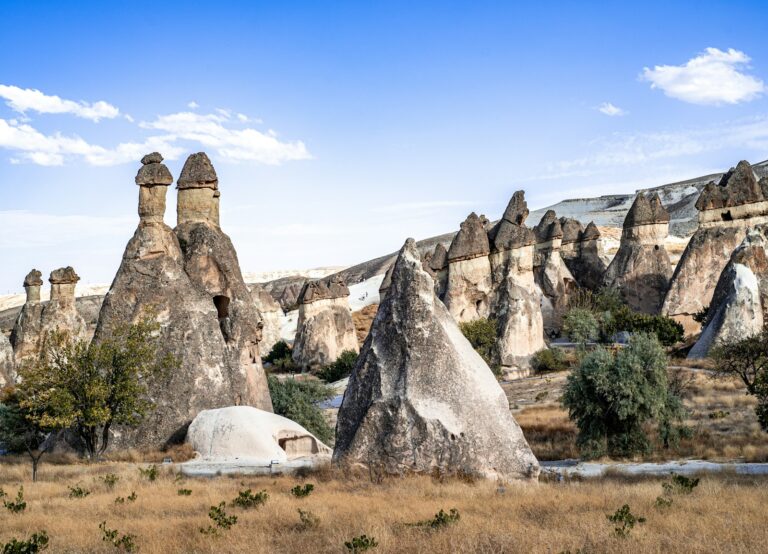
A 15-minute drive from Göreme. Multi-headed fairy chimneys — the ones you see on every postcard — and hermit cells carved high into the rock by monks who wanted to be left alone. Your guide can explain the geology here in a way that makes the landscape click: why some chimneys have caps and others don’t, why some lean, why the whole valley looks like it was sculpted on purpose.
Devrent Valley
No churches, no signs, no entrance fee. Just a landscape of rock formations that look like camels, seals, and things you’ll argue about. This is where Cappadocia feels the most alien — like a place that shouldn’t exist on Earth. A short stop, but the kind you remember.
Avanos
The Kızılırmak — Turkey’s longest river — runs red with clay through this small town. Potters have worked here since the Hittites, 4,000 years ago. You won’t watch a staged demo. You’ll sit at a wheel in an actual workshop, and a master potter will guide your hands while your cup takes a shape you didn’t plan. It’s messy and satisfying.
Uçhisar Castle
The highest point in Cappadocia. A natural rock fortress riddled with tunnels and rooms, with a panoramic view from the top that puts the entire region in context — Erciyes volcano to the east, the valleys stretching south, Göreme below. This is a good place to end the day, when the late afternoon light turns the rock gold and pink.
Your evening is yours. Your guide can recommend a restaurant in Göreme where the testi kebab is cracked open at your table, or a quieter terrace in Uçhisar if you’d rather watch the valley go dark from above.
Day 2: The South — Balloon, Underground City, and the Red Valley
Sunrise Balloon Flight (Optional)
The alarm goes early — pickup is 60 to 90 minutes before sunrise. The basket holds 12 to 20 people, and for the next hour you drift over Rose Valley, Red Valley, the fairy chimneys of Göreme, and the vineyards that fill the gaps between them. The silence is the part nobody warns you about. At 300 meters, there’s no sound except the occasional burst of the burner.
After landing, there’s a small celebration — sparkling drinks, a flight certificate — and you’re back at your hotel by 8:30 or 9:00. Plenty of time for breakfast on the terrace before the day’s second act.
One note: balloon flights operate weather-permitting. If your flight is cancelled, your guide will adjust the day — an early-morning valley walk at sunrise is a genuine alternative, not a consolation prize.
Red Valley Hike
A 3 to 4 kilometer walk, mostly downhill, through rose-tinted rock formations and rock-cut chapels that most visitors never see because they’re not on the bus route. The trail is well-maintained and moderate — no climbing, no scrambling. Your guide sets the pace based on your comfort, with stops for the chapels, the rock formations, and the views that open up between them.
Çavuşin
A village abandoned in the 1950s after rockfalls made the cliff dwellings unsafe. The old settlement climbs the rock face like a vertical city — doorways opening to nothing, staircases leading into rock. At the base, a 5th-century basilica dedicated to St. John the Baptist, one of the oldest churches in the region.
Kaymaklı Underground City
Eight levels deep, built to shelter 3,500 people during raids. Ventilation shafts, storage rooms, a winery, a church — an entire city carved beneath the surface. The tunnels are narrow and the ceilings are low in places. If tight spaces aren’t your thing, your guide can take you through the upper levels only, or suggest Derinkuyu as a slightly more spacious alternative.
This is the part of Cappadocia that shifts your understanding of the place. It’s not just about the landscape above ground — people lived inside this rock for centuries.
Pigeon Valley
The final stop. Hundreds of dovecotes carved into the cliff face, built by farmers who used pigeon droppings as fertilizer for their vineyards — a practical solution turned into an architectural curiosity. The valley runs from Göreme to Uçhisar, and the walk offers one last wide view of the landscape you’ve spent two days inside.
What Makes Two Days Enough
The standard advice is three days. And if you’re on a group tour, that’s probably right — you need the buffer for bus logistics, fixed lunch stops, and the pace of twenty people moving as one.
With a private guide and a flexible schedule, two full days cover the essential Cappadocia — both valleys, the underground city, the Open Air Museum, and the balloon flight. Nothing is rushed. Nothing is skipped. The difference is that every minute is spent on what you came to see, not on waiting for the group to reassemble at the bus.
If you have a third day, your guide can add a sunrise hike through Love Valley, a Turkish cooking class in a village kitchen, or a deeper dive into the Soğanlı Valley — the less-visited southern corner where the churches have faces scratched out by iconoclasts a thousand years ago.
The Practical Details
Getting there: A 1-hour flight from Istanbul to Kayseri or Nevşehir airport. On a private tour, airport transfers are included — your guide meets you at arrivals.
Where to stay: Cave hotels in Göreme or Uçhisar are the standard, and for good reason. Rooms carved from soft tuff rock with arched stone ceilings, natural temperature regulation, and terraces overlooking the valleys. Your guide can match you to a hotel based on what matters to you — rooftop views, walking distance to restaurants, or simply quiet.
When to go: April through June and September through October. Summer is hot (35°C+) and winter is cold, but the balloon flights run year-round, weather permitting. Spring has wildflowers in the valleys. Autumn has harvest light and fewer visitors.
What to wear: Comfortable walking shoes with grip — the valley trails are unpaved. Layers in spring and autumn. A hat and water in summer. The underground city is cool regardless of season.
Balloon flight booking: Flights sell out weeks ahead in peak season. On a private tour, your guide handles this — including rebooking if weather cancels your first attempt.
You Came Here for a Reason. Let’s Build the Trip Around It.
Maybe it’s the balloon flight. Maybe it’s walking through a church that’s been empty for a thousand years. Maybe you don’t know yet — you just know Cappadocia has been on your mind.
Tell us what matters to you, and we’ll shape two days around it. No fixed itinerary. No group compromises. Just your pace, your interests, and a guide who knows every trail in the valley.
Tell us what you have in mind →
Frequently Asked Questions
Is 2 days enough for Cappadocia?
Yes — with a private guide and no group logistics, two full days cover the Göreme Open Air Museum, Paşabağ, an underground city, the Red Valley hike, and a sunrise balloon flight. You see the same sites as a three-day group tour, without the waiting. If you have more time, a third day opens up less-visited areas like Soğanlı Valley or Ihlara Valley.
How much does a 2-day Cappadocia tour cost?
A private 2-day tour with guide, vehicle, accommodation, meals, and all entrance fees typically ranges from $800 to $1,500 per person, depending on the hotel category and whether you add the balloon flight. The balloon itself is an additional $250 to $350 per person. Group tours are cheaper, but you’ll spend a significant portion of your time on a bus.
What is the best time of year to visit Cappadocia?
April through June and September through October offer the best combination of weather, light, and crowd levels. July and August are hot (regularly above 35°C) but the balloon flights still run. Winter brings snow-dusted fairy chimneys and fewer tourists, though some valley trails may be closed.
Can I do Cappadocia as a day trip from Istanbul?
Technically yes — a 1-hour flight each way makes it possible. But a day trip means 4 to 5 hours on-site after travel. You’ll see the highlights, but you’ll miss the sunrise balloon flight (requires an overnight) and the unhurried pace that makes the region special. Two days is the minimum we recommend for Cappadocia.
Is the balloon ride in Cappadocia worth it?
For most visitors, yes. One hour floating silently over the valleys at sunrise is unlike anything else in the region. That said, it’s weather-dependent — flights cancel roughly 15-20% of the time in peak season, more in winter. If it matters to you, plan at least two mornings in Cappadocia so you have a backup window.
Are the underground cities safe for claustrophobic visitors?
The upper levels of Kaymaklı and Derinkuyu have reasonable ceiling height and width. The deeper levels get tighter — narrow passages and low doorways. Your guide can adjust the visit: upper levels only, or skip to an open-air alternative. Nobody is forced through a tunnel they’re not comfortable with.
Do I need to be fit to hike the valleys?
The Red Valley trail is 3 to 4 kilometers, mostly downhill, on a maintained path. Moderate fitness is enough — no climbing or scrambling required. Your guide adjusts the pace and can shorten the route if needed. The terrain is uneven in places, so sturdy walking shoes matter more than endurance.