Most visitors to Istanbul spend their days on the Sultanahmet-to-Galata axis — the historic peninsula, the Bosphorus, the Grand Bazaar. Balat and Fener, the neighborhoods that line the western shore of the Golden Horn about three kilometers north of the tourist center, do not appear on the standard itinerary. They should. Not because they are undiscovered — the colorful houses have been on social media for years — but because they contain something the famous sites do not: the physical evidence of how Istanbul’s different communities lived side by side for centuries, and what happened when that coexistence ended.
Balat was the Jewish quarter. Fener, immediately adjacent, was the Greek quarter. The two neighborhoods share a hillside, a waterfront, and a history that runs from the fifteenth century to the present. Walking through them is not a tour of monuments but a tour of the city’s social memory — synagogues next to mosques next to churches, some still in use, some locked, some converted, all within a few hundred meters of each other.
How These Neighborhoods Came to Be
Balat’s Jewish community dates to 1492, when Sultan Bayezid II offered citizenship to the Sephardic Jews expelled from Spain by the Alhambra Decree. The refugees settled along the Golden Horn, establishing synagogues, schools, and a hospital. At its peak, Balat had eighteen synagogues. The neighborhood’s name likely derives from the Greek word palation — palace — a reference to the nearby Byzantine Palace of Blachernae. But by the sixteenth century, the name was synonymous with the Jewish community that made it their home.
Fener, next door, was the Greek Orthodox quarter — home to the Ecumenical Patriarchate of Constantinople, the spiritual center of the world’s Orthodox Christians. The Phanar Greeks, as they became known, produced the diplomats, translators, and administrators who served as intermediaries between the Ottoman Empire and Christian Europe. Their influence far exceeded their numbers, and the grand stone mansions that still line the upper streets of Fener were built with the wealth that role generated.
The two communities coexisted within the Ottoman millet system, which organized the empire’s non-Muslim populations into self-governing religious communities. The system was not equality — Christians and Jews paid additional taxes and faced restrictions — but it was a functioning framework for diversity that lasted centuries. Balat and Fener were where that framework was lived, daily, at street level.
What You See Today
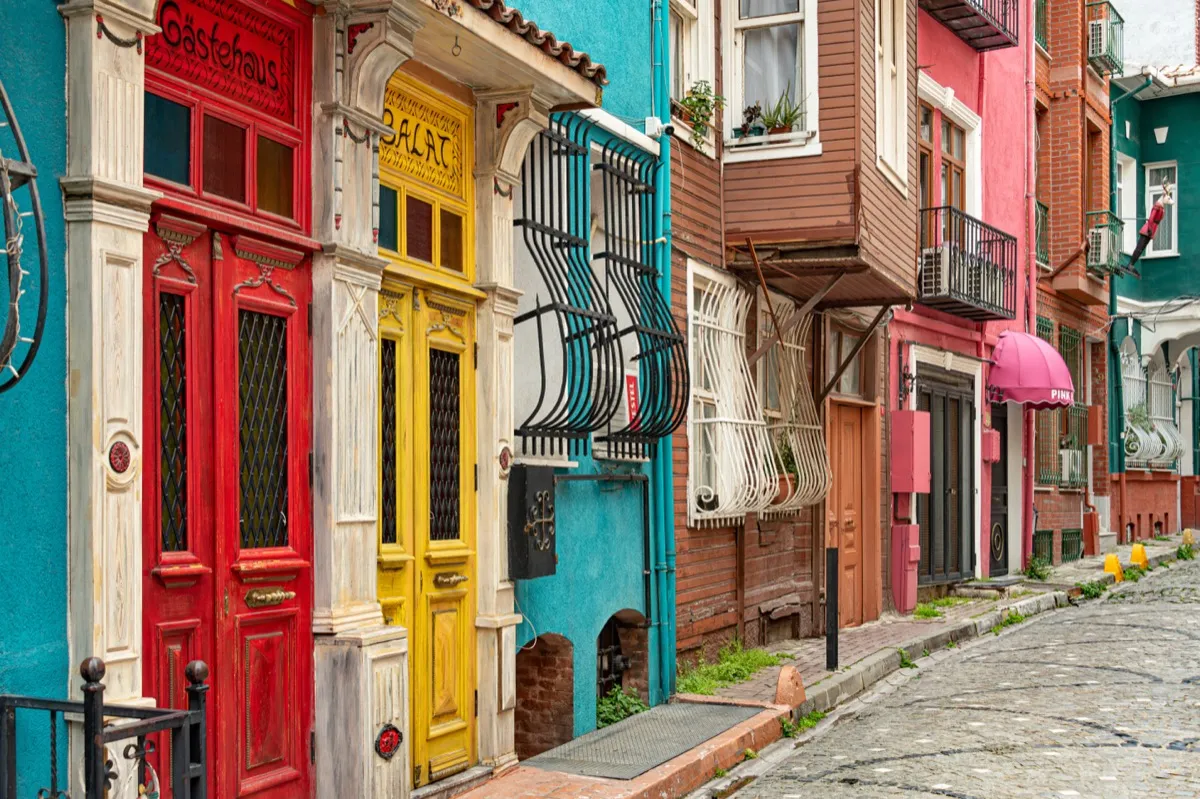
The streets of Balat are narrow, steep, and paved in stone. The houses are two and three stories tall, built in the Ottoman wooden style with projecting upper floors — bay windows cantilevered over the street on timber brackets. Many have been repainted in recent years in vivid colors — terracotta, turquoise, dusty pink, saffron yellow — and these colors have become the neighborhood’s visual signature. The palette is not historically accurate — Ottoman houses were typically more muted — but the effect is immediate, and the streets are photogenic in a way that draws visitors up the hill from the waterfront.
Behind the color, the architecture tells a more complex story. The houses are modest — nothing like the grand yalıs of the Bosphorus or the stone mansions of the Phanar Greek elite. These were working-class homes, built for families who made their living in the markets and workshops along the Golden Horn. Some are in excellent condition, restored by new owners or converted into cafés and boutique hotels. Others are visibly aging — cracked plaster, sagging timber, shuttered windows. The neighborhood is gentrifying, but unevenly. A renovated café with industrial lighting sits next to a locksmith’s shop that has not changed in decades.
The cats, as everywhere in Istanbul, are permanent residents.
The Religious Landmarks
The density of religious architecture in Balat and Fener is unlike anything else in Istanbul. Within a thirty-minute walk, you can visit buildings belonging to four different faiths.
Ahrida Synagogue
Founded in the fifteenth century by Jews from Ohrid (in present-day North Macedonia), the Ahrida Synagogue is the oldest surviving synagogue in Istanbul and one of the most beautiful. Its wooden bema — the raised pulpit from which the Torah is read — is carved in the shape of Noah’s Ark, a detail that is unique in the Jewish world. The synagogue is still active, though the congregation is small. Visits can be arranged by contacting the Chief Rabbinate in advance.
The Ahrida also carries a specific historical moment: in 1666, the false messiah Sabbatai Zevi announced his breakaway beliefs here, an event that split the Ottoman Jewish community and reverberated through Jewish history for centuries.
The Bulgarian Iron Church
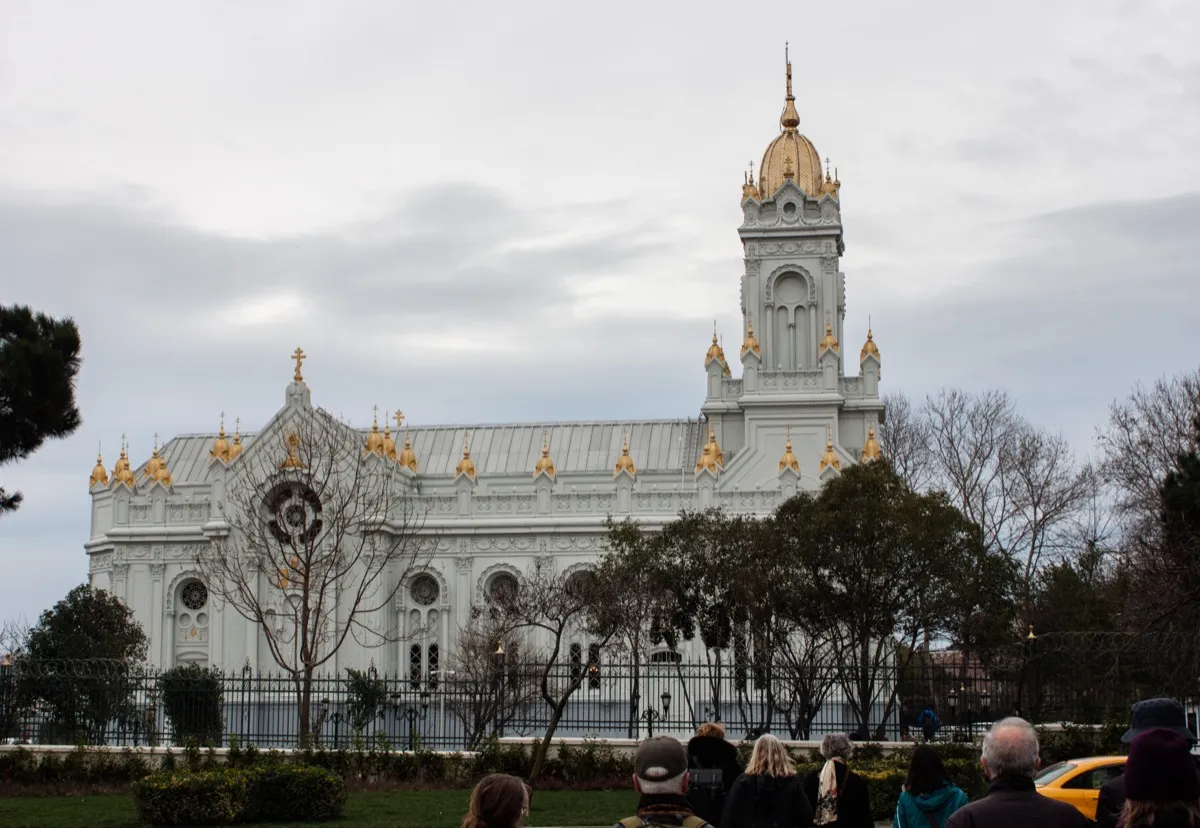
Officially the Church of St. Stephen of the Bulgars, this is one of the most unusual religious buildings in the world. It was built entirely from prefabricated cast-iron elements manufactured in Vienna, shipped down the Danube by barge, and assembled on the Golden Horn shore in 1898. The church served the Bulgarian Exarchate, which had split from the Greek Orthodox Patriarchate in 1872 — a political as much as a theological separation, reflecting the nationalist movements that were reshaping the Ottoman Balkans.
The building was comprehensively restored and reopened in 2018. It gleams in a way that iron architecture rarely does — gold paint on the exterior, detailed ironwork on the balconies, and an interior that is small but ornate. The waterfront setting, with the Golden Horn behind it, makes it one of the more photogenic churches in the city.
The Ecumenical Patriarchate (Fener)
A five-minute walk uphill from Balat into Fener brings you to the Church of St. George — the seat of the Ecumenical Patriarchate of Constantinople, the spiritual leadership of the world’s roughly 300 million Orthodox Christians. The building is modest from the outside — deliberately so, given centuries of political sensitivity — but the interior contains icons, relics, and liturgical objects of extraordinary significance. The Patriarchate has occupied this site since 1601, and its continued presence in Istanbul is one of the more complex threads in the city’s modern identity.
Ferruh Kethüda Mosque
This small mosque, a minor work by the great architect Mimar Sinan dating to 1562, sits in the middle of the neighborhood. The mihrab features tiles from the Tekfur Palace workshops — handmade ceramics with a quality that later mass production never matched. The mosque is easy to miss, which is part of its value: it is a neighborhood mosque, built for the people who lived here, not for visitors.
What Happened to the Communities
The diversity that built Balat and Fener did not survive the twentieth century intact. The Greek population was decimated by the population exchanges of the 1920s, the wealth tax of 1942, and the anti-Greek riots of September 1955. The Jewish community, though not targeted in the same way, gradually migrated — to Israel after 1948, to wealthier Istanbul neighborhoods as the Golden Horn industrialized. The Armenian community, already small here, was devastated by the events of 1915.
Today, Balat is overwhelmingly Muslim. The synagogues are mostly closed or maintained by tiny congregations. The Greek Orthodox churches open for services only on feast days. The Patriarchate remains, but the community it once served in this neighborhood has largely gone. What survives is the architecture — the buildings the communities built, now repurposed, repainted, or simply standing empty, holding the shape of a social arrangement that no longer exists.
This is what makes walking Balat and Fener different from visiting Sultanahmet. The famous sites celebrate imperial power — the sultans, the emperors, the monumental architecture of the state. Balat and Fener show you the texture of ordinary life in a multiethnic city, and the cost of losing it. A guide who can read the buildings — who can point to a doorframe and explain what the Hebrew inscription says, or identify a Greek school by its architectural style — changes the walk from scenic to significant.
Walking the Neighborhood
The best approach is from the waterfront. Start at the Balat ferry stop on the Golden Horn, where the T5 tram also has a station. Walk inland and uphill — the neighborhood reveals itself vertically, from the waterfront up to the old Byzantine land walls at the top of the ridge.
The colorful streets are concentrated in the middle band of the hillside. The cafés, vintage shops, and small galleries that have opened in recent years cluster here. The lower streets near the waterfront are more industrial — workshops, small factories, and commercial spaces that serve the working neighborhood rather than visitors. The upper streets, near the old walls, are quieter and more residential.
Allow two to three hours for a thorough walk through both Balat and Fener, including time in the churches and along the waterfront. If you add the Chora Church (Kariye Mosque) — a ten-minute walk north, famous for its extraordinary Byzantine mosaics and frescoes — the visit extends to a half-day.
Timing: Weekday mornings are the most atmospheric — the neighborhood is awake but not yet crowded with weekend visitors. Saturday mornings bring a social energy to the cafés and streets. Sunday is quieter.
Combining with other sites: The walk pairs naturally with a visit to the Chora Church, the Byzantine land walls, or a Golden Horn ferry ride. Eyüp — Istanbul’s holiest mosque and the Pierre Loti hilltop café — is a short ferry ride or walk further up the Golden Horn.
Plan Your Istanbul Visit
Balat and Fener are the neighborhoods that show you the Istanbul the monuments do not — a city of communities, of daily coexistence, and of the changes that reshaped it. If you would like to walk these streets with a private guide who can read the history in the architecture, tell us what interests you and we will build the day around it.
Frequently Asked Questions
Where are Balat and Fener in Istanbul?
Balat and Fener are adjacent neighborhoods on the western shore of the Golden Horn, in the Fatih district on the European side. They are about three kilometers north of Sultanahmet and accessible by the T5 tram, Golden Horn ferry, or a short taxi ride. The two neighborhoods blend into each other — Balat to the south, Fener to the north — and are best explored together on foot.
Why are the houses in Balat so colorful?
The brightly painted façades are a relatively recent development. In the 2010s and 2020s, as the neighborhood attracted tourism and gentrification, many of the Ottoman-era wooden houses were repainted in vivid colors — pinks, yellows, blues, greens. The original Ottoman palette was more muted. The colors have become the neighborhood’s signature, drawing visitors and photographers, but the underlying architecture — two- and three-story wooden houses with projecting bay windows — is genuinely Ottoman and several centuries old.
Is Balat worth visiting in Istanbul?
Yes, particularly if you are interested in Istanbul beyond the imperial monuments. Balat and Fener show you the city’s multicultural past — Sephardic synagogues, Greek Orthodox churches, a Bulgarian iron church, Ottoman mosques, and Armenian churches all within walking distance. The neighborhood also has a growing café and gallery scene, colorful streets, and a waterfront setting on the Golden Horn.
Can you visit the Ahrida Synagogue?
The Ahrida Synagogue is an active house of worship and visits must be arranged in advance through the Chief Rabbinate of Turkey. It is not open for walk-in tourism. The process typically requires submitting a request with passport details a few days before your visit. A private guide can arrange this for you as part of a Balat walking tour.
What is the Iron Church in Balat?
The Church of St. Stephen of the Bulgars, commonly called the Iron Church, is a Bulgarian Orthodox church built entirely from prefabricated cast-iron elements shipped from Vienna and assembled in Balat in 1898. It was restored and reopened in 2018. The church sits on the Golden Horn waterfront and is open to visitors — entry is free, and the interior is worth seeing for its detailed ironwork and restored decoration.
How long does it take to walk through Balat and Fener?
A focused walk through the main streets takes about ninety minutes. To visit the Iron Church, explore the side streets, stop at a café, and walk up to the Ecumenical Patriarchate in Fener, allow two to three hours. Adding the Chora Church (a ten-minute walk north) extends the visit to a half-day.