There is a moment, about fifteen minutes into a Bosphorus cruise, when the city rearranges itself. From the street, Istanbul is dense and vertical — minarets above rooftops, traffic below, the horizon broken by buildings in every direction. From the water, the city opens. The shoreline stretches out on both sides, the hills behind it become visible, and the buildings that dominate at street level take their place in a much larger composition. You begin to see how Istanbul is shaped by its geography: a city built across two continents, organized around a thirty-one-kilometer strait that connects the Black Sea to the Sea of Marmara and, beyond that, to the Mediterranean.
The Bosphorus is not scenic background. It is the reason Istanbul exists where it does. Emperor Constantine chose this site in 330 AD because the strait controlled the maritime passage between two seas. The Ottomans fortified both shores to take it. The modern city of seventeen million people still turns toward the water — its palaces face it, its neighborhoods descend toward it, and its daily rhythm is shaped by the ferries that cross it.
A cruise along the Bosphorus is the most efficient way to understand this relationship. In two hours, you see what would take two days on foot.
What You See on the European Shore
Leaving from the Eminönü waterfront, the first landmark on the European side is Dolmabahçe Palace — a three-hundred-meter white marble façade stretching along the shoreline, visible long before you reach it. Dolmabahçe replaced Topkapi Palace as the Ottoman seat of government in 1856 and its waterfront position was deliberate: the empire had turned from the walled hilltop of the old city to face the Bosphorus and the European world beyond it. From the water, the palace’s scale is immediately clear in a way that a land visit does not quite convey.
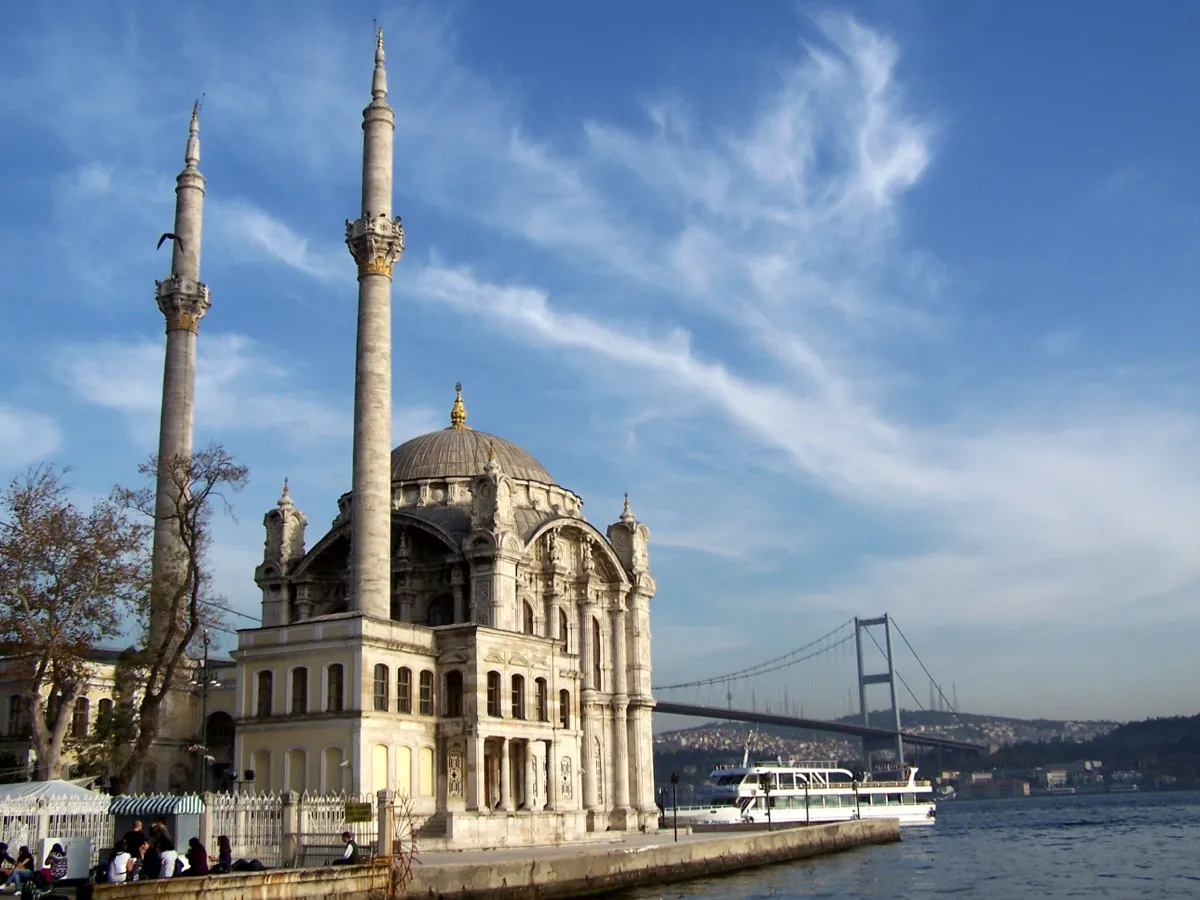
Past Dolmabahçe, the shore curves into Beşiktaş, then Ortaköy. The Ortaköy Mosque sits directly at the water’s edge, a small white Ottoman baroque structure framed by the first Bosphorus Bridge rising behind it. The mosque was built in 1856 by the Armenian architect Nigoğayos Balyan — the same family that designed Dolmabahçe — and its position, squeezed between the waterline and the modern bridge, has made it one of the most photographed compositions in Istanbul. From a boat, you see why: the scale contrast between the delicate mosque and the massive suspension span above it is striking.
The 15 July Martyrs Bridge (the first Bosphorus Bridge, completed in 1973) spans the strait at this point — 1,074 meters of steel cable suspended 64 meters above the water. Passing beneath it is one of the markers of a Bosphorus cruise. The bridge connects the Ortaköy neighborhood on the European side to Beylerbeyi on the Asian side.
North of the bridge, the shore passes through Arnavutköy — a village of nineteenth-century wooden houses painted in faded pastels, their upper floors projecting over the water on timber brackets. These are yalıs, the Ottoman waterfront mansions that line both shores of the Bosphorus. Approximately 620 yalıs survive in various states of repair, ranging from meticulously restored private residences to structures slowly settling toward the water. They are one of the Bosphorus’s defining visual elements, and they are best appreciated from a boat, where you can see how they were designed to be seen — from the strait, not from the road behind them.
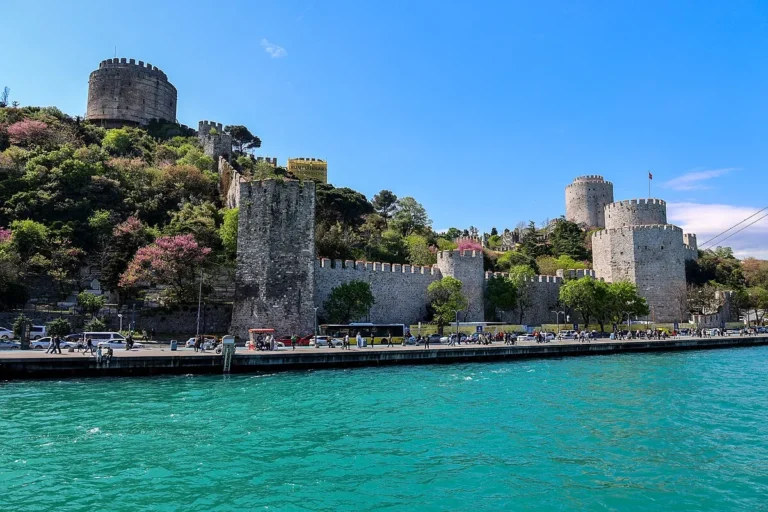
Bebek follows, a wealthy waterfront neighborhood with a curving bay, then the strait narrows as you approach Rumelihisarı — the Fortress of Europe. Sultan Mehmed II built this fortress in 1452, just four months before his conquest of Constantinople, on the narrowest point of the strait opposite the earlier Anadolu Hisarı on the Asian shore. The two fortresses together controlled Bosphorus traffic completely — no ship could pass without Ottoman permission. From the water, Rumelihisarı rises directly from the shoreline: three massive towers connected by curtain walls that climb the hillside above. It is the most visually imposing structure on the European shore.
Past the fortress, the character of the shoreline changes. The neighborhoods become quieter — Baltalimanı, Emirgan, İstinye, Yeniköy, Tarabya, Sarıyer. These are the Bosphorus villages, still carrying the suffix “-köy” (village) in their names, now absorbed into the metropolitan sprawl but retaining something of their waterfront character. Wooden boathouses, fish restaurants at the water’s edge, small mosques and fountains — the Bosphorus north of the second bridge has a pace that the city center does not.
What You See on the Asian Shore
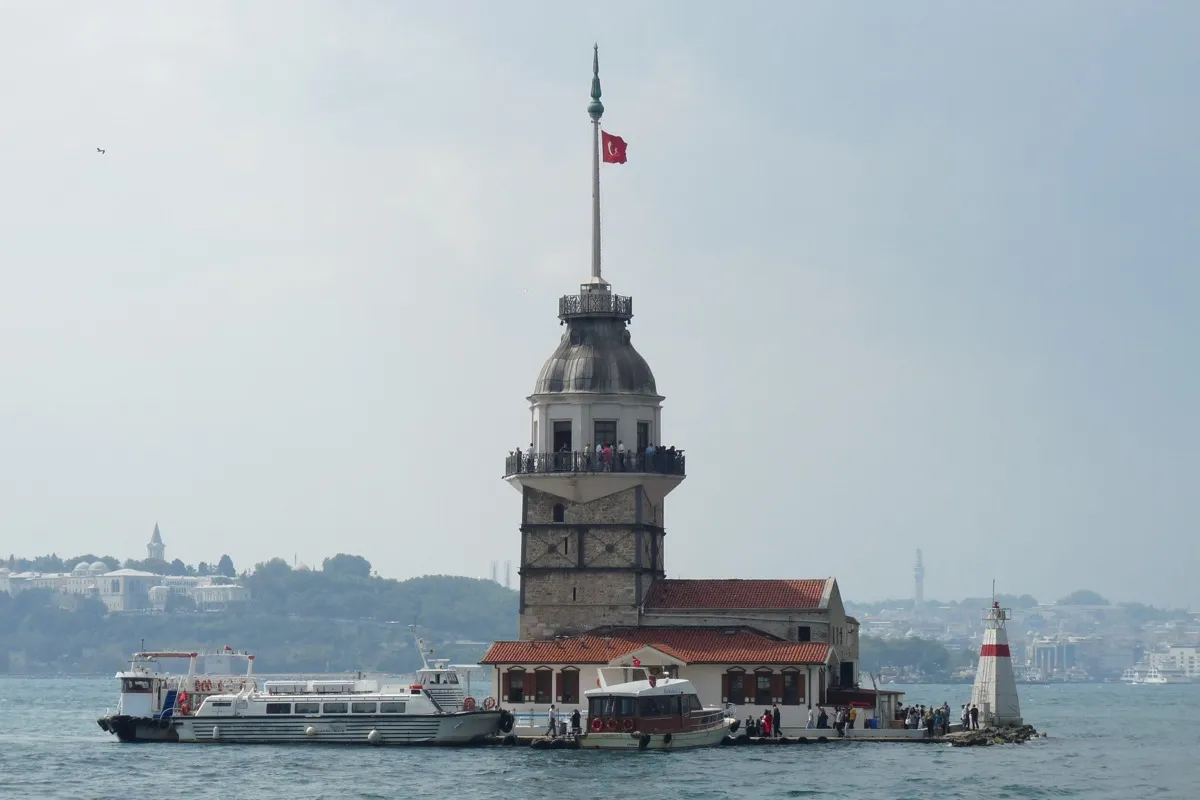
The Asian shore runs parallel, and a good cruise narrates both sides. Starting from the south, the Maiden’s Tower — Kız Kulesi — sits on a small islet just off the coast of Üsküdar. The tower has served as a lighthouse, a quarantine station, a customs checkpoint, and a restaurant, and its image appears on everything from postcards to Turkish lira. The legends attached to it — involving a sultan’s daughter and a prophecy involving a snake — are multiple and contradictory, which is usually a sign that a place has been important for a very long time.
Üsküdar itself is one of Istanbul’s oldest settlements, with Ottoman mosques lining its waterfront — the Mihrimah Sultan Mosque, designed by the great architect Sinan, is visible from the water. The neighborhood has a more conservative, residential character than the European shore opposite, and the contrast between the two sides is part of what the Bosphorus cruise reveals.
North of Üsküdar, the Asian shore passes through Beylerbeyi, where the Beylerbeyi Palace stands at the waterline — a smaller, more intimate summer palace built in 1865, less famous than Dolmabahçe but architecturally interesting for its blend of Ottoman and French styles. The palace was used to host visiting European heads of state and, later, as the place of exile for the deposed Sultan Abdülhamid II, who spent his final years here.
Çengelköy and Kandilli follow — quiet, tree-lined neighborhoods where the Bosphorus narrows to its tightest point, just 700 meters across. The currents here are strong — up to seven or eight knots — and watching the water move between the continents at this point gives you a physical sense of the strait’s power. Ships navigating this section must make a forty-five-degree course correction, which is why the Bosphorus is one of the most challenging commercial waterways in the world.
Anadolu Hisarı — the Fortress of Anatolia — sits on the Asian shore opposite Rumelihisarı. Built in 1393 by Sultan Bayezid I, it is the older of the two fortresses and smaller in scale, but its position facing its European counterpart across the narrowest stretch of water makes the strategic logic of both structures immediately clear from a boat.
Further north, Kanlıca is known for its yogurt — a specific, thick, creamy variety served with powdered sugar at waterfront cafés. Beykoz, with its glass factory heritage and forested hillsides, marks the approach to the upper Bosphorus, where the strait widens and the density of the city begins to thin.
The Water Itself
The Bosphorus is not just a view — it is a hydrological system. Two currents run simultaneously: a surface current flowing south from the Black Sea carrying fresh water, and a deeper current flowing north carrying denser, saltier Mediterranean water. The surface flow moves at about sixteen thousand cubic meters per second. In 2010, researchers discovered that the deeper current has carved a submarine channel along the strait floor — an underwater river of sediment-laden water that, if it flowed on land, would rank as the sixth largest river on Earth.
For the traveler, what this means is that the water is always moving. The Bosphorus is not a calm lake but a working strait — ferries crisscross it constantly, container ships transit under pilot guidance, fishing boats work the currents near the shore, and the surface itself ripples and shifts with the flow between two seas. The movement is part of the experience. Sitting on a boat and watching the current carry you south toward the Sea of Marmara, you are participating in the same transit that has shaped the city’s economy and strategic importance for two thousand years.
Choosing the Right Cruise
Not all Bosphorus cruises are equivalent, and the difference matters.
Public ferry (Şehir Hatları): The municipal ferry company runs a daily Bosphorus cruise from Eminönü that travels the full length of the strait to Anadolu Kavağı, a fishing village near the Black Sea entrance. The round trip takes about six hours, with stops along the way. It is the most affordable option and gives you the most complete view of both shores. The trade-off is that the ferry is crowded in peak season, the commentary is limited, and you share the deck with several hundred other passengers.
Short cruises: Shorter private or commercial cruises typically cover the lower Bosphorus — from Eminönü to the second bridge and back — in about ninety minutes to two hours. You see the major landmarks (Dolmabahçe, Ortaköy, Rumelihisarı, Beylerbeyi, Maiden’s Tower) without the full-day commitment.
Private cruise: A private boat — arranged through a tour operator — gives you control over the route, the pace, and the stops. You can linger at Rumelihisarı, pull close to the yalıs at Arnavutköy, stop for tea at Kanlıca, or time the return for sunset behind the Sultanahmet skyline. The commentary is personal, the questions are yours, and the deck is not shared.
When I arrange a Bosphorus cruise for travelers, the private option is what I recommend — not because it is the most expensive, but because the Bosphorus is a place that rewards attention, and attention requires space. The difference between a crowded ferry deck and a quiet boat with a guide who can point out the Köprülü Yalı (1698, the oldest surviving waterfront mansion on the Asian shore) as you pass it is the difference between seeing the strait and understanding it.
The Practical Side
Duration: Short cruises run 90 minutes to 2 hours. The full-length public ferry takes approximately 6 hours round trip (with a lunch stop at Anadolu Kavağı). A private cruise can be tailored to any duration, typically 2 to 4 hours.
Best time of day: Late afternoon light is warm and directional — the European shore catches the western sun, and the palaces and mosques glow. Sunset on the return south, with the Sultanahmet skyline silhouetted against the sky, is the most photographed moment of the trip. Morning cruises are quieter and the light is clean, particularly good for photography of the yalıs and the upper Bosphorus villages.
What to bring: A light jacket — the wind on the water is cooler than on shore, even in summer. Sunscreen for daytime cruises. A camera with a zoom lens if you want to capture the yalıs and architectural details along the shore.
Weather: The Bosphorus is open water, and conditions can change. On calm days, the cruise is smooth. On windy days — particularly when the north wind (poyraz) blows — the strait can be choppy. Private cruises can adjust timing based on conditions; public ferries run on schedule regardless.
Plan Your Istanbul Day
The Bosphorus is the spine of Istanbul — seeing it from the water puts the rest of the city in context. If you would like a private Bosphorus cruise as part of your Istanbul visit, with a guide who knows what you are looking at on both shores, tell us how you would like to spend the day and we will shape it around you.
Frequently Asked Questions
How long is a Bosphorus cruise?
Short sightseeing cruises take 90 minutes to 2 hours and cover the lower Bosphorus between Eminönü and the second bridge. The full-length public ferry (Şehir Hatları) runs about 6 hours round trip, traveling the entire strait to Anadolu Kavağı with a lunch stop. Private cruises are flexible — typically 2 to 4 hours, with the route and pace tailored to your interests.
What do you see on a Bosphorus cruise?
The major landmarks on the European shore include Dolmabahçe Palace, Ortaköy Mosque, the Bosphorus bridges, the wooden yalıs of Arnavutköy, and Rumelihisarı (the Fortress of Europe). On the Asian shore: the Maiden’s Tower, Beylerbeyi Palace, Anadolu Hisarı, and the Bosphorus villages. Between the two shores: the strait itself, with its competing currents, commercial shipping, and ferry traffic connecting the continents.
When is the best time for a Bosphorus cruise?
Late afternoon offers the warmest light on the European shore and the possibility of a sunset return past the Sultanahmet skyline. Morning cruises are quieter with cleaner light for photography. The full-day public ferry departs in the morning (typically 10:35 AM from Eminönü) — check the current schedule before your visit, as departure times shift seasonally.
Is a Bosphorus cruise worth it?
Yes. The Bosphorus is the geographic feature that defines Istanbul, and seeing the city from the water gives you a perspective that no amount of walking can replicate. The relationship between the palaces and the strait, the way the neighborhoods descend to the waterfront, the visual dialogue between the European and Asian shores — all of this becomes clear from a boat in a way it cannot from land.
What is the difference between a public ferry and a private Bosphorus cruise?
The public ferry (Şehir Hatları) is affordable and covers the full length of the strait, but it is crowded in peak season, has limited commentary, and follows a fixed schedule. A private cruise gives you control over the route, pace, and stops — you can linger where something interests you, adjust for weather, and have a guide narrate both shores. The trade-off is cost, but the experience is substantially different.
Can you stop during a Bosphorus cruise?
On the public ferry, stops are fixed — the boat calls at designated piers along the route. On a private cruise, stops can be arranged: a tea break at Kanlıca, a closer look at Rumelihisarı from the water, or a pause at one of the Bosphorus villages. Some private cruises include a stop on the Asian shore for a meal or a walk through a waterfront neighborhood.
What should I wear on a Bosphorus cruise?
Dress comfortably and bring a light jacket — the wind on the water is cooler than on shore, even during Istanbul’s hot summers. Flat, non-slip shoes are sensible on a boat deck. Sunscreen and sunglasses are essential for daytime cruises. In spring and autumn, an extra layer is worth having for the return trip when the temperature drops with the sun.