From almost anywhere along the Golden Horn waterfront, you can see it — a round stone cylinder rising above the roofline of Beyoğlu, capped with a conical roof that has been destroyed by storms, rebuilt, burned, rebuilt again, and most recently restored in copper. The Galata Tower has been the most visible structure on this side of Istanbul for nearly seven hundred years. It was the tallest building in Constantinople when it was completed in 1348, and while the modern city has long since grown past it, the tower still holds the skyline in a way that newer buildings do not.
The reason is partly height — 62 meters of medieval stone is hard to ignore — and partly position. The tower stands at the highest point of the old Genoese quarter, a hilltop that commands a direct sightline across the Golden Horn to the historic peninsula: Hagia Sophia, the Blue Mosque, Topkapi Palace, and the minarets of Sultanahmet arranged along the opposite ridge. The view from the top is the reason most visitors come. The history inside the walls is the reason the visit stays with you.
A Genoese Fortress in a Byzantine City
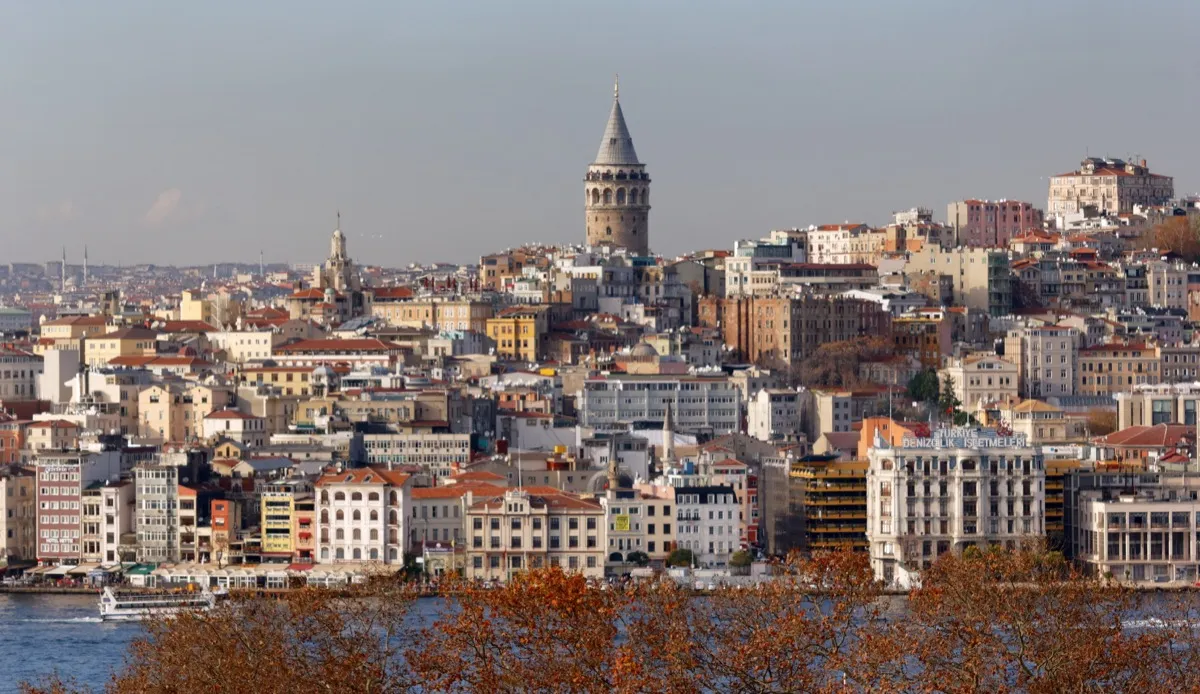
The tower was not built by the Ottomans or the Byzantines but by the Genoese — the Republic of Genoa, a Mediterranean maritime power that maintained a trading colony on this hillside from 1267 onward. The colony, called Galata, was a walled settlement of Genoese merchants, bankers, and sailors who operated under a treaty with the Byzantine emperor. They had their own walls, their own laws, and their own fortifications, of which the Galata Tower was the largest and most prominent.
The Genoese called it Christea Turris — the Tower of Christ — and it served as the anchor of Galata’s northern defensive wall. The construction date is 1348, a year that also marks the arrival of the Black Death in Constantinople. The Genoese colony was expanding rapidly, and the tower was both a military statement and a practical necessity: a watchtower that could see approaching ships, a stronghold that could be defended, and a landmark visible to any vessel entering the Golden Horn.
The walls that once surrounded the colony have mostly disappeared — demolished in the nineteenth century as Istanbul expanded northward into Beyoğlu and Beşiktaş. Small sections survive in unexpected places, visible between apartment buildings and along narrow side streets. But the tower remains, and it remains Genoese in proportion and feeling: thick-walled, cylindrical, Romanesque in style, built to last by people who understood stone.
What Happened After 1453
When Sultan Mehmed II conquered Constantinople in 1453, the Genoese colony was dissolved. The merchants stayed — many converted, many simply adapted — but the colony’s political independence ended. The tower passed into Ottoman hands and began a long second career.
Its first Ottoman use was as a prison. The thick walls and single entrance made it a practical holding space, and for a period it served that function. By the early eighteenth century, the tower had found a more lasting role: fire watchtower. Istanbul was a city of dense wooden construction, and fires were frequent and catastrophic. A watchman stationed at the top of the Galata Tower could spot smoke anywhere in the city and sound an alarm. From 1717 onward, the tower was part of Istanbul’s fire-warning network, and it continued in that role for over a century.
The tower also carries a story that sits somewhere between legend and history. According to the seventeenth-century Ottoman traveler Evliyâ Çelebi, a man named Hezarfen Ahmed Çelebi launched himself from the top of the tower in 1638 wearing a set of wings and glided across the Bosphorus to land in Üsküdar, on the Asian shore. Whether the flight happened exactly as described — or at all — is debated by historians. But the story has become part of the tower’s identity, and it speaks to something true about the building: it has always been a place people looked at and imagined flying from.
Inside the Tower
The tower is nine stories tall, with walls 3.75 meters thick at the base and an external diameter of about 16 meters. Two elevators carry visitors to the upper floors, and a staircase winds around the interior — the staircase is narrow, as medieval staircases tend to be, and gives you a physical sense of the wall’s depth as you climb.
The interior floors now function as a museum. The exhibition spaces are compact — the tower’s circular floor plan limits what can be displayed — but the curation focuses on the building’s history across its Genoese, Ottoman, and Republican periods. Scale models, historical images, and panels tracing the tower’s many restorations fill the middle floors.
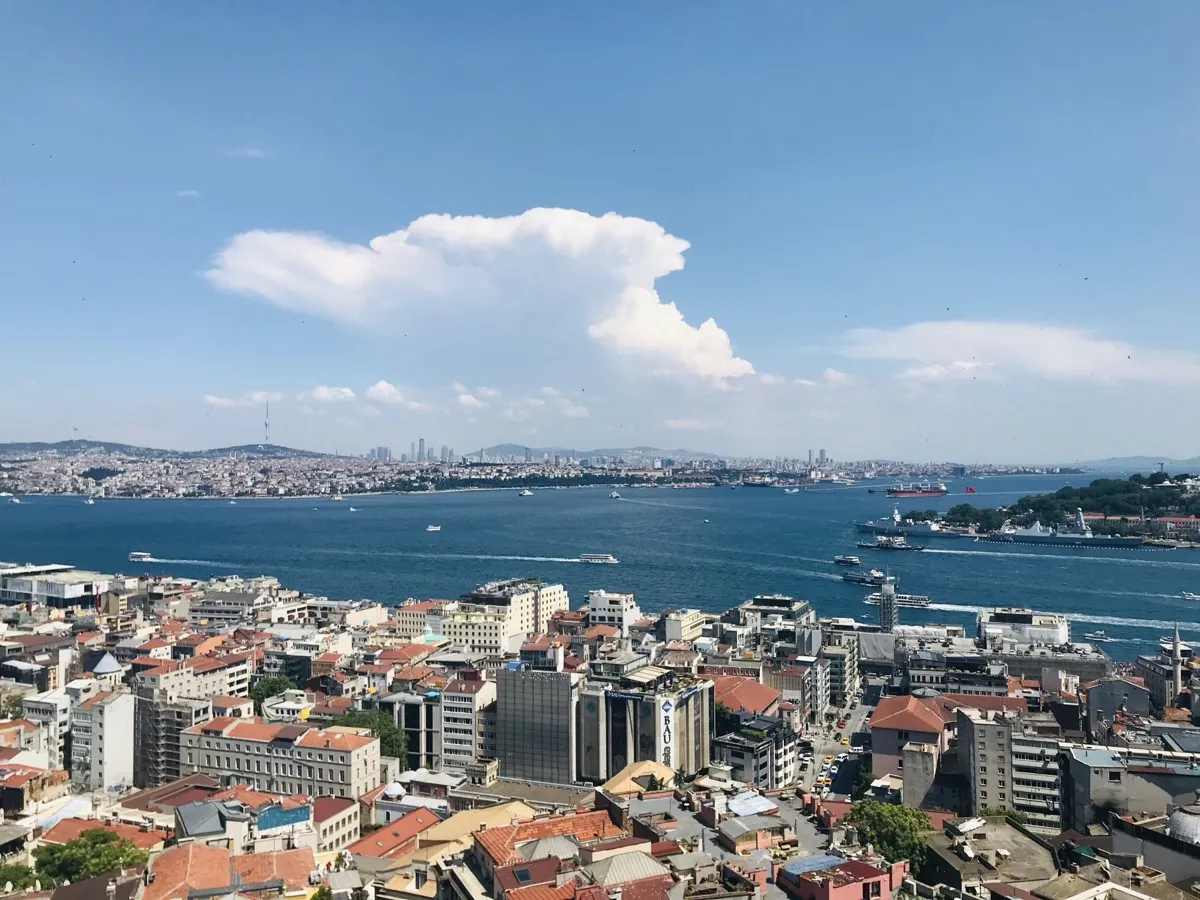
The observation deck is the ninth floor: an open-air balcony that wraps around the outside of the tower, just below the conical roof. The view is 360 degrees. To the south, across the Golden Horn, the Sultanahmet skyline unfolds — Hagia Sophia’s broad dome, the six minarets of the Blue Mosque, the walls and gardens of Topkapi Palace. The Bosphorus opens to the east, with ferries crossing between Europe and Asia and the bridges spanning the strait in the middle distance. To the north, the modern city rises — Taksim, Nişantaşı, the commercial towers of Levent and Maslak. To the west, the Golden Horn curves inland, lined with mosques and neighborhoods that descend to the waterfront.
The view is why people come, and it is worth the visit. But what makes it more than a scenic overlook is the historical context it provides. From the top of the Galata Tower, you can see how Istanbul is organized — the old city on the peninsula, the commercial quarter across the Golden Horn, the Bosphorus dividing the continents, and the modern city pressing outward in every direction. The geography of the city becomes readable in a way that street-level walking does not quite allow.
The Neighborhood Below
The streets around the base of the tower are among the most walked in Istanbul, and for good reason. The Galata neighborhood — once the Genoese colony itself — is now a dense quarter of nineteenth-century apartment buildings, independent shops, cafés, galleries, and music venues. Galata has gentrified significantly in the past two decades, but it retains a texture that the more polished neighborhoods of Istanbul do not: narrow streets that bend without reason, small squares that open without warning, and a vertical terrain that keeps you aware of the hill the tower was built to command.
Galip Dede Caddesi, the street that descends from the tower toward the Galata Bridge, is lined with music shops — a legacy of the neighborhood’s long association with Istanbul’s music scene. Instrument makers, vinyl shops, and small performance spaces occupy the ground floors of buildings that once housed Genoese merchants. The contrast is not accidental — Galata has always been a trading quarter, and the goods have simply changed.
The Galata Bridge itself is a five-minute walk downhill. Crossing it puts you in Eminönü, at the doorstep of the Spice Bazaar and the ferry terminals. Walking uphill from the tower takes you to İstiklal Caddesi and the Beyoğlu district — Taksim, the Pera Palace Hotel, and the long pedestrian avenue that was once the Grande Rue de Péra, the main street of the European quarter.
The tower sits at the intersection of these routes, which is exactly what it was designed to do. The Genoese built it at the highest point because the highest point controlled the approaches. Seven centuries later, the tower still functions as a navigational landmark — the point from which the neighborhood, and much of the city, makes spatial sense.
The Practical Side
Tickets: The Galata Tower operates as a museum managed by the Directorate General of Foundations. Tickets can be purchased on-site or online in advance. Advance booking is recommended during peak season (May through September) to avoid queue times.
Hours: Generally open from 8:30 AM to 11:00 PM, though hours can shift seasonally — confirm before your visit.
Crowd patterns: The tower limits visitor capacity to about 100 people per hour, which means the observation deck is never dangerously crowded but the wait to enter can be significant during busy periods. Early morning and late afternoon are the quietest times. Sunset is the most popular — and the most photographed — but the wait is longest.
Best time for the view: Late afternoon light is warm and directional, making the Sultanahmet skyline across the Golden Horn especially photogenic. After sunset, the mosques are illuminated and the city takes on a different character. Both are worth seeing if your schedule allows.
Accessibility: The tower has two elevators that reach the upper floors, but the final access to the observation deck involves stairs. The interior spaces are compact and the balcony is narrow — visitors with mobility concerns should check current arrangements before visiting.
Plan Your Istanbul Visit
The Galata Tower works as a starting point for an Istanbul day — the view from the top gives you a map of the city before you walk into it. If you would like to explore the tower, the Galata neighborhood, and the historic peninsula across the water as part of a private day in Istanbul, tell us what interests you and we will build the day around it.
Frequently Asked Questions
Is the Galata Tower worth visiting?
Yes. The 360-degree view from the observation deck is one of the best in Istanbul — it gives you a panoramic understanding of how the city is arranged across its peninsula, its waterways, and its hills. The interior museum adds historical context, and the neighborhood around the base of the tower is one of the most interesting walking districts in the city. Allow at least an hour for the visit, more if you want to explore the surrounding streets.
How long does it take to visit the Galata Tower?
The tower itself takes about 30 to 45 minutes — time to ride the elevator up, walk through the museum floors, and spend time on the observation deck. If you add the surrounding Galata neighborhood, an hour and a half to two hours is comfortable. The streets around the tower, the descent to the Galata Bridge, and the music shops along Galip Dede Caddesi are all worth your time.
What can you see from the top of the Galata Tower?
The observation deck offers a 360-degree view of Istanbul. To the south, across the Golden Horn: Hagia Sophia, the Blue Mosque, Topkapi Palace, and the Sultanahmet skyline. To the east: the Bosphorus, the ferries, and the Asian shore. To the west: the Golden Horn stretching inland. To the north: the modern city, Taksim, and the commercial districts beyond. On a clear day, you can see the Princes’ Islands in the Sea of Marmara.
When is the best time to visit the Galata Tower?
Early morning (just after opening) and late afternoon offer the shortest queues. Sunset is the most popular time — the light over the Sultanahmet skyline is at its warmest, and the transition to the illuminated night skyline is striking. If sunset is your goal, arrive at least 30 minutes before to allow for the queue. Weekdays are less crowded than weekends.
Who built the Galata Tower?
The tower was built in 1348 by the Genoese — the Republic of Genoa maintained a fortified trading colony on this hillside from 1267 to 1453. The tower’s original name was Christea Turris (Tower of Christ), and it served as the anchor of the colony’s northern defensive wall. After the Ottoman conquest of Constantinople, the tower passed through various uses — prison, fire watchtower, observation point — before becoming the museum it is today.
Did someone really fly from the Galata Tower?
According to the seventeenth-century Ottoman writer Evliyâ Çelebi, a man named Hezarfen Ahmed Çelebi attached wings to his body and glided from the tower across the Bosphorus to Üsküdar in 1638. The account is the only historical source for the event, and its accuracy is debated. Whether or not the flight happened exactly as described, the story has become part of Istanbul’s folklore and part of the tower’s identity.
How do I get to the Galata Tower?
The tower is in the Beyoğlu district. From Sultanahmet, take the T1 tram to Karaköy and walk uphill for about ten minutes — the tower is visible from the tram stop, so navigation is straightforward. From Taksim, walk down İstiklal Caddesi to the Tünel end and continue downhill to the tower. The Tünel funicular (from Karaköy to Beyoğlu) brings you within a five-minute walk. Taxis can drop you directly at the base.