The first thing you notice is not the color or the noise but the light. Step through one of the eighteen gates and the sky disappears behind a vaulted stone ceiling, and the sunlight that follows you in scatters across the corridor in thin shafts from arched windows cut high above the shopfronts. Your eyes adjust. The corridor stretches ahead, branching left and right into more corridors, each one lined with shops and each one leading somewhere you did not plan to go.
This is the Grand Bazaar — Kapalıçarşı in Turkish, meaning simply “covered market” — and it has been operating in some form since 1461. Not as a museum. Not as a heritage attraction preserved behind glass. As a working market where people buy and sell things every day, as they have for over five hundred and sixty years.
The numbers are large enough to feel abstract: 61 covered streets, somewhere between 3,000 and 4,000 shops, an estimated 26,000 people working inside, and between 250,000 and 400,000 visitors passing through on any given day. In 2014, it was ranked the most visited tourist attraction in the world, ahead of Times Square and the Las Vegas Strip. But numbers flatten what is actually a spatial experience — a market that reveals itself one corridor at a time, where the geography is part of the point.
What the Grand Bazaar Actually Is
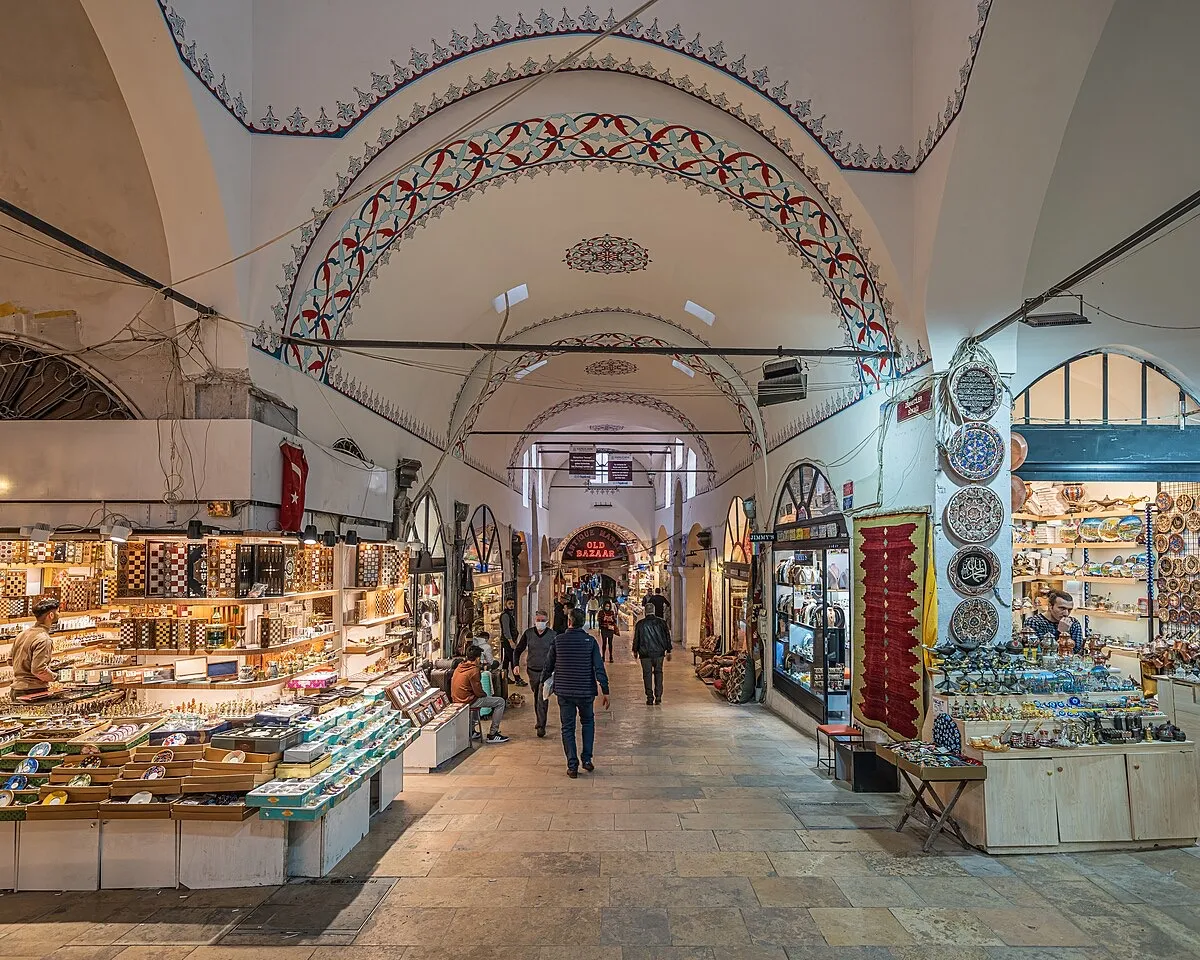
The bazaar is not a single building. It is a complex of covered streets, courtyards, fountains, and hans — the Ottoman equivalent of a commercial inn, where merchants stored goods and conducted wholesale trade. The whole structure sits on the ridge between the Beyazıt and Nuruosmaniye neighborhoods, covering roughly 30,700 square meters. From above, it looks like a city within the city, which is essentially what it is.
At its core are two bedestens — fortified stone halls with heavy doors that were locked at night and used to store the most valuable goods. The older one, the İç Bedesten (Inner Bedesten), was the first structure Sultan Mehmed II ordered built after conquering Constantinople in 1453. It measures about 43 by 30 meters, supported by eight stone piers beneath fifteen brick domes. This was the vault of the empire’s commercial life — silk, jewels, weapons, and coin all passed through here under armed guard.
The second, the Sandal Bedesten, came later under Suleiman I around 1545, built to handle the growing textile trade, particularly silk. It is slightly larger and carries twenty brick domes on twelve stone piers. Both bedestens still stand, still in use, still at the center of the bazaar.
Everything else grew outward from these two anchors. Streets of shops were added, covered first with wood, then — after a series of devastating fires — with stone vaults and brick domes. The market expanded organically for centuries, absorbing surrounding hans and streets until it reached something close to its present footprint.
A Market Organized by Trade
One of the things that still gives the bazaar its character is a principle that dates back to the Ottoman guild system: merchants selling the same type of goods are grouped together on the same street. The system was not decorative — it was regulatory. Each guild controlled quality, pricing, and entry into the trade. A jeweler could not simply open a carpet shop, and a new merchant could not set up without the guild’s approval.
The guild system was formally abolished in 1913, but the spatial logic it created persists. Walk through Kalpakçılar Caddesi — the bazaar’s main artery — and you are in the jewelry quarter, where gold gleams under fluorescent lights from every direction. Turn into the side streets and you find leather concentrated along Perdahçılar Sokak, carpets along what was once the booksellers’ row, and ceramics clustered near the Nuruosmaniye Gate.
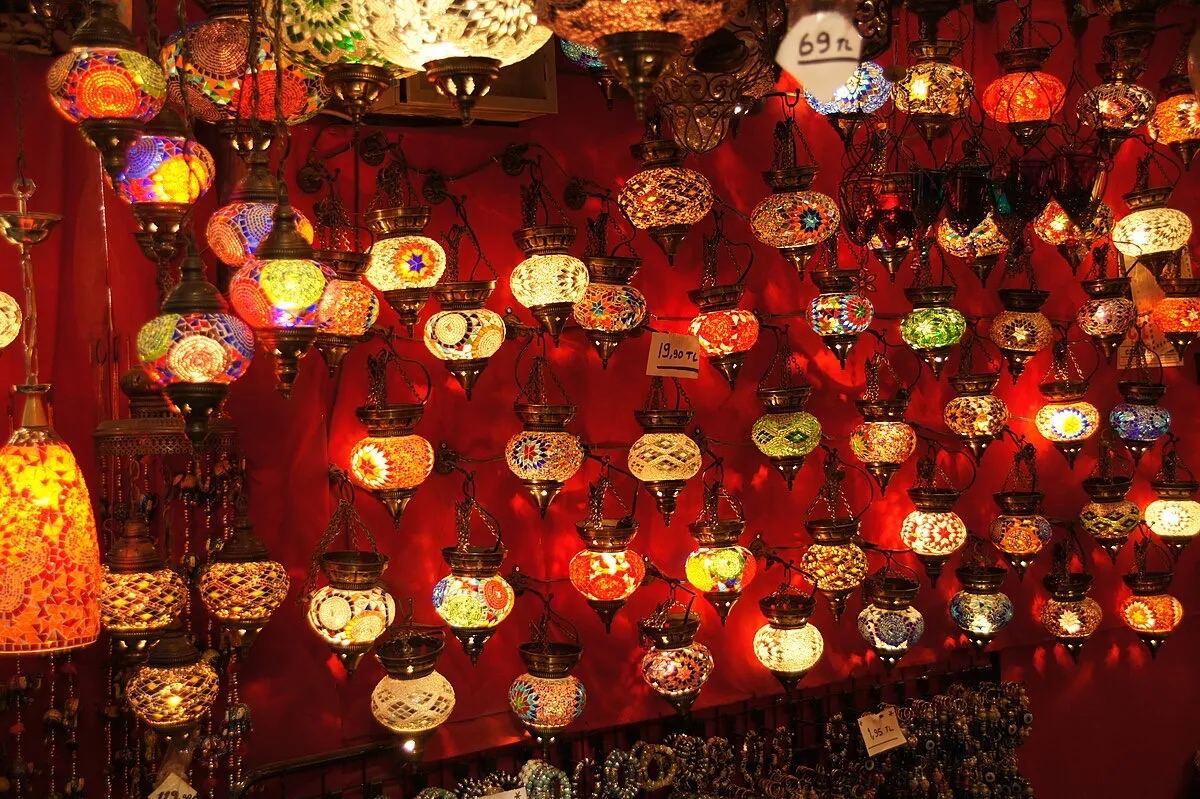
This organization means that the bazaar rewards a specific kind of attention. You are not browsing a random assortment of shops. You are moving through zones, each with its own visual identity and its own rhythm. The lamp shops are a corridor of suspended color. The textile merchants drape fabric from ceiling to floor. The antique dealers sit behind glass cases in quieter alcoves.
When I walk travelers through the bazaar, I find that understanding this structure changes the experience. It stops feeling like a maze and starts feeling like a city with neighborhoods.
What Most Visitors Walk Past
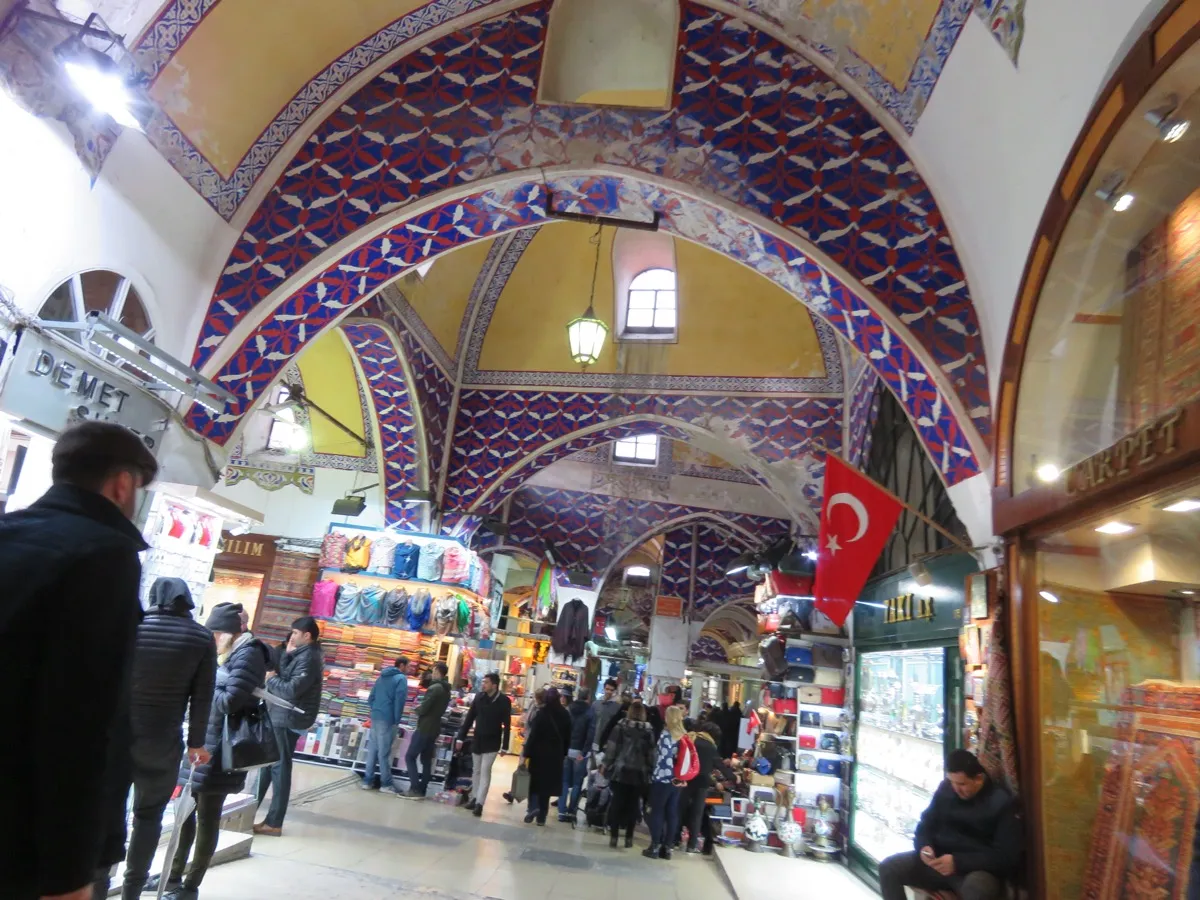
The shops get the attention, but the architecture above them is worth looking at. The vaulted ceilings of the main corridors are painted — some recently, some with older decorative schemes visible beneath later layers. The brickwork is Ottoman, restored many times but still carrying the proportions of the original construction. Light enters through small arched windows set high in the walls, and at certain times of day the corridors take on a warm, amber quality that photographs cannot quite reproduce.
The hans are another layer most visitors miss. These were originally caravanserais — buildings with an internal courtyard surrounded by two or three stories of rooms where traveling merchants stayed, stored their goods, and conducted business. The Grand Bazaar complex includes over twenty hans, and several are still functioning as workshops and wholesale spaces. The Zincirli Han, with its quiet courtyard and working jewelers, is one of the more accessible. You walk through an unmarked doorway off a busy corridor and find yourself in a stone courtyard where the noise of the market drops to almost nothing.
There are also fountains — nineteen of them according to an 1890 survey — though not all are still active. The mosque inside the bazaar, the Beyazıt Mosque nearby, and the small mausoleum within the complex all remind you that this was not merely a commercial space but a civic one. People prayed here, washed here, buried their dead here, and conducted legal business here. The bazaar was, for centuries, the center of Istanbul’s economic and social life.
Five Centuries of Fire and Rebuilding
The bazaar you walk through today is not the one Mehmed II built. It cannot be. The history of the Grand Bazaar is substantially a history of fires: 1515, 1548, 1588, 1618, 1645, 1652, 1658, 1660, 1687, 1688, 1695, 1701. The 1701 fire was catastrophic enough that Grand Vizier Nevşehirli Damad İbrahim Pasha ordered a comprehensive reconstruction in the 1730s, mandating that wooden structures be replaced with stone and brick.
Earthquakes compounded the damage. The 1766 earthquake required structural repairs across the complex. The 1894 earthquake was severe enough to reshape parts of the bazaar’s layout — the old Bit Pazarı (flea market) section was too damaged to restore and was converted into the open-air Çadırcılar Caddesi.
The most recent major fires came in 1943 and 1954, with the final restoration completed on July 28, 1959. A comprehensive renovation in 1980 addressed infrastructure and removed decades of accumulated advertising. The most recent restoration project, begun in 2012, focused on heating, lighting, and internal structural work.
What this means for the visitor is that the Grand Bazaar is not a preserved artifact but a continuously rebuilt one. The bedestens are the oldest surviving elements. The street layout is largely Ottoman. But the surfaces — the painted ceilings, the shopfronts, the lighting — have been replaced and restored many times over. The bazaar endures not because it has been frozen in time but because it has been remade, repeatedly, by the people who use it.
How to Navigate Without a Map
The bazaar has a reputation for being disorienting, and the reputation is earned. Sixty-one streets, eighteen gates, no grid pattern, and a ceiling that prevents you from using the skyline for orientation. First-time visitors commonly enter through one gate, walk for twenty minutes, and find themselves back at the same gate.
A few reference points help. The main axis runs roughly from the Beyazıt Gate (west) to the Nuruosmaniye Gate (east), with Kalpakçılar Caddesi — the jewelers’ street — forming the central spine. If you can locate this street, you can orient yourself relative to everything else. The İç Bedesten sits near the center of the complex. The Sandal Bedesten is slightly to the east.
Beyond that, the most practical navigation strategy is not to fight the disorientation but to accept it. The bazaar is one of those places where getting lost is a legitimate way to find things. The side corridors are where the more interesting shops tend to be — the workshops, the family-run businesses, the places that have not been repositioned for tourist traffic. When you stop trying to find a specific exit, the bazaar opens up.
With a private guide, the navigation problem disappears — but more importantly, the guide can take you to the hans, the back corridors, and the artisan workshops that you would walk past on your own without knowing they were there.
Shopping With Intention
The Grand Bazaar sells everything from gold jewelry to leather bags to spices to hand-knotted carpets. The quality ranges from genuine craft to factory-made souvenirs, and the line between them is not always obvious. A few observations that may help:
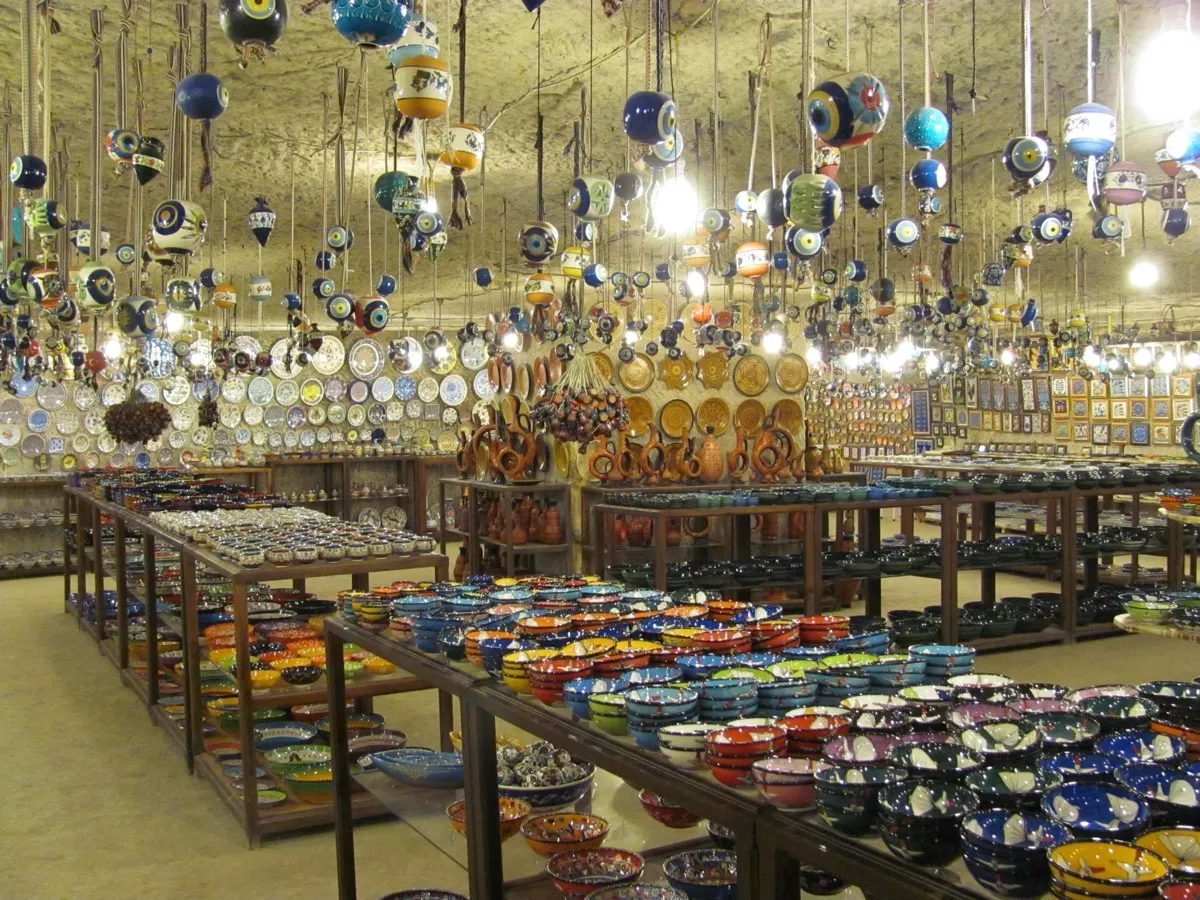
Ceramics and Iznik tiles: The bazaar has many shops selling painted ceramics. Genuine Iznik-style work — hand-painted with quartz-based pigments on a specific type of clay — is heavier, slightly irregular, and significantly more expensive than mass-produced alternatives. If the price seems too good, it usually is. The best ceramic shops will explain their materials and process without pressure.
Turkish lamps: The mosaic glass lamps are one of the bazaar’s most recognizable images. Handmade versions use individually cut glass pieces set into a metal frame, and the color palette and symmetry reflect the maker’s skill. They can be shipped internationally, and most established lamp shops handle the logistics.
Carpets and kilims: Carpet buying in the Grand Bazaar is its own world. A proper carpet shop will serve you tea, lay out dozens of pieces, explain the regional differences — Hereke silk, Anatolian wool kilims, Kurdish tribal weaves — and let you take your time. The transaction is as much a conversation as a purchase. If you are considering a carpet, the guide’s role is to help you understand what you are looking at, not to steer you toward a specific shop.
Gold and jewelry: Kalpakçılar Caddesi is one of the largest concentrations of gold retailers in the world. Gold is sold by weight based on the daily market rate, with a markup for craftsmanship. The system is transparent once you understand it: ask the gram price, check the day’s gold rate, and the arithmetic is straightforward.
Leather: The bazaar’s leather shops range from high-quality handmade goods to mass-produced items. Fit and finish tell the story — stitching, lining quality, and the smell of the leather itself are reliable indicators.
Pairing It With the Surrounding Quarter
The Grand Bazaar sits in a historically dense part of Istanbul. The Beyazıt Mosque — commissioned by Sultan Bayezid II and completed in 1506 — is immediately adjacent to the western entrance. Istanbul University’s main gate faces the same square. The Sahaflar Çarşısı (Book Market), one of the oldest book markets in the world, occupies a small courtyard between the bazaar and the mosque — a quiet pocket of secondhand bookstalls and calligraphy prints that makes a useful decompression stop after the bazaar’s intensity.
Walking east from the Nuruosmaniye Gate brings you to the Nuruosmaniye Mosque, an 18th-century Ottoman baroque structure worth a pause for its unusual curved courtyard. Continue downhill and you are in the Sultanahmet district — Hagia Sophia, the Basilica Cistern, and the Hippodrome are all within a fifteen-minute walk.
The Spice Bazaar (Mısır Çarşısı) is a twenty-minute walk north, near the Galata Bridge. The two bazaars are often paired in a single day, and the route between them passes through the Eminönü waterfront and the busy commercial streets of Tahtakale — a neighborhood that gives you a sense of what Istanbul’s market culture looks like outside the tourist-facing spaces.
When I plan a Grand Bazaar visit for travelers, the timing matters. The market opens at 9:00 AM and the first hour is noticeably calmer. By mid-morning the corridors are full. Late afternoon — from about 4:00 PM onward — the crowds thin again and the light in the corridors shifts. The bazaar closes at 7:00 PM daily, except Sundays and national holidays.
Plan Your Istanbul Visit
The Grand Bazaar is the kind of place that changes depending on how you approach it. Rushed, it is overwhelming — a blur of shops and corridors that all look similar. With time and a guide who knows the back streets, it becomes a walk through five centuries of Istanbul’s commercial life, from the Ottoman guild system to the artisan workshops that still operate behind unmarked doors. If you would like to explore the bazaar as part of a private Istanbul day — at your pace, with context — tell us what interests you and we will build a day around it.
Frequently Asked Questions
How long should I spend at the Grand Bazaar?
A focused visit takes about two hours. If you want to explore the back corridors, visit a han or two, and spend time in specific shops — ceramics, carpets, or jewelry — allow three to four hours. The bazaar is large enough that you will not see everything in a single visit, but two hours gives you a solid sense of the main corridors and the market’s character.
Is the Grand Bazaar open every day?
The Grand Bazaar is open Monday through Saturday, from 9:00 AM to 7:00 PM. It is closed on Sundays and on national holidays (such as the first days of Ramadan and Kurban Bayramı). During Ramadan, some shops may adjust their hours, but the bazaar itself remains open on weekdays.
Is bargaining expected at the Grand Bazaar?
Yes, and it is part of the culture of the market. Prices in most shops — particularly for carpets, leather, ceramics, and souvenirs — are not fixed, and a polite negotiation is expected. That said, bargaining at the Grand Bazaar is a conversation, not a confrontation. A respectful exchange usually lands somewhere both sides find fair. Gold and jewelry on Kalpakçılar Caddesi are an exception — prices are based on daily gold rates and gram weight, so the margin for negotiation is narrower.
What should I buy at the Grand Bazaar?
The bazaar’s strongest offerings are hand-painted ceramics and Iznik tiles, Turkish mosaic lamps, hand-knotted carpets and kilims, leather goods, gold jewelry, and Turkish textiles. The key is distinguishing handmade craft from factory-produced goods — a private guide or a knowledgeable shopkeeper can help you understand the difference. Spices and Turkish delight are better purchased at the Spice Bazaar nearby, where the selection is more focused.
Can I visit the Grand Bazaar without a guide?
You can, and many visitors do. The bazaar is a public market with no entry fee. That said, a guide changes the experience in ways that are hard to replicate on your own. The han courtyards, the artisan workshops, the architectural details above the shopfronts — these are not signposted, and most visitors walk past them without knowing they are there. A guide also provides context for shopping: understanding what makes a ceramic piece hand-painted versus printed, or what distinguishes a Hereke silk carpet from a machine-made reproduction.
Is the Grand Bazaar safe?
The bazaar is well-patrolled and has its own security. Pickpocketing can occur in crowded corridors, as in any major tourist site — keep valuables secure and be aware of your surroundings in the busiest areas. Beyond that, the Grand Bazaar is one of the safer public spaces in Istanbul. Shop owners and workers have a vested interest in maintaining the market’s reputation, and the atmosphere, while busy, is commercial rather than threatening.
How do I get to the Grand Bazaar?
The most convenient access is via the Istanbul tram (T1 line) — the Beyazıt-Kapalıçarşı stop is directly adjacent to the western entrance. From Sultanahmet, the tram ride is one stop. From Eminönü (near the Galata Bridge and Spice Bazaar), it is three stops. If you are coming from the Asian side or from Taksim, the Marmaray or metro lines connect to the tram at Eminönü or Sirkeci. Taxis can drop you at any of the gates, though traffic in the Beyazıt area can be heavy during midday.