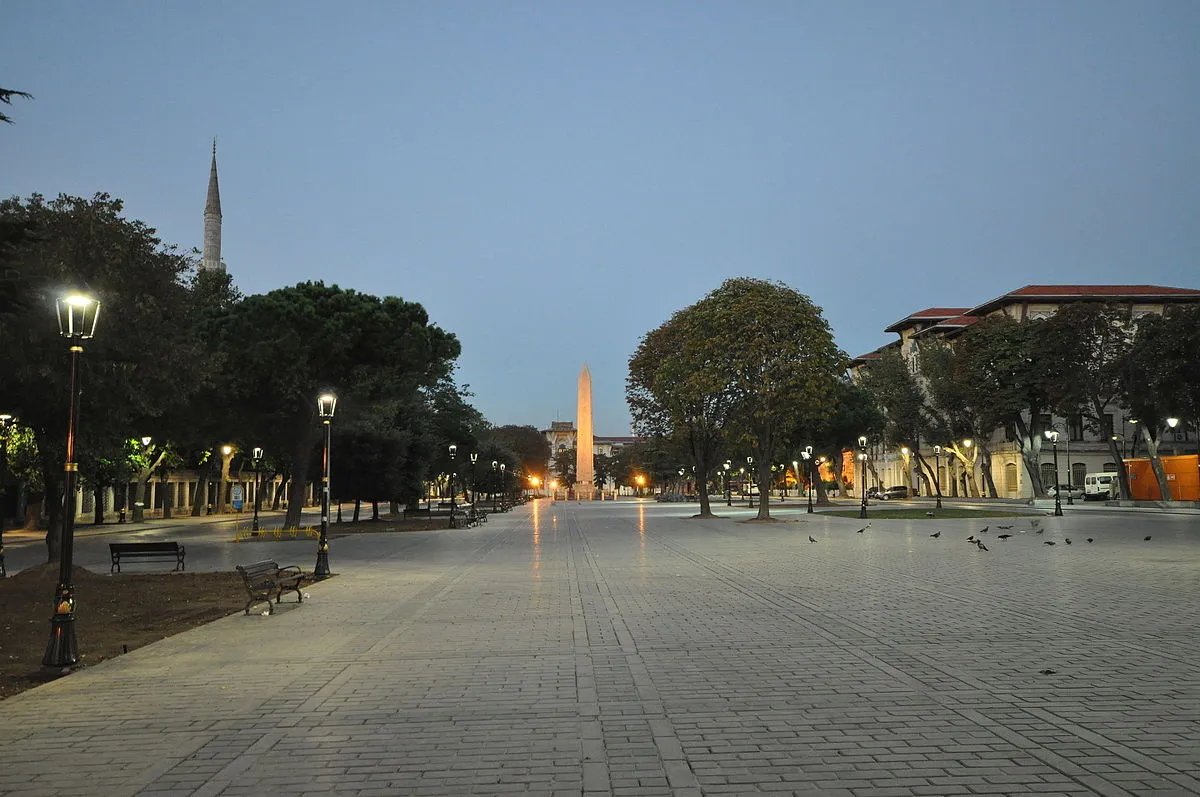
You are probably standing on it without knowing. Sultanahmet Square — the open park between Hagia Sophia and the Blue Mosque, the space most visitors cross a dozen times during an Istanbul trip — is not a plaza. It is the floor of a Roman hippodrome, buried under two meters of accumulated city. The three stone monuments that stand in the center of the park are not decorative installations placed there by a modern urban planner. They are the remains of the spina — the central barrier of a chariot-racing track that held 100,000 spectators, hosted the bloodiest civic riot in Byzantine history, and served as the political and social center of Constantinople for nearly a thousand years.
The shape of the park gives it away, if you know what to look for. Sultanahmet Square is long and narrow — roughly 450 meters by 130 meters — with a gentle curve at the southern end. That curve follows the sphendone, the rounded tribune where spectators sat at the turning end of the racetrack. Parts of the sphendone’s lower walls still survive, visible from the streets below the park’s southern edge. The rest of the hippodrome — the tiered seating, the starting gates, the imperial lodge — lies beneath the modern surface, still largely unexcavated.
A Track Built for a Capital
The hippodrome was first laid out in AD 203 by Emperor Septimius Severus, when the city was still Byzantium — a provincial town on the European side of the Bosphorus. When Constantine the Great chose this site as his new capital in AD 324, one of his first acts was to expand the hippodrome to a scale appropriate for an imperial city. He lengthened the track, enlarged the seating, and connected the emperor’s viewing box — the kathisma — directly to the Great Palace via a private passage. The emperor could walk from his residence to his seat above the races without ever setting foot in a public space.
The track itself was U-shaped: a long straight run, a tight turn around the sphendone at the south end, and a return straight back to the starting gates at the north. Up to eight chariots — two per team, each pulled by four horses — raced simultaneously. The surface was sand. The walls of the spina, running down the center of the track, were lined with monuments, statues, and trophies collected from across the empire. The hippodrome was not just a stadium. It was a display case for imperial power.
The capacity — approximately 100,000 — made it one of the largest public venues in the ancient world. For context, the Colosseum in Rome held about 50,000. The hippodrome was twice that. On race days, it was the largest gathering of people in Constantinople, and it was the only place where the emperor appeared in public before the full citizenry. The political implications of that arrangement shaped the city for centuries.
The Monuments That Survive
Three monuments from the hippodrome’s spina still stand in Sultanahmet Square, now sitting in excavated pits slightly below the modern park surface.
The Obelisk of Theodosius
The oldest object in Istanbul — and it is not close. This pink granite obelisk was originally carved around 1490 BC and erected at the Temple of Karnak in Luxor by Pharaoh Thutmose III. It stood in Egypt for nearly two thousand years before Emperor Theodosius the Great had it cut into sections, shipped across the Mediterranean, and reassembled in the hippodrome in AD 390. The obelisk has survived 3,500 years in remarkably good condition — the hieroglyphs are still legible.
The marble pedestal beneath the obelisk is almost as interesting as the monument itself. Carved reliefs on all four sides show Theodosius in the imperial box: watching the races, receiving tribute, presiding over the erection of the obelisk. The crowd is depicted below, and the details — the clothing, the gestures, the spatial relationship between emperor and subjects — provide one of the clearest visual records of late Roman imperial ceremony that survives.
The Serpentine Column
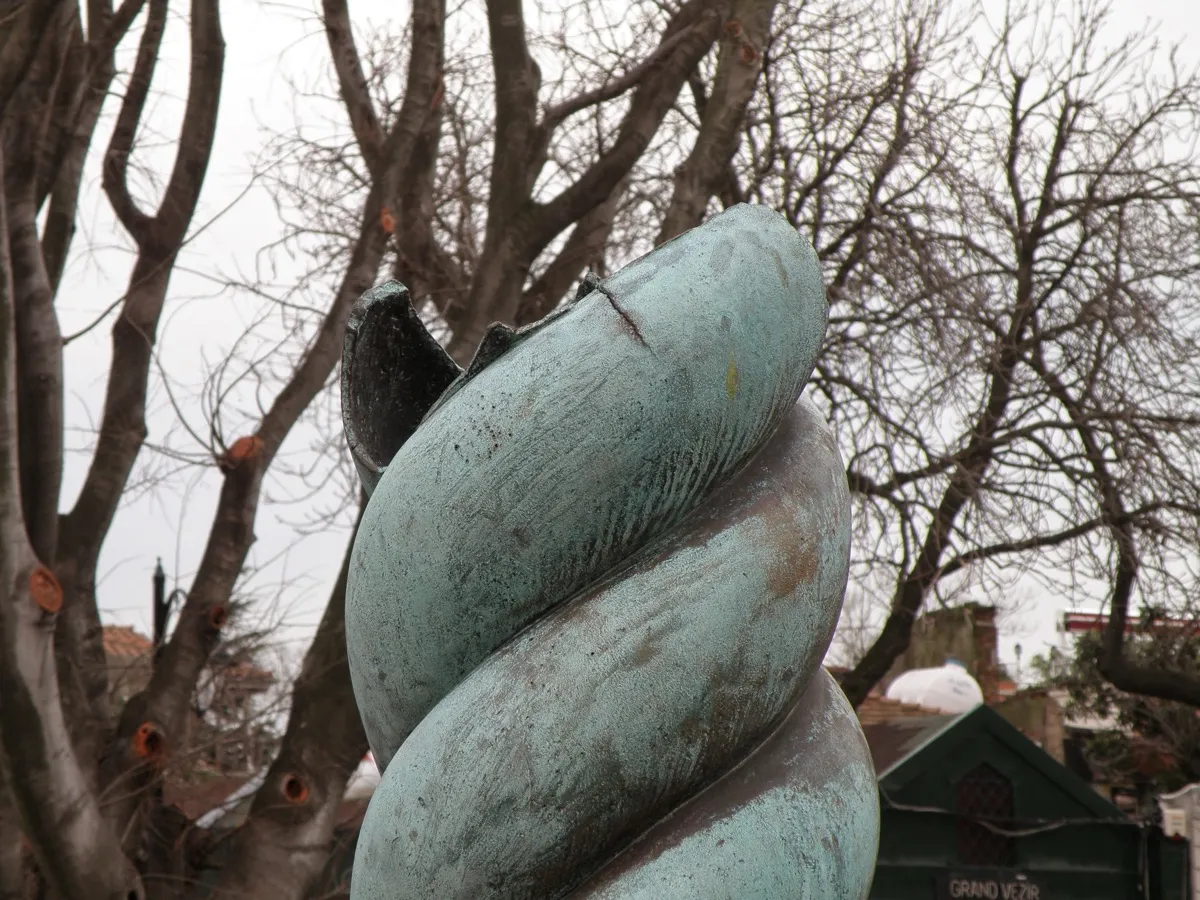
This is the most historically layered object in the square. The column is a bronze sculpture of three intertwined serpents, originally created in 479 BC as a victory offering at the Temple of Apollo in Delphi after the Greek city-states defeated the Persian Empire at the Battle of Plataea. Constantine the Great moved it to Constantinople in the fourth century AD. At Delphi, it had supported a golden tripod bowl — the bowl was never brought to Constantinople, and the serpent heads that once crowned the top were destroyed in 1700. A fragment of one head is now in the Istanbul Archaeology Museum.
What remains is the lower two-thirds of the column — a twisted bronze shaft rising about five meters from its pit in the center of the square. It is the kind of object that does not look like much until you understand what it is: a 2,500-year-old Greek victory monument, relocated by a Roman emperor, set into a Byzantine racetrack, surviving the Ottoman conquest, and now standing in a public park in modern Turkey. The column has outlasted three empires.
The Walled Obelisk
The third monument, at the southern end of the spina, is the least visually impressive but has its own story. Emperor Constantine VII Porphyrogennetos built it in the tenth century AD as a rough stone obelisk covered in gilded bronze plaques. The bronze was stripped during the Fourth Crusade in 1204, when Latin Crusaders sacked Constantinople and looted anything of value. What remains is the bare stone core — a stripped monument that tells you as much about 1204 as the Serpentine Column tells you about 479 BC.
The Nika Riots
The hippodrome’s most consequential event was not a race but a riot. In January 532, the two dominant chariot-racing factions — the Blues and the Greens — turned their rivalry into a unified revolt against Emperor Justinian I. The factions had long functioned as something between sports clubs and political parties, and their combined anger over taxation, corruption, and Justinian’s advisors erupted into five days of violence that nearly ended his reign.
The rioters set fire to large sections of the city. The second Hagia Sophia — the church that preceded the current one — was burned to the ground. The crowd gathered in the hippodrome and declared a rival emperor. Justinian reportedly considered fleeing the city. According to the historian Procopius, it was Empress Theodora who convinced him to stay, arguing that “purple makes a fine burial shroud” — meaning it was better to die as emperor than to live in exile.
Justinian sent his general Belisarius into the hippodrome with troops. The result was a massacre: an estimated 30,000 people were killed in the arena. The revolt ended. Justinian used the destruction as an opportunity to rebuild the city, including commissioning the third and current Hagia Sophia — the building that still stands across the park from the hippodrome site. The Nika riots, in other words, produced the most famous building in Istanbul.
The connection between the hippodrome and Hagia Sophia is not incidental. The two sites are separated by less than two hundred meters. Standing in Sultanahmet Square, you can see the dome of Hagia Sophia to the northeast and understand that the building exists, in part, because the one before it was burned down by a mob that gathered on the ground beneath your feet.
What Happened After the Races Ended
The last recorded chariot race in the hippodrome took place in 1200 — three years before the Fourth Crusade devastated the city. After 1204, Constantinople never fully recovered its population or its wealth, and the hippodrome fell into disuse. The bronze statues that had lined the spina were looted — most famously the four gilded copper horses that had stood above the starting gates, which were taken to Venice and installed on the façade of St. Mark’s Basilica, where replicas still stand today.
When Sultan Mehmed II conquered the city in 1453, the Ottomans had no interest in chariot racing. The hippodrome’s stone seating was quarried for building material. The arena floor gradually filled with earth and debris. The site became known as At Meydanı — “Horse Square” — a name that preserved the memory of what had happened here even as the physical structure disappeared beneath the rising ground level.
The Ottomans built around the hippodrome but never directly over it, which is why the park exists today. The Blue Mosque (1616) faces the western side of the old arena. The Ibrahim Pasha Palace (now the Museum of Turkish and Islamic Arts) occupies the site of the hippodrome’s western seating. The German Fountain — an octagonal domed structure in neo-Byzantine style, given by Kaiser Wilhelm II to Sultan Abdülhamid II in 1900 — stands at the northern entrance where the starting gates once were.
Archaeological excavations in the 1950s and again in the 1990s uncovered rows of seats and structural columns, confirming that substantial portions of the hippodrome survive beneath the modern surface. Researchers believe much more remains to be found.
Walking the Hippodrome Today
The hippodrome is not a ticketed site — it is a public park, open at all hours. The three monuments of the spina are fenced but clearly visible, and information panels provide basic context. The park is best walked from north to south, starting at the German Fountain near the Blue Mosque entrance and following the line of the spina toward the sphendone curve at the far end.
The experience changes significantly with a guide. The monuments themselves are modest in appearance — a stone column, a bronze shaft, a rough obelisk. Without context, they register as old objects in a park. With context — the 3,500-year journey of the Egyptian obelisk, the Greek victory at Plataea, the Nika riots, the Crusader looting — they become a compressed history of three civilizations layered onto a single public space.
The surrounding sites reinforce the narrative. Hagia Sophia is a two-minute walk northeast. The Blue Mosque is immediately west. The Basilica Cistern entrance is five minutes north. Topkapi Palace is ten minutes through the park. All of these sites are connected to the hippodrome historically — the cistern supplied water to the same district, Hagia Sophia was rebuilt because of a riot that started here, and the Blue Mosque was positioned to face the arena it replaced as the neighborhood’s center of gravity.
Plan Your Istanbul Visit
The Hippodrome is the place where Istanbul’s Byzantine past is closest to the surface — literally and historically. If you would like a private guide to walk you through Sultanahmet and explain how these monuments, these buildings, and this ground connect across fifteen centuries, tell us what interests you and we will build the day around it.
Frequently Asked Questions
Where is the Hippodrome in Istanbul?
The Hippodrome is now Sultanahmet Square — the long, narrow park between Hagia Sophia and the Blue Mosque in Istanbul’s historic peninsula. The three monuments from the ancient spina (the Obelisk of Theodosius, the Serpentine Column, and the Walled Obelisk) still stand in the center of the park. The actual racetrack surface lies about two meters below the current ground level.
What is the Obelisk of Theodosius?
A pink granite obelisk originally carved around 1490 BC for Pharaoh Thutmose III and erected at the Temple of Karnak in Luxor, Egypt. Emperor Theodosius the Great had it shipped to Constantinople and installed in the hippodrome in AD 390. At roughly 3,500 years old, it is the oldest monument in Istanbul. The marble pedestal beneath it shows carved reliefs of Theodosius presiding over the races.
What is the Serpentine Column?
A bronze column of three intertwined serpents, originally made in 479 BC as a Greek victory offering at Delphi after the Battle of Plataea against the Persian Empire. Constantine the Great moved it to Constantinople in the fourth century. The golden tripod bowl it once supported was never brought to the city, and the serpent heads were destroyed in 1700. The surviving lower shaft, now about five meters tall, is one of the oldest Greek bronze sculptures still standing in the world.
What were the Nika riots?
In January 532 AD, the two main chariot-racing factions — the Blues and the Greens — united in a revolt against Emperor Justinian I. The riots lasted five days, destroyed large parts of Constantinople including the second Hagia Sophia, and nearly ended Justinian’s reign. The revolt was suppressed when General Belisarius led troops into the hippodrome, killing an estimated 30,000 people. Justinian subsequently rebuilt the city, including commissioning the current Hagia Sophia.
Can you still see the Hippodrome?
The three spina monuments are visible in Sultanahmet Square. Parts of the sphendone (the curved southern end of the racetrack) survive as visible stonework below the park’s southern edge. The rest of the hippodrome — the seating, the starting gates, the imperial lodge — lies beneath the modern surface, largely unexcavated. Archaeological work in the 1950s and 1990s confirmed that substantial structural remains survive underground.
How long does it take to visit the Hippodrome?
As an open-air site, the hippodrome can be walked in fifteen minutes. But to appreciate what you are looking at, allow thirty minutes to an hour — time to examine the three monuments, read the reliefs on the Obelisk of Theodosius pedestal, and understand the spatial relationship between the hippodrome and the surrounding sites (Hagia Sophia, the Blue Mosque, the Basilica Cistern). With a guide, the hippodrome often takes longer because the stories it contains are layered and interconnected.