How to Plan a Turkey Trip: A First-Timer’s Honest Guide
Turkey is one of those destinations that looks simple on a map and complicated in a browser tab. You start researching and within an hour you’ve got seventeen tabs open: visa rules, balloon flights, which city first, how many days, is it safe, what do I wear, should I book a tour or go solo.
This guide is the one we wish every first-time visitor had before they started planning. No fluff, no “top 10 must-sees,” just the honest answers to the questions that actually determine whether your trip works.
Do I Need a Visa?
US citizens: No. You enter visa-free for up to 90 days. No e-visa, no ETIAS, no paperwork. Your passport needs to be valid for at least six months beyond your entry date, and you need at least one blank page. That’s it.
UK citizens: E-visa required. You apply online before travel — it takes about five minutes and costs roughly $35. Multiple-entry, valid for 90 days within a 180-day period.
EU citizens: Most EU nationalities enter visa-free for up to 90 days. A few exceptions (including some newer EU members) require an e-visa. Check your specific nationality on the Turkish e-visa portal before booking flights.
Canadian citizens: E-visa required. Same online process as UK — quick, straightforward, valid for 90 days.
No vaccinations are required for entry from the US, UK, EU, or Canada.
When to Go (The Real Answer)
The short version: April through June and September through October. The long version depends on where you’re going.
Spring (April–May) is the sweet spot. Temperatures hover between 20°C and 28°C across most of the country. Crowds are lighter than summer. Hotel prices are 20–30% lower. Cappadocia’s valleys have wildflowers. Istanbul is warm enough for outdoor dining but cool enough for walking all day.
Early fall (September–October) is nearly as good. The summer crowds have thinned, the heat has broken, and the light turns golden — particularly in Cappadocia and along the Aegean coast. Harvest season means fresh figs, pomegranates, and grapes at every roadside stand.
Summer (July–August) works but comes with trade-offs. Istanbul is crowded — Turkey welcomed over 7 million visitors in July alone in recent years. Ephesus regularly exceeds 35°C. Cappadocia is hot and dusty. Prices peak. If summer is your only option, go early (first two weeks of June) or late (last two weeks of September) to catch the edges.
Winter (December–February) is off the radar for most visitors, but Cappadocia under snow is striking. Istanbul is quieter and atmospheric, though rainy. Balloon flights in Cappadocia cancel more frequently due to weather. Indoor sites — mosques, museums, underground cities — are unaffected.
How Many Days Do I Need?
This is the most common question we get, and the honest answer is: 7 to 10 days for a first trip that doesn’t feel rushed.
Here’s the breakdown by region:
| Destination | Minimum Days | Why |
|---|---|---|
| Istanbul | 3 | 1,500 years of layered history. Two days covers the highlights; a third lets you explore neighborhoods beyond Sultanahmet |
| Cappadocia | 2–3 | Two full days cover both valleys, an underground city, and the balloon flight. A third adds deeper hikes or cooking classes |
| Ephesus | 1 | One full day covers the ancient city, the House of the Virgin Mary, and Şirince village |
| Pamukkale | 1 | The travertines and Hierapolis take a solid day |
| Antalya / Coast | 2–3 | Old town, ancient ruins at Perge and Aspendos, plus beach or boat time |
| Fethiye / Blue Cruise | 2–4 | A day trip covers Ölüdeniz; a 2–4 day gulet cruise explores the Turquoise Coast properly |
A practical first trip:
- 5 days: Istanbul (3) + Cappadocia (2). The essential combination. A 1-hour flight connects them.
- 7 days: Istanbul (3) + Cappadocia (2) + Ephesus (1) + travel day. Adds the Aegean.
- 10 days: Istanbul (3) + Cappadocia (3) + coast/Pamukkale/Ephesus (3) + travel day. The full picture.
- 13 days: All of the above plus Antalya, Fethiye, and a Blue Cruise. The comprehensive tour.
The domestic flight network makes multi-city trips practical. Istanbul to Cappadocia is 1 hour 20 minutes by air. Istanbul to Izmir (for Ephesus) is about an hour. You’re not spending days on buses unless you want to.
Where to Go: What Each Region Offers
Istanbul — Where Everything Starts
Most international flights arrive here, and for good reason — Istanbul alone justifies a trip to Turkey.
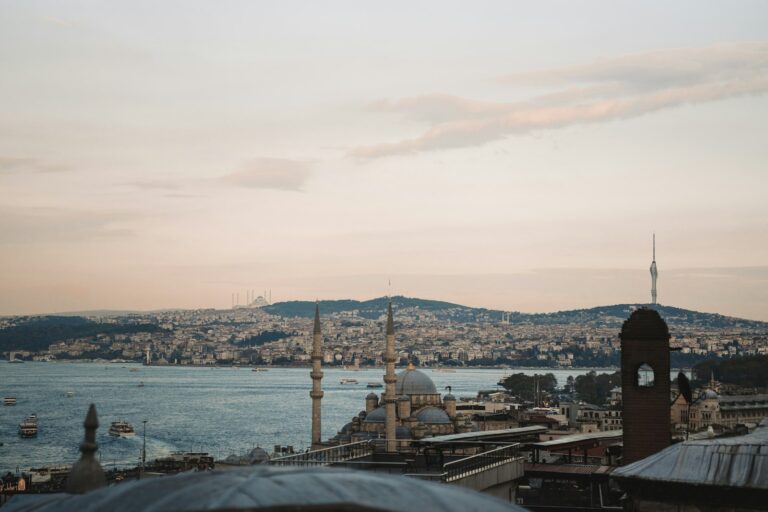
The essential sites in the Sultanahmet district sit within walking distance of each other: the Hagia Sophia (Roman engineering, Byzantine mosaics, and Ottoman calligraphy in one building), the Blue Mosque (20,000 handmade İznik tiles), the Basilica Cistern (336 marble columns holding up a Byzantine water reservoir), the Hippodrome, and the Grand Bazaar.
Beyond Sultanahmet, the city opens up: the Spice Bazaar, a Bosphorus cruise past Ottoman waterfront mansions, Galata Tower for panoramic views, and neighborhoods like Balat and Karaköy where the tourist infrastructure thins out and the city feels like itself.
Three well-planned days covers the essential Istanbul. Add a fourth if you want Topkapı Palace, Dolmabahçe Palace, or the Asian side.
Cappadocia — The Landscape That Doesn’t Look Real
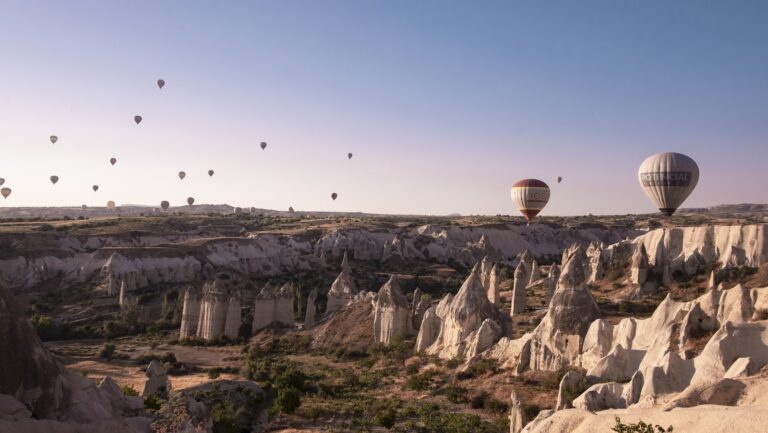
Sixty million years of volcanic ash, wind, and water carved a landscape that looks like it belongs on another planet. Fairy chimneys, underground cities, rock-cut churches with Byzantine frescoes — all of it within a compact area you can explore on foot, by car, or from 300 meters up in a balloon basket.
The sunrise balloon flight is what most people come for, and it delivers. But Cappadocia’s depth is in the valleys — hiking through Red Valley past rock-cut chapels, exploring Kaymaklı Underground City eight levels below the surface, standing at the top of Uçhisar Castle with the entire region spread below you.
Stay in a cave hotel carved from volcanic tuff. It’s not a gimmick — the rooms are cool in summer, warm in winter, and unlike any hotel you’ve slept in.
Ephesus — The Second-Largest City in the Roman Empire
At its peak, 250,000 people lived here. The Library of Celsus, the 25,000-seat Great Theater, the Temple of Hadrian — these aren’t ruins in the sense of scattered stones. They’re standing structures that communicate scale in a way photographs can’t.
The nearby village of Şirince, tucked into the hills, makes a good afternoon stop: cobblestone streets, fruit wines, and a pace that’s the opposite of the ancient city.
Ephesus is hot in summer — 35°C and no shade. Spring and fall are dramatically more comfortable.
Pamukkale — The White Terraces
A 2.7-kilometer shelf of white thermal travertines cascading down a hillside, with the ruins of Hierapolis — a Roman spa city — sitting on top. You wade barefoot through shallow warm water on the terraces (shoes and sandals are prohibited to protect the calcium deposits).
The optional addition: Cleopatra’s Antique Pool, a warm spring filled with Roman column fragments where you swim among 2,000-year-old ruins.
Pamukkale sits about three hours from the Aegean coast. Most travelers combine it with Ephesus in a single routing.
How Much Does Turkey Cost?
Turkey offers more for less than almost any comparable destination. The currency situation works heavily in your favor if you’re coming from the US, UK, or EU.
Rough benchmarks:
– A quality dinner for one: $10–15
– A five-star cave hotel in Cappadocia: less than a mid-range hotel in Paris
– Domestic flights: $40–80 one-way (Istanbul–Cappadocia, Istanbul–Izmir)
– Museum and site entrance fees: $5–25 per site
– A local SIM card with data: a few dollars
For comparison: mid-range Turkish hotels cost 2 to 3 times less than equivalent rooms in Paris, Rome, or Barcelona. A quality restaurant dinner for two runs roughly half the price of Western European capitals.
A private guided tour — your own vehicle, guide, hotels, flights, and entrance fees included — costs less per day than you’d pay for a self-guided trip in Italy or Greece, once you factor in the logistics you’d otherwise arrange yourself.
Is Turkey Safe?
Yes. The tourist regions — Istanbul, Cappadocia, the Aegean coast, Antalya, Pamukkale — are well-policed and well-traveled.
Some data points:
– Turkey’s overall crime rate per capita is 9 times lower than the United States
– The homicide rate is approximately 60% lower than the US
– The US State Department advisory is Level 2 (“exercise increased caution”) — the same classification as France, Belgium, and Germany
– Istanbul recorded a 16% drop in crimes against individuals between 2023 and 2025
– Istanbul scores between Berlin and London on standard crime indices
The southeastern border areas warrant caution, but Istanbul is 950 kilometers from those zones, and Cappadocia is nearly 500. The tourist corridor and the areas that make the news are not the same places.
Solo female travelers: Turkey is welcoming and increasingly popular for solo women. The combination of a private guide and a well-planned itinerary eliminates most of the friction that comes with solo travel in any unfamiliar country.
The Practical Details That Matter
Language: English is widely spoken in tourist areas. Hotel staff, restaurant menus, and signs at major sites are bilingual. Google Translate handles the rest — particularly useful for reading menus at local restaurants off the tourist strip.
Money: The Turkish lira is the local currency. Credit cards are accepted at most hotels, restaurants, and shops in tourist areas. ATMs are everywhere. US dollars and euros are accepted at some tourist-facing businesses, but you’ll get better value paying in lira.
Connectivity: Free Wi-Fi is standard at hotels and cafes. Local SIM cards are available at the airport for a few dollars and give you data coverage throughout the country.
What to wear: Turkey is a secular country with a Muslim majority. In tourist areas, dress as you would in southern Europe — no restrictions. At mosques: women should cover shoulders and hair (scarves are provided at major mosques); everyone should cover knees. Comfortable walking shoes are essential — Istanbul has cobblestone streets and hills, Ephesus has ancient marble paths, and Cappadocia’s valleys are unpaved.
Getting around: Domestic flights are frequent and affordable. Istanbul has an efficient tram, metro, and ferry network. For taxis, use BiTaksi or Uber — both show fare estimates before you book, which is better than street-hailing.
Booking window: Four to six weeks in advance for peak season. Balloon flights in Cappadocia and cave hotels fill up early — especially in April, May, and October.
Start With the Destination, Not the Details
The logistics can feel overwhelming before you’ve been. Once you’re on the ground, Turkey is one of the easiest countries to travel — the infrastructure is built for tourism, the people are welcoming, and the distances between highlights are short by air.
Pick the places that interest you. Figure out how many days you have. Let the itinerary take shape from there.
If you want someone to handle the planning — flights, hotels, guides, entrance tickets, the balloon booking, the dinner reservations — that’s what we do. Tell us where you want to go and we’ll come back with a plan.
Tell us what you have in mind →
Frequently Asked Questions
Do I need travel insurance for Turkey?
It’s not a legal requirement for entry, but strongly recommended. Medical care in Turkey is high quality and affordable by Western standards, but a policy covering trip cancellation, medical evacuation, and lost luggage gives peace of mind. Most travel insurance policies cover Turkey without additional riders.
Should I exchange money before I arrive?
No. ATMs at Istanbul airport dispense Turkish lira at competitive rates. Your bank card will work at most ATMs — just notify your bank before travel. Avoid airport exchange counters, which charge high commissions. In tourist areas, credit cards are widely accepted.
Is it easy to get around Turkey without speaking Turkish?
Yes, in tourist areas. Hotel staff, guides, and restaurant workers in Istanbul, Cappadocia, Ephesus, and the coast speak English. Google Translate’s camera mode is helpful for signs and menus in smaller towns. Learning a few words — merhaba (hello), teşekkürler (thank you), lütfen (please) — goes a long way.
Can I drink tap water in Turkey?
Stick to bottled water, which is available everywhere and inexpensive. Hotels often provide complimentary bottles in rooms. Tap water is treated and safe for brushing teeth, but locals and visitors alike drink bottled.
What’s the tipping culture in Turkey?
Tipping is appreciated but not obligatory. A general guide: round up at restaurants or leave 5–10% of the bill; tip hotel housekeeping 20–30 TL per day; tip your tour guide €10–20 per day and driver €5–10 per day if the service was good.
Is Ramadan a good time to visit Turkey?
Yes, with minor adjustments. Turkey is a secular state, and tourist services — hotels, restaurants, tours, sites — operate normally during Ramadan. Some smaller local restaurants may close during daylight hours in conservative areas, but in Istanbul, Cappadocia, and the coast, you won’t notice a difference. The evening iftar meals (breaking of the fast) are actually a cultural highlight worth experiencing.
How far in advance should I book?
Four to six weeks for spring and fall travel. Eight weeks or more if you want specific cave hotels in Cappadocia or guaranteed balloon flight slots. Off-season trips can often be arranged in two to three weeks. The earlier you book, the more flexibility you have in guide and hotel selection.