The photographs you’ve seen of Pamukkale — white terraced pools cascading down a hillside — are real. The place genuinely looks like that. But most people arrive, take the picture, and leave without understanding what they’re looking at, or that an entire Roman city sits on top of the cliff. That city is part of the same UNESCO site. It deserves the same attention.
Pamukkale is not snow. It is not cotton, despite the name — “pamuk kale” means cotton castle in Turkish. What you’re looking at is calcium carbonate, deposited over thousands of years by 17 thermal springs that push water to the surface at 35°C. As the water flows over the edge of the plateau and cools in the open air, the dissolved minerals precipitate out and harden into travertine — the same material that makes up the Colosseum’s walls, the same stone used in Roman baths across the empire. Pamukkale just happens to have 17,000 square meters of it arranged in one of the more visually arresting formations in the natural world.
When I bring travelers to Pamukkale, I always suggest we start with the geology before we step into the water. Knowing what created those pools changes how you see them.
How the Terraces Form
The thermal water emerging from Pamukkale’s springs is saturated with calcium bicarbonate. At 35°C underground, the mineral stays dissolved. The moment the water reaches the surface and begins to cool, carbon dioxide escapes and calcium carbonate precipitates out — hardening into the white and pale cream-colored stone you see forming the pool edges and the cliff face.
The process is ongoing. Some of the terraces you’ll walk through are still actively forming; you can watch new deposits crystallizing at the water’s edge. Others are dormant, their pools temporarily drained so the stone can regenerate. The Turkish government and UNESCO manage the site’s water flow carefully, rotating which sections receive water and which rest. This is why parts of the site are closed at any given time — not bureaucratic inconvenience, but a deliberate effort to keep the travertines viable for the next century.
The color varies depending on mineral content. Most of the stone is white or pale cream. Where iron-rich water flows, you’ll see rust-orange streaks. Where the water pools and light hits it at the right angle, the color shifts to pale turquoise. The same spring, the same water, producing different colors based on what it picks up along the way.
Accumulating a single centimeter of travertine takes roughly a decade. The cliff you walk along is approximately 160 meters high. That gives some sense of the timescale involved.
Walking the Terraces
Shoes come off at the entrance. Every visitor carries them in a bag — this is one of the non-negotiable site rules, and rightly so. Bare feet on travertine is a particular sensation: the stone is slightly rough where it’s dry, slightly slippery where water is flowing, and warm underfoot from the sun and the thermal water running beneath.
The pools range from ankle-deep to knee-deep in the walking sections. Water temperature holds at around 35°C — the same warmth as a bath drawn to the right temperature, except that you’re standing outdoors on a white stone cliff with a view across the Çürüksu Valley. The water is clear, and in the shallower pools you can see the calcium carbonate patterns forming on the bottom.
Midday is the most crowded window, typically from around 11:00 AM to 2:00 PM when the group tours converge. The light is also harsher then, flattening out the whites and making the pools look slightly bleached in photographs. Early morning — 8:00 to 10:00 AM — gives you softer light, fewer people on the terraces, and the particular pleasure of having the pools to yourself for stretches of time. Late afternoon light is warm and directional, which does interesting things to the white stone, but the site is busy until closing.
The main walking route runs along the top of the cliff and back down. It takes 30 to 45 minutes at an unhurried pace, not including time spent standing in the pools. Wear something you don’t mind getting wet to the knees.
Hierapolis: The Roman City on Top
The plateau above the travertines is not empty hillside. It is the site of Hierapolis, a Greco-Roman city founded around 190 BC by the Attalid kings of Pergamon. The Romans developed it into a significant spa town — wealthy people came from across the empire to bathe in the thermal waters, which were believed to have curative properties. The city was rebuilt after an earthquake in 17 AD and continued to flourish until the Byzantine period. It was abandoned after another earthquake in the 7th century AD and largely untouched until excavations began in the 19th century.
What remains is substantial.
The Necropolis
On the northern edge of the site, the Necropolis of Hierapolis is the largest ancient burial ground in Anatolia — around 1,200 tombs spread across the hillside, ranging from simple sarcophagi to elaborate two-story mausoleums with carved reliefs. Many are inscribed with the occupant’s name, profession, and in some cases warnings to future grave robbers. The scale of it is something you feel on foot in a way you cannot from a photograph. Hierapolis was a city people came to die in as well as to heal in; the Christian martyr Philip the Apostle is traditionally believed to have been martyred here in 80 AD.
The Theater
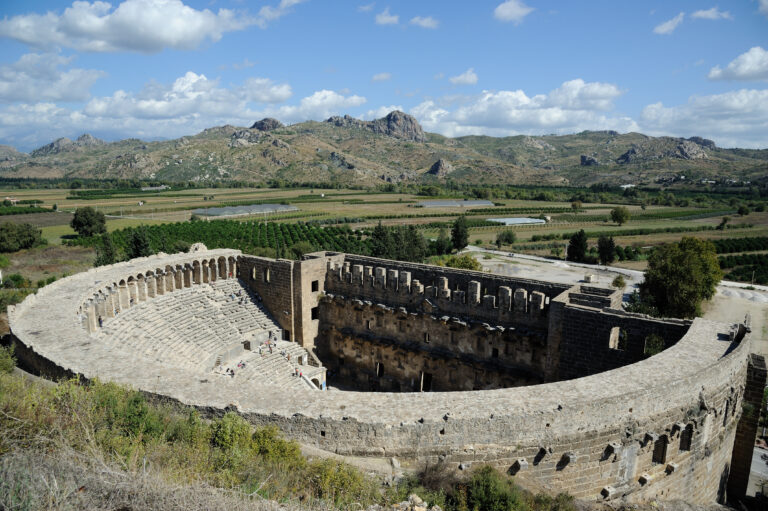
The theater at Hierapolis held approximately 12,000 spectators and is one of the best-preserved Roman theaters in Turkey. The stage building — the scaena — still has its decorative friezes largely intact, including narrative relief panels depicting the myths of Dionysus and Apollo. You can walk up through the seating tiers and look back across the ruins toward the travertines below. The city’s relationship to the landscape becomes clear from up here in a way it doesn’t at ground level.
The Colonnaded Street
The main avenue of Hierapolis ran north to south through the city, flanked by columns and lined with shops and public buildings. Much of it has been excavated and partially restored. Walking its length gives a sense of how a Roman city was organized — the civic logic of wide processional streets, the placement of baths near the city center, the gates at either end marking the transition from urban to rural.
Cleopatra’s Antique Pool
Within the Hierapolis site, there is a thermal pool where you can swim among Roman columns — not a metaphor. A major earthquake in the 7th century collapsed several structures directly into the thermal spring. When the pool was developed for bathing in the modern period, the submerged ruins — column drums, capitals, carved architectural fragments — were left where they fell. You swim over and around them in the 36°C water. The pool is fed by the same thermal source that created the travertines below. It is a genuinely unusual experience: floating in warm mineral water while your feet occasionally brush a 2,000-year-old marble column.
There is an entrance fee for Cleopatra’s Pool above the general site admission. Bring a swimsuit. It’s worth the additional cost.
The Hierapolis Archaeology Museum
The museum is housed inside a beautifully restored Roman bath building at the center of the site. It holds sculpture, sarcophagi, relief panels, and everyday objects recovered from the Hierapolis excavations. The building itself — with its vaulted ceilings and thick stone walls — is as interesting as many of the objects inside. Allow 30 to 40 minutes here.
The Practical Side
Pamukkale is in Denizli Province, approximately 250 kilometers from Izmir and 190 kilometers from Antalya. The most comfortable approach from Istanbul or Izmir is by train to Denizli, then a short minibus (dolmuş) transfer to Pamukkale village at the base of the cliff — about 20 minutes. Driving from Izmir takes roughly three hours; from Istanbul, it is more practical to fly to Denizli or combine Pamukkale with a broader western Turkey route.
The site is open year-round. Spring (April to early June) and autumn (September to October) offer comfortable temperatures for walking the terraces and the ruins. Summer is hot — August temperatures reach the mid-30s Celsius — which makes the thermal pools feel slightly less appealing and the midday crowds more intense. Winter visits are quieter and the white travertines against a grey sky have their own character, though some areas may have reduced water flow.
Tickets cover both the travertines and the Hierapolis ruins. Cleopatra’s Pool requires a separate fee. You’ll want a bag for your shoes on the terraces, a swimsuit if you plan to use Cleopatra’s Pool, and comfortable walking shoes for the Hierapolis ruins — the site covers significant ground on uneven ancient stone. Sun protection matters in every season.
With a Private Guide: How Sequencing Changes the Day
The standard group tour does the terraces at midday and the ruins when everyone is tired. The sequencing a private guide can offer is different.
When I bring travelers to Pamukkale, we arrive early — on the terraces by 8:30 AM, while the light is still low and the pools are quiet. We spend 45 to 60 minutes walking barefoot through the water, taking our time at the pools that are currently flowing. Then we move to Hierapolis while most group tours are still arriving at the site entrance. The theater, the Necropolis, the colonnaded street — we cover these before the midday heat sets in.
Cleopatra’s Pool works well around midday, when the terraces are at their most crowded and the water is at its warmest. It becomes a natural pause in the day: an hour in the pool, lunch nearby, then the Archaeology Museum in the early afternoon when the site is still busy but the worst of the heat has passed.
That sequencing — terraces first, ruins second, pool at midday — means you’re moving with the rhythm of the site rather than against it. You’re not fighting crowds at the terraces. You’re not rushing the ruins. You arrive at each section when the conditions favor it.
A full day at Pamukkale and Hierapolis, done properly, takes six to seven hours. Most visitors allocate half that. The difference is in what you take away.
Pamukkale is one of those places where the reality matches the photographs — and then turns out to be considerably more than the photographs showed. The terraces are only part of the story. The Roman city on top is the other half. Give the whole site the time it asks for, and it will give you back something worth carrying home.
If you’d like to visit Pamukkale and Hierapolis as part of a tailored private tour through western Turkey, tell us what matters to you and we’ll plan the itinerary around it.
Frequently Asked Questions
Can you swim in Pamukkale?
You can walk through the thermal pools on the terraces — they’re typically ankle to knee deep in the permitted walking sections, at around 35°C. Swimming is not permitted on the main travertines. If you want to swim in thermal water at the site, Cleopatra’s Antique Pool is the place to do it. It’s a separate fee from the main site admission and genuinely worth including in your day.
Why are some of the terraces closed?
Pamukkale’s travertines require active water flow to stay white and healthy. The site management rotates water across different sections to prevent overuse and allow stone to regenerate where it has been worn or discolored. Closed areas are not due to damage or safety concerns — they’re resting. The sections that are open at any given time are fully accessible and actively flowing.
How long does Pamukkale take?
If you’re covering only the travertines, you can walk through in 45 minutes to an hour. If you’re doing the full UNESCO site — travertines, Hierapolis ruins, and the Archaeology Museum — allow at least five to six hours for an unhurried visit. Add another hour if you want time in Cleopatra’s Pool. Most group tours try to cover everything in three hours. That leaves a lot on the table.
Is Cleopatra's Pool worth it?
Yes, for most travelers. The experience of swimming in 36°C thermal water among submerged Roman columns is genuinely unusual — there is nowhere else quite like it. The pool is well-maintained, the water is clear, and it makes for a practical midday pause when the terraces are crowded and the sun is at its strongest. Bring a swimsuit and factor in an additional entry fee.
Is Pamukkale a feasible day trip from Istanbul?
It is possible as a very long day if you fly to Denizli (roughly 50 minutes), but it leaves limited time at the site and none of the slower pace the place rewards. Pamukkale works best as part of a western Turkey itinerary — a natural stop between Izmir or Ephesus and Antalya or Cappadocia — or as a two-day visit staying overnight in Pamukkale village. The site in early morning and late afternoon, when most day-trippers have left, is a different experience than midday.
What's the best time of day to visit — morning or afternoon?
Morning, specifically before 10:00 AM. The light is better for the white terraces, the crowds are thinner, and you can complete the travertine walk before group tours arrive in force. If you’re arriving in the afternoon, late afternoon from around 4:00 PM onward also works — the light is warm and directional, the day-trippers are leaving, and the site takes on a quieter character. Midday, from roughly 11:00 AM to 2:00 PM, is the least favorable window: busiest and harshest light.