In the spring of 1452, Sultan Mehmed II stood on the European shore of the Bosphorus at its narrowest point — 660 meters of water separating two continents — and ordered a fortress built. Not in a year. Not in six months. In one season. By the end of that summer, three massive towers and a curtain wall covering 31,250 square meters stood on the hillside above the strait. The fortress had not been built to defend. It had been built to choke off the last supply line to a dying empire.
Constantinople, the Byzantine capital, depended on grain and military supplies shipped south through the Bosphorus from the Black Sea. The fortress, together with Anadolu Hisarı on the opposite shore — built by Mehmed’s great-grandfather in 1393 — formed a pair of stone jaws that closed around the strait. Any ship attempting to pass would come within cannon range of both fortifications. By the time Rumelihisarı was complete, the siege of Constantinople had already begun in everything but name.
The city fell on May 29, 1453. The fortress had done its work.
Built in Four Months
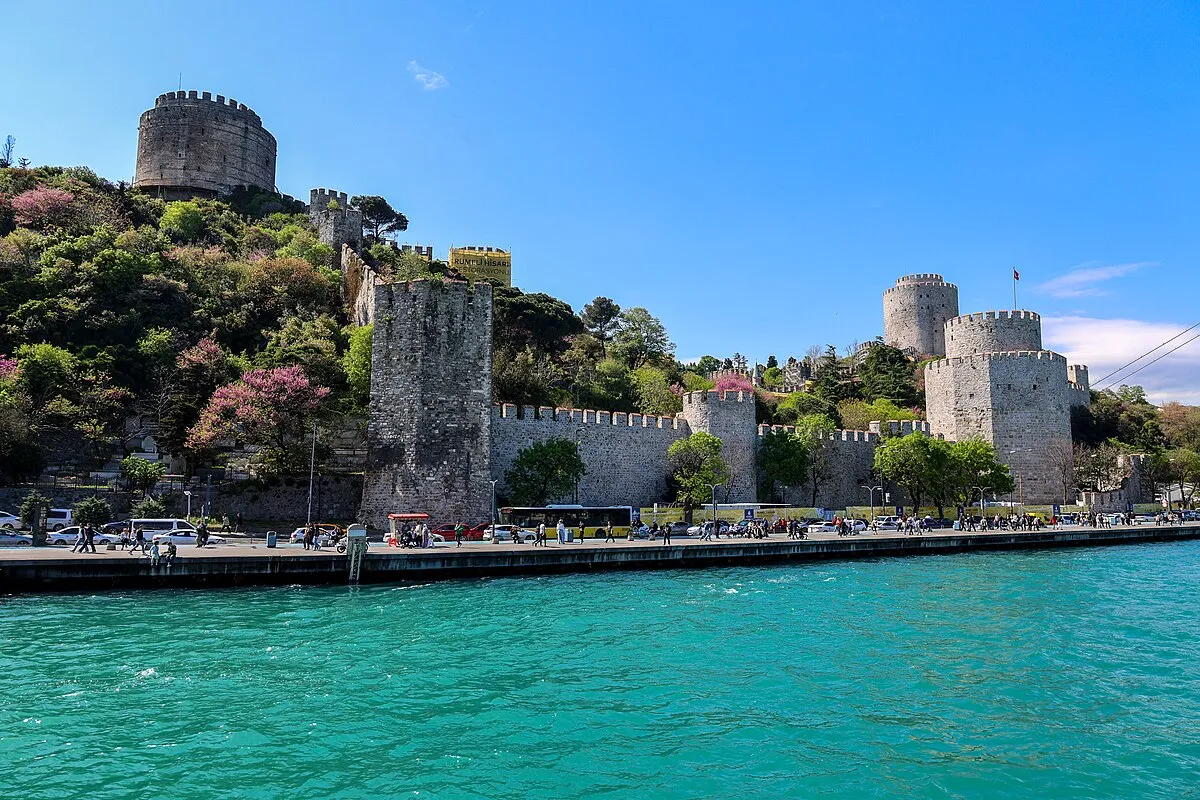
The speed of construction was itself a strategic weapon. Mehmed needed the fortress operational before Constantinople could organize a naval response, and he treated the project with the urgency of a military campaign. The story goes that he assigned each of the three main towers to a different vizier — Sarıca Pasha, Halil Pasha, and Zağanos Pasha — and held each personally responsible for the completion of his section. The sultan himself inspected the work daily.
Construction began on April 15, 1452. Thousands of workers — masons, laborers, carpenters — were brought to the site. Stone was quarried locally and from ruined Byzantine buildings in the area. The walls rose fast. By late summer, three towers, thirteen watchtowers, and a curtain wall stretching 250 meters from north to south were standing. The fortress enclosed an area running 50 to 125 meters from the waterline up the hillside. Wooden barracks, a small mosque, and a cistern with three wall fountains completed the interior.
The Byzantines watched from across the Golden Horn. Emperor Constantine XI sent envoys to protest — Mehmed had, technically, built a fortress on land that bordered Byzantine territory. The protests were ignored. The diplomatic fiction that the Ottoman and Byzantine empires coexisted as neighbors was ending, and the fortress was the physical statement that it was over.
Three Towers, Three Commanders
The fortress plan is organized around three large towers positioned to cover different approaches, connected by curtain walls that follow the terrain uphill from the waterline.
Halil Pasha Tower stands at the waterfront, directly on the strait. It is dodecagonal — twelve-sided — with a diameter of 23 meters, walls 6.5 meters thick, and nine stories rising 22 meters above the shore. This was the weapons platform. Large cannons were mounted here, aimed directly across the water. When a Venetian ship attempted to run the blockade, it was sunk with a single shot from this tower. After that, traffic stopped.
Sarıca Pasha Tower (also called Fatih Tower) anchors the northern end of the complex. It is cylindrical, 23 meters in diameter, with walls 7 meters thick — the thickest in the fortress — and rises 28 meters, the tallest of the three towers. Its nine stories provided the fortress’s highest observation point and the most commanding view up the strait toward the Black Sea.
Zağanos Pasha Tower holds the southern end. Also cylindrical, it is the widest of the three at 26.7 meters in diameter, with walls 5.7 meters thick and eight stories standing 21 meters high. Two secret gates near this tower allowed supplies to be brought in from the south without using the main entrances.
Between the three main towers, six polygonal and six cylindrical watchtowers are spaced along the curtain walls, each one providing overlapping fields of view. The original towers had conical wooden roofs covered in lead — a detail lost to fire and earthquake over the centuries, but the stone shells remain intact.
The overall impression, from the water or from inside the walls, is of a fortress built by people who understood exactly what they needed and built exactly that. There is no ornamentation. No decorative stonework. No concession to aesthetics. Rumelihisarı is pure military architecture — mass, angle, and position calculated for one purpose.
After 1453
Once Constantinople fell, the fortress’s primary mission was accomplished. It served for a time as a customs checkpoint — ships passing through the Bosphorus were stopped, inspected, and taxed. A garrison of 400 Janissaries remained stationed here.
As the Ottoman Empire expanded and a second pair of fortifications was built further up the strait near the Black Sea entrance, Rumelihisarı gradually lost its strategic importance. By the seventeenth century, it had been repurposed as a prison, primarily for foreign prisoners of war. The fortress suffered damage in the great earthquake of 1509 and was repaired. A fire in 1746 destroyed the wooden interiors of two of the main towers. Sultan Selim III ordered further repairs in the late eighteenth century.
By the nineteenth and early twentieth centuries, the fortress had been partially absorbed into the surrounding neighborhood. Wooden houses were built within the walls, and the military structure became domestic space — an Ottoman pattern of reuse that speaks to a pragmatic culture that wasted nothing, including castles.
In 1953 — exactly five hundred years after the conquest the fortress enabled — President Celal Bayar ordered the residents relocated and a comprehensive restoration begun. The work started on May 16, 1955, and concluded on May 29, 1958. Since 1960, Rumelihisarı has operated as a museum. The fortress appeared on various Turkish banknotes between 1939 and 1986 — a mark of national significance.
Walking the Fortress Today
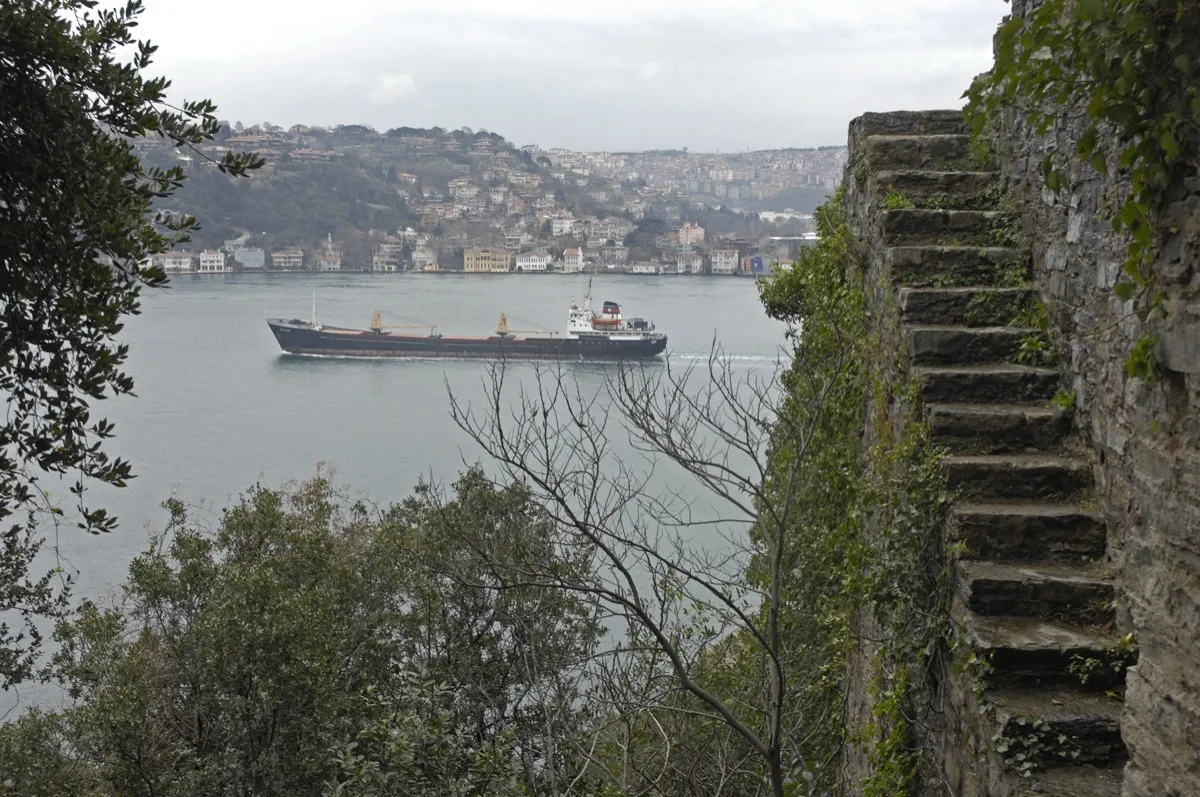
The museum is open to visitors, and the site rewards physical exploration. The curtain walls can be walked — climbing from the waterfront up the hillside along the parapets, with the Bosphorus visible through the crenellations. The three main towers are accessible, and climbing to the upper levels of the Sarıca Pasha Tower gives you a view of the strait that has changed remarkably little since 1452. The water is the same width. Anadolu Hisarı is still visible on the opposite shore. The geography that made this site strategically essential is still legible.
The interior space — the area enclosed by the walls — has been used as an open-air concert and event venue since the fortress became a museum. The acoustics of the stone walls and the backdrop of the Bosphorus make it one of Istanbul’s more unusual performance spaces. Summer concerts and cultural events are held here seasonally.
The small mosque within the walls — one of the original structures — has been restored. The cistern that once supplied the garrison’s water is still present, though only one of the original three wall fountains survives.
Allow one to two hours. The fortress is not large in terms of horizontal distance, but the vertical climb along the walls and through the towers requires time and reasonable fitness. Comfortable shoes are essential — the stone surfaces are uneven and the walkways along the walls are narrow in places.
Getting there: Rumelihisarı is on the European shore of the Bosphorus, about 10 kilometers north of the city center. The most atmospheric approach is by boat — the fortress is visible from the water long before you reach it, and arriving by Bosphorus cruise puts the building in its strategic context. By land, the 22 or 25E bus from Kabataş reaches the fortress, and the Rumelihisarı stop is directly at the entrance. A taxi from Sultanahmet takes about 25 minutes, depending on traffic.
Across the Water: Anadolu Hisarı
The story of Rumelihisarı is incomplete without its partner. Anadolu Hisarı — the Fortress of Anatolia — sits on the Asian shore directly opposite, built in 1393 by Sultan Bayezid I during an earlier (unsuccessful) siege of Constantinople. It is much smaller than Rumelihisarı, more compact and more weathered, and it is not currently open as a museum.
But from the walls of Rumelihisarı, looking across the 660 meters of water to the older fortress, the strategic design becomes immediately clear. No ship could pass between them without being seen and fired upon from both sides. The two fortresses were not just defensive structures — they were a weapon system, and the Bosphorus at this point was the kill zone.
When I bring travelers here, this is the moment that tends to land. The distance across the water is short enough that you can see individual windows on the far shore. The strait is narrow enough that the current is visibly strong. And the realization — that this crossing, this specific 660 meters of water, decided the fate of Constantinople — gives the fortress a weight that its bare stone walls communicate better than any museum panel.
Plan Your Istanbul Visit
Rumelihisarı is the kind of place that changes how you understand 1453 — and how you understand Istanbul’s relationship to the Bosphorus. If you would like to include the fortress in a private Istanbul day — combined with a Bosphorus cruise, or with the Bosphorus-side neighborhoods that surround it — tell us what interests you and we will build the day around it.
Frequently Asked Questions
How long does it take to visit Rumeli Fortress?
Allow one to two hours. The fortress is compact in footprint but vertical — walking the curtain walls, climbing the towers, and taking in the views requires time. If you are combining it with the surrounding Bosphorus neighborhood or a boat cruise, the fortress fits comfortably into a half-day itinerary.
Why was Rumeli Fortress built?
Sultan Mehmed II built the fortress in 1452 — one year before the conquest of Constantinople — to control the Bosphorus at its narrowest point. Together with Anadolu Hisarı on the opposite Asian shore, Rumelihisarı blocked maritime supply routes to Constantinople from the Black Sea, cutting off the grain and military reinforcements that the Byzantine capital depended on.
Can you walk on the walls of Rumeli Fortress?
Yes. The curtain walls are accessible, and walking along the parapets from the waterfront up the hillside is one of the highlights of the visit. The three main towers can also be entered and climbed. The walkways are narrow in places and the stone is uneven, so comfortable, sturdy shoes are important.
Is Rumeli Fortress worth visiting?
Yes, particularly if the history of the Ottoman conquest interests you, or if you want to see the Bosphorus from a perspective that explains its strategic importance. The fortress is also one of the best-preserved medieval military structures in Istanbul, and the views from the walls — of the strait, of Anadolu Hisarı opposite, and of the Bosphorus villages in both directions — are among the least crowded panoramic views in the city.
How do I get to Rumeli Fortress?
By bus: the 22 or 25E from Kabataş stops directly at the fortress entrance. By taxi: about 25 minutes from Sultanahmet (traffic dependent). By boat: a Bosphorus cruise passes directly in front of the fortress, and arriving by water gives you the best first impression of the structure’s scale and position. The fortress is on the European shore, about 10 kilometers north of the old city.
What is the connection between Rumeli Fortress and Anadolu Hisarı?
Anadolu Hisarı was built in 1393 on the Asian shore by Sultan Bayezid I. Rumelihisarı was built in 1452 on the European shore directly opposite by his great-grandson Mehmed II. Together, the two fortresses controlled the Bosphorus at its narrowest point — 660 meters — making it impossible for ships to pass without coming under cannon fire from both sides. This chokehold on the strait was a decisive factor in the fall of Constantinople in 1453.