You smell it before you see it. Walking toward the Eminönü waterfront, somewhere between the ferry terminals and the Galata Bridge, the air shifts. Cumin first, then dried mint, then something warmer — saffron or sumac or the sharp sweetness of Turkish delight stacked in open boxes. Follow that shift and you arrive at a stone gateway under a low dome, and beyond it a vaulted corridor where the scent becomes the architecture.
This is the Spice Bazaar — Mısır Çarşısı in Turkish — and it has been the center of Istanbul’s spice and provisions trade since the 1660s. It is smaller than the Grand Bazaar, more focused, and easier to navigate. It is also louder, more fragrant, and more immediately overwhelming to the senses, because nearly everything sold here is designed to be tasted, smelled, or eaten.
What the Name Means (and Does Not Mean)
The Turkish name, Mısır Çarşısı, translates literally as “Egyptian Bazaar.” The reason is financial, not geographic. The bazaar was built as part of the Yeni Cami (New Mosque) complex in the 1660s, and its construction was funded with tax revenues collected from the Ottoman province of Egypt. The goods sold here came from everywhere — India, China, Southeast Asia, the Arabian Peninsula — but the money that built the walls came from Cairo. The name stuck.
There is a secondary confusion worth clearing up. In Turkish, the word “mısır” also means “corn” or “maize,” which has led some travel guides to occasionally refer to this as the “Corn Bazaar.” It is not. The name refers to Egypt, not to any grain.
The bazaar was also known historically as the Yeni Çarşı (New Bazaar) and Valide Çarşısı (Queen Mother’s Bazaar), after the women of the Ottoman dynasty who funded its construction — first Safiye Sultan, who commissioned the New Mosque complex in 1597, and later Hatice Turhan Sultan, mother of Mehmed IV, who saw the project through to completion sixty-seven years later. The bazaar finally opened between 1663 and 1664.
Built as Revenue, Not Just Commerce
The Spice Bazaar was not designed as a standalone market. It is part of a külliye — the Ottoman system of building a mosque together with supporting institutions: a school, a public bath, a hospital, and a commercial building whose rental income funded the entire complex. The bazaar was that commercial building. Every shop lease and every transaction helped pay for the New Mosque’s upkeep, its charitable services, and its staff.
This is a pattern you see across Ottoman cities. The great mosques were not just houses of worship but institutions embedded in an economic system. The Spice Bazaar exists because the New Mosque needed a revenue stream, and the spice trade — with its high margins and constant demand — was the most reliable source available.
The architect was Koca Kasım Ağa, the imperial court architect, who designed an L-shaped covered hall with six gates, vaulted ceilings, and a series of small domes along the roofline. The plan is simple: two main corridors meeting at a right angle, lined with 85 shops. Unlike the Grand Bazaar’s labyrinth of sixty-one streets, the Spice Bazaar can be walked end to end in ten minutes. That compactness is part of its appeal — it concentrates the experience rather than dispersing it.
What You Walk Through
The interior is a single vaulted corridor that bends into an L. The ceiling is high — high enough that the sound of the crowd rises and disperses rather than pressing in on you. Light enters through arched windows near the roofline and through the open gates at either end, and the combination of stone walls, warm light, and the accumulated scent of centuries of spice trade gives the space a density that photographs struggle to convey.
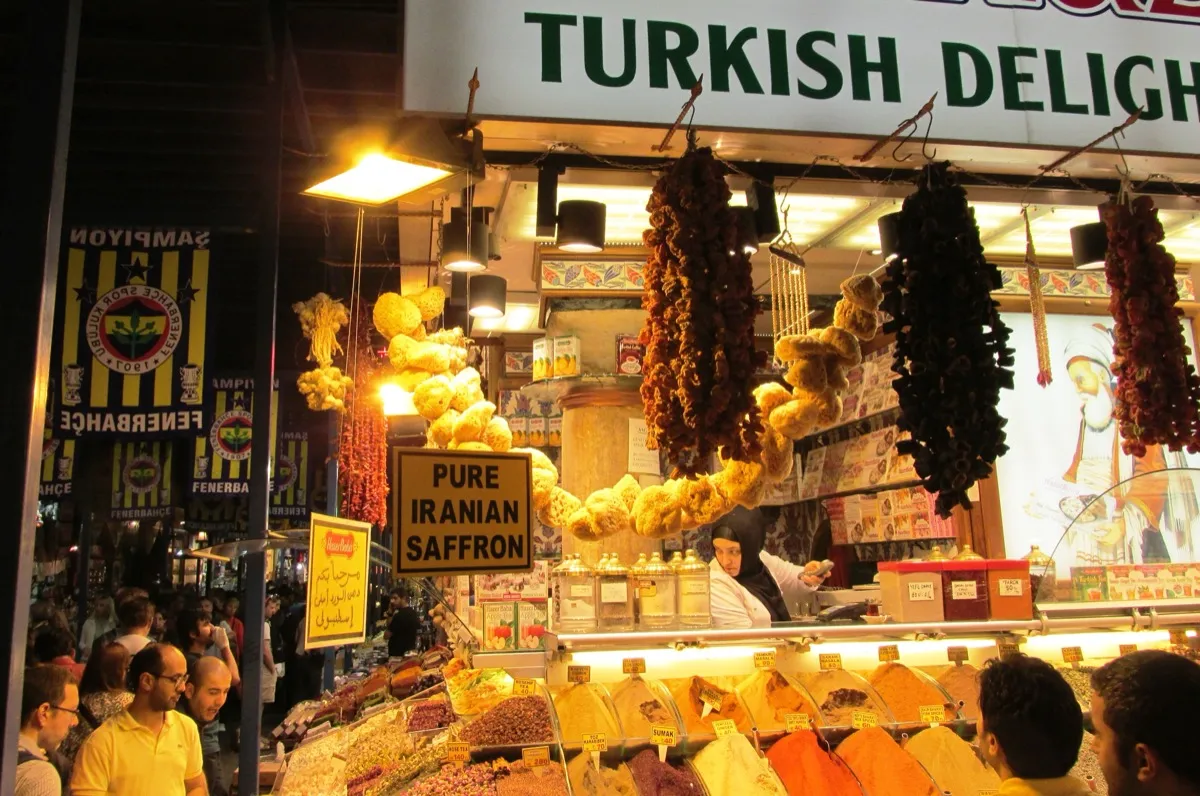
The shops line both sides of the corridor, each one a wall of color. Saffron in small glass jars. Pyramids of ground spices — paprika, turmeric, cumin, sumac — in tones that run from deep red through orange to pale yellow. Dried fruits and nuts piled in copper-toned bins. Turkish delight in every combination imaginable: pistachio, rose, pomegranate, double-roasted with hazelnut, dusted in powdered sugar or coated in coconut. Dried apricots stuffed with cream or walnut. Lokum in boxes stacked five high.
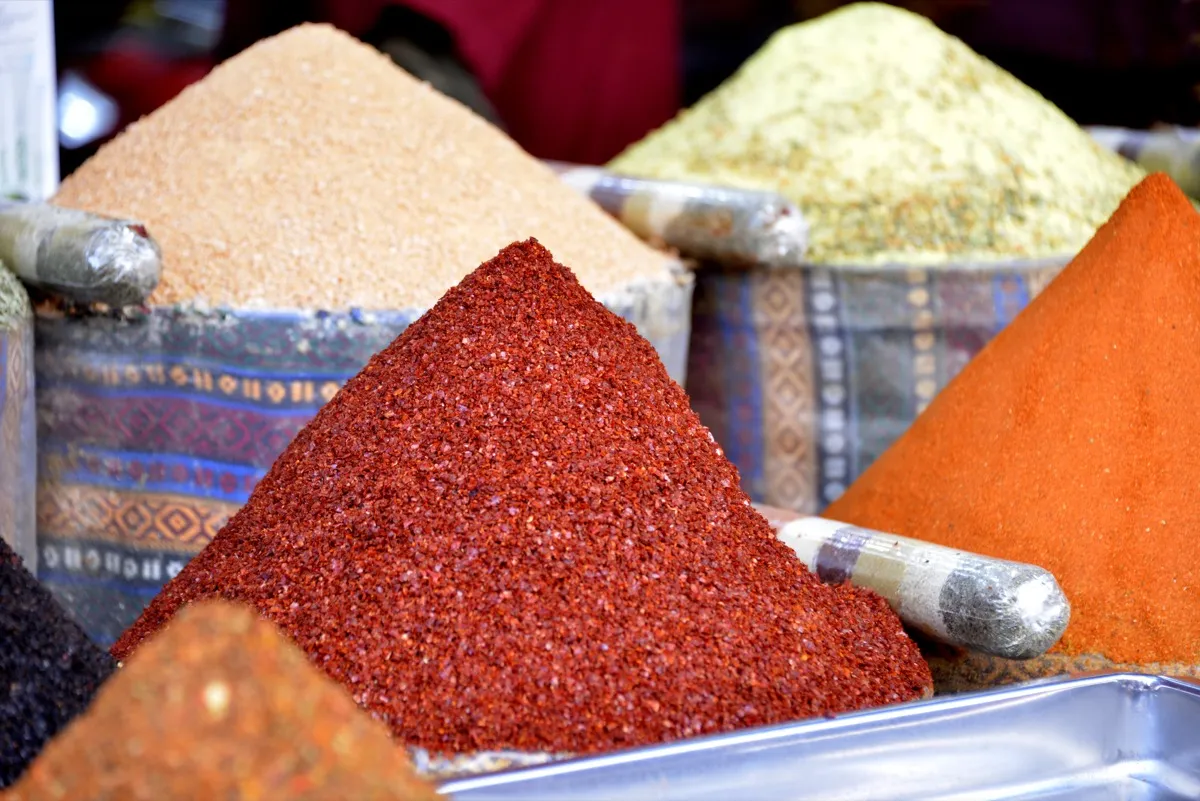
The shopkeepers are vocal. Samples are offered freely — a piece of Turkish delight on a toothpick, a sliver of dried apricot, a cube of halva. The generosity is genuine and also strategic. But the quality in many of the established shops is real. The saffron is graded. The spice blends are mixed on-site. The Turkish delight is often made fresh, not factory-wrapped.
What has changed in recent decades is the product mix. Where once nearly every shop sold spices, herbs, or medicinal preparations, you now find shops selling jewelry, textiles, and souvenirs alongside the traditional spice vendors. The commercial pressure of tourist foot traffic has diversified what the bazaar offers. But the spice and food shops remain the core, and the first few steps inside still deliver the experience the bazaar is known for.
What to Buy (and What to Skip)
Spices: The bazaar’s primary draw. Turkish red pepper flakes (pul biber), sumac, cumin, dried mint, and saffron are the standards. The quality at established shops is good — the spices are sourced from producers across Turkey and packaged for retail. Smell before you buy: if a spice has lost its scent, it has lost its potency. The best shops will let you compare grades.
Turkish delight (lokum): The range is vast. The pistachio and rose varieties are the most traditional. Pomegranate with walnut is a local favorite. Avoid the cheapest boxes stacked near entrances — they tend to be mass-produced. The shops in the interior corridors, where shopkeepers can explain the ingredients and offer samples, are worth the few extra lira.
Dried fruits and nuts: Turkish dried apricots, figs, hazelnuts, and pistachios are among the best in the world. The quality at the bazaar is generally high, and the prices — while higher than a neighborhood market — are reasonable for the grade.
Tea and herbal infusions: Turkish apple tea, pomegranate tea, and herbal blends are sold in bulk or in gift-ready packaging. The apple tea sold at the bazaar is typically a flavored powder rather than actual dried apple — this is the commercial standard, not a deception, but worth knowing.
What to approach carefully: Pre-packaged “saffron” at very low prices. Genuine saffron is expensive because the harvest is labor-intensive — if the price seems too good, it may be safflower or turmeric-based. Also be selective with vacuum-packed spice blends aimed at tourists — the quality varies widely.
The Surrounding Quarter
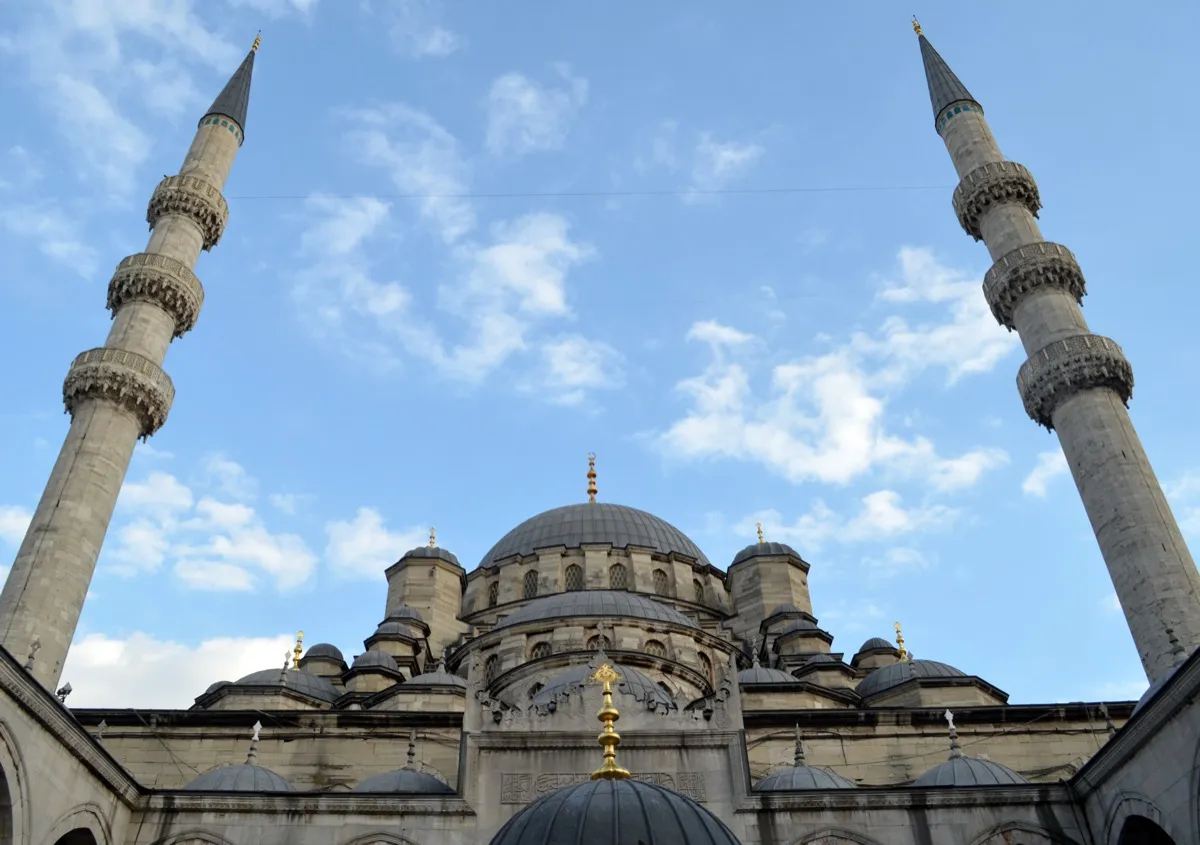
The Spice Bazaar sits at the base of the New Mosque, and the relationship between the two buildings is visible from the outside — the bazaar’s stone walls adjoin the mosque’s courtyard wall, a physical reminder that they were designed as a single complex. The New Mosque itself is worth stepping inside. Completed in 1665, just after the bazaar, its interior is tiled with blue and white İznik-style ceramics and lit by a low ring of windows that gives the prayer hall a distinctive soft light.
Outside the bazaar’s western gate, the streets of the Eminönü waterfront open up. The Galata Bridge is a two-minute walk, with fishermen lining the upper deck and fish restaurants below. The ferry terminals for Kadıköy, Üsküdar, and the Bosphorus are directly ahead. This waterfront area — noisy, commercial, full of movement — is one of the places where Istanbul’s different layers are most visible at once: Ottoman mosques, Republican-era infrastructure, and the constant traffic of a working port city.
Directly behind the bazaar, the streets of Tahtakale form a dense commercial neighborhood where Istanbul’s wholesale trade still operates. Hardware, textiles, plastics, electronics — the shops here serve the city’s working economy rather than its tourists, and the prices and the pace reflect that difference. It is a useful reminder that the bazaar sits at the edge of a much larger commercial ecosystem.
The Süleymaniye Mosque is a fifteen-minute walk uphill from the bazaar, through the streets of Eminönü. The Grand Bazaar is a twenty-minute walk — or one tram stop — to the west.
When to Go
The Spice Bazaar is open daily from 8:00 AM to 7:30 PM (hours may shift slightly in winter). Unlike the Grand Bazaar, it is open on Sundays, which makes it a useful alternative on the one day the Grand Bazaar is closed.
The first hour after opening is the quietest. By mid-morning, particularly on weekends and during summer, the corridors are crowded enough that moving at your own pace becomes difficult. Late afternoon — from about 5:00 PM — the crowds thin again as tour groups leave and the market settles into a calmer rhythm.
If you are combining the Spice Bazaar with the Grand Bazaar in a single day, the sequence matters. Starting at the Grand Bazaar in the morning, walking through the Eminönü district over lunch, and arriving at the Spice Bazaar in the mid-afternoon gives you the best balance of crowd levels and energy.
With a private guide, the visit extends beyond the bazaar itself. The back streets, the rooftop terrace of the bazaar (accessible from an upper-level café with views over the Golden Horn), and the surrounding Eminönü quarter all add layers to the experience that a quick walk through the main corridor does not offer.
Plan Your Istanbul Visit
The Spice Bazaar is one of those places where ten minutes gives you a photograph and two hours gives you a story. The scent, the color, the conversation with a shopkeeper about where the saffron comes from — these are the things that stay. If you would like to explore the Spice Bazaar and the surrounding Eminönü quarter as part of a private Istanbul day, tell us what you are interested in and we will shape the day around it.
Frequently Asked Questions
How long should I spend at the Spice Bazaar?
The bazaar itself can be walked in twenty minutes, but that misses the point. If you want to browse the shops, taste samples, compare spice qualities, and step outside to see the New Mosque and the waterfront, allow one to two hours. The compact size means you can revisit shops easily — it is worth doing a first pass to get your bearings, then returning to the places that caught your attention.
What is the difference between the Spice Bazaar and the Grand Bazaar?
The Grand Bazaar is much larger — 61 covered streets, thousands of shops, and a focus on jewelry, carpets, leather, and textiles. The Spice Bazaar has 85 shops arranged in a single L-shaped corridor, and the focus is food: spices, Turkish delight, dried fruits, nuts, tea, and honey. The two are a twenty-minute walk apart (or one tram stop) and pair naturally in a single day. The Grand Bazaar is closed on Sundays; the Spice Bazaar is open daily.
Is the Spice Bazaar worth visiting?
Yes, particularly if food and sensory experience matter to you. The bazaar concentrates Istanbul’s provision trade into a single vaulted corridor — the density of color, scent, and taste is immediate in a way that photographs do not capture. It is also architecturally interesting as part of the New Mosque complex, and the surrounding Eminönü quarter adds context to the visit.
What should I buy at the Spice Bazaar?
The strongest buys are Turkish dried fruits (apricots, figs), pistachios and hazelnuts, quality Turkish delight from shops that make their own, whole or ground spices (especially pul biber, sumac, and cumin), and saffron from reputable vendors. For gifts, the packaged spice sets and lokum boxes are convenient and travel well. Taste before you buy — the established shops encourage sampling.
Is bargaining expected at the Spice Bazaar?
Less so than at the Grand Bazaar. Many food items have fixed or near-fixed prices, particularly when sold by weight. There is some room for negotiation on larger purchases — if you are buying several boxes of Turkish delight or a large spice order, asking for a better price is reasonable. The conversation is typically brief and friendly. Jewelry and souvenir shops within the bazaar follow the more flexible pricing customs of Turkish markets.
How do I get to the Spice Bazaar?
The easiest route is the T1 tram line — the Eminönü stop is directly adjacent to the bazaar’s main entrance. From Sultanahmet, the tram ride is two stops. If you are coming from the Asian side, the Eminönü ferry terminal is a three-minute walk from the bazaar. From Taksim or Karaköy, the most practical option is the tram or a short taxi ride. The bazaar entrance faces the New Mosque — look for the stone gateway with the low dome at the corner of the mosque’s courtyard.
Can I visit both bazaars in one day?
Yes, and most travelers do. The Grand Bazaar and the Spice Bazaar are about twenty minutes apart on foot, connected by the busy commercial streets of the Eminönü district. The walk itself is interesting — you pass through working neighborhoods that show a different side of Istanbul’s market culture. Alternatively, the T1 tram connects the two in one stop (Beyazıt to Eminönü). Starting with the Grand Bazaar in the morning and finishing at the Spice Bazaar in the afternoon is the most comfortable sequence.