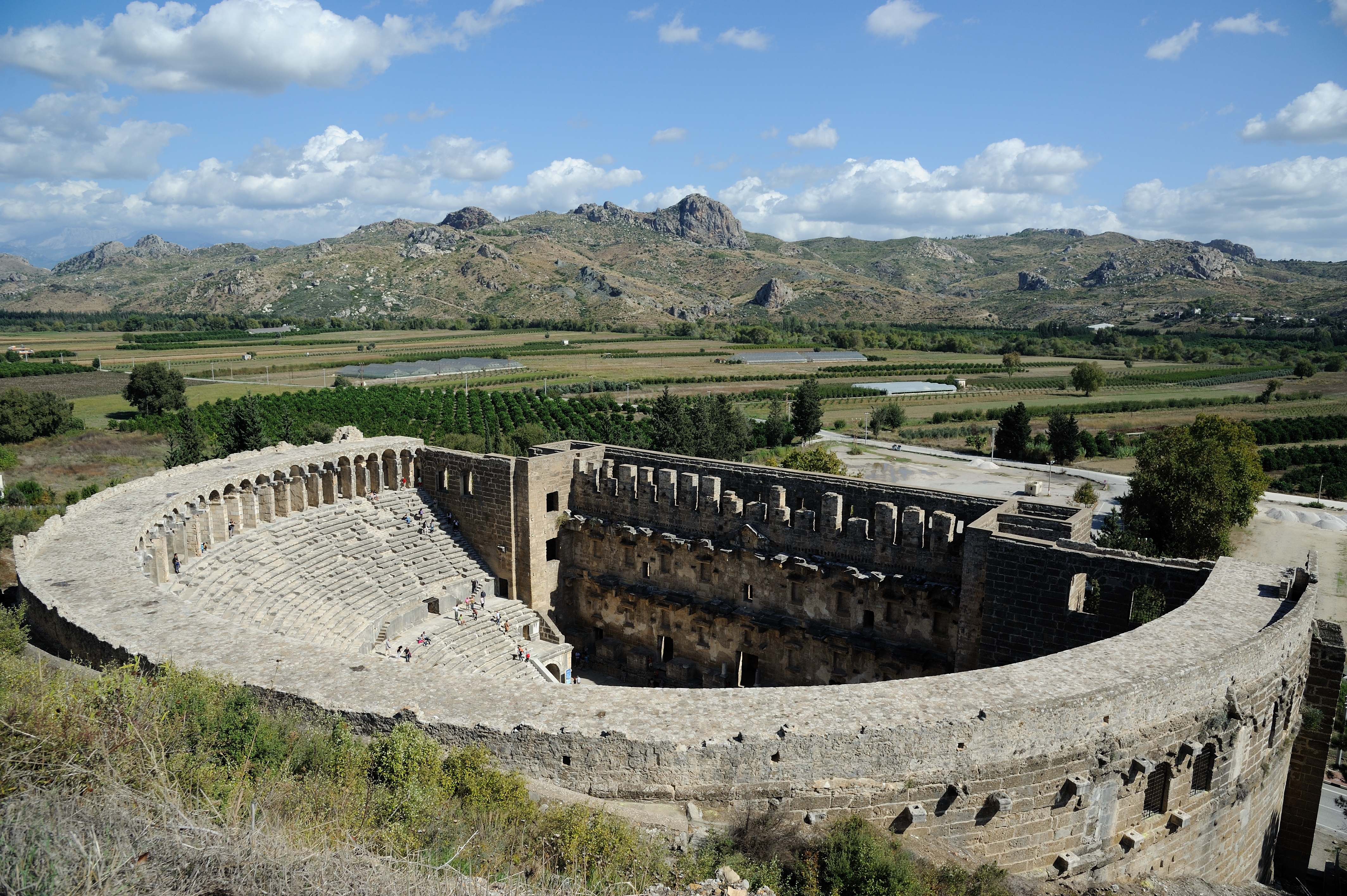
The first thing you understand about the theater at Aspendos is that it is still here. Not partially. Not in the way most Roman theaters survive — a curve of seating, a few standing arches, the rest reconstructed in the imagination. Aspendos is intact. The stage building is intact. The seating is intact. The vaulted entrance galleries are intact. You walk in through the same door a Roman audience walked in through in the second century AD, and you find yourself looking at the same wall they looked at.
This is the best-preserved Roman theater in the Mediterranean. There are people who will quibble about whether Orange in France or Bosra in Syria deserves the title instead. The argument is technical and the answer depends on which element you weight most heavily. What is not in dispute is that nothing else in Anatolia comes close, and that walking into Aspendos for the first time is one of those moments where the gap between “ancient ruins” and “an actual building you can use” suddenly closes.
Who Built It and Why
The theater was built around 155 AD during the reign of the emperor Marcus Aurelius, financed by two wealthy local brothers, Curtius Crispinus and Curtius Auspicatus, and dedicated — as the Greek and Latin inscriptions on the entrance arches still proclaim — to the gods of the empire and the imperial house. The architect was a man named Zenon, the son of Theodorus, and he is named on the inscriptions as well. This is unusual. Most Roman public buildings do not preserve the name of the architect. Aspendos preserves Zenon’s name in stone, in two languages, on the wall he built.
The theater seated approximately 12,000 to 15,000 people across forty rows of marble seating divided horizontally by a walkway (the diazoma) and vertically by ten staircases (scalaria) that radiate from the orchestra to the upper gallery. The arched gallery at the top is the part that almost no other Roman theater preserves at full height. At Aspendos it is complete, and walking along it gives you the rare experience of looking at a Roman theater from the perspective of the cheap seats — which is, in fact, where most of the audience sat.
The reason the building survived is the kind of historical accident that decides what we have left from antiquity. After the Roman period, the Seljuk Turks reused the theater as a caravanserai — a fortified roadside inn — in the 13th century. They repaired the stage building, plastered some of the interior, and added decorative motifs that you can still find faintly in the upper levels. Because the building had a continuous use, it was continuously maintained. It was never quarried for its stone, never abandoned to weather, never reduced to the rubble that ate most Roman theaters in the eastern Mediterranean.
What You See When You Walk In
Most visitors enter through the western parodos (the side passage) and step out into the orchestra — the semicircular performance space at the foot of the stage. From this angle the building is overwhelming because the stage wall (scaenae frons) rises directly in front of you to a height of about 30 meters, almost the full original height. The wooden roof that once covered the stage is gone, and the marble veneer and the freestanding columns of the original two-story facade are gone, but the underlying brick-and-stone wall is intact, with its niches, doors, and decorative recesses still legible.
Look up. The wall is pierced by three doors at the orchestra level — the central one was the porta regia (“royal door”), used by the lead actors, and the two flanking doors were used by supporting players. Above the central door, in a triangular pediment, the relief of Dionysus that originally crowned the facade is partly preserved. Dionysus, as god of theater, was the appropriate dedicatee.
The acoustics still work. This is the part of the visit nobody quite believes until they try it. Stand in the center of the orchestra and speak at a conversational volume. Have someone sit in the upper rows. They will hear you clearly — not the way they would hear someone over a microphone, but with a clarity that does not depend on shouting. The Romans designed the geometry of the seating, the angle of the stage wall, and the proportions of the orchestra specifically to produce this effect. Two thousand years later, with the wooden roof gone and weather damage on the stage facade, it still does what it was built to do.
Walk up the stairs. The climb to the upper gallery is steep, but the view from the top is the right one — the angle from which most of the original audience experienced a performance, with the stage wall reading as an architectural backdrop and the orchestra and lower seating arranged below like a diagram of the Roman idea of public space.
The Aqueduct and the City Above
Most visitors come to Aspendos for the theater and leave without realizing that the theater is the smallest part of the ancient city. Above the theater, on a flat-topped hill, is the rest of Aspendos: the agora, the basilica, the nymphaeum, the council chamber (bouleuterion), and the foundations of a large stadium. None of it is reconstructed. All of it is overgrown. Walking up there involves a fifteen-minute climb on a dirt path and a tolerance for stepping over loose stones, but it is empty and quiet and gives you the scale of what Aspendos actually was: a wealthy provincial city of the late Hellenistic and Roman period, built to support the kind of population that could fill a 12,000-seat theater.
The other thing most visitors miss is the Roman aqueduct, which crosses the plain to the north of the site. It is one of the best-preserved aqueducts in Anatolia, with two impressive surviving towers and a long arched section that you can see clearly from the road as you approach. It was built to supply water to the upper city, and the engineering — including a pressurized inverted siphon that climbed two hills using the natural water pressure — is a piece of Roman hydraulic problem-solving that earns more attention than it usually gets. If you have a guide and a car, ask to detour past the towers on the way out. Five minutes, very much worth it.
Practical Information
Tickets are sold at the site entrance and through the Turkish Ministry of Culture’s official museums portal, which is the authoritative source for current prices and hours. Aspendos is part of the national museum system, so the standard Museum Pass Türkiye (Müzekart+) covers admission if you happen to have one.
Hours. The site opens at 8:00 or 8:30 AM (seasonal) and closes mid-evening in summer, mid-afternoon in winter. There is no advance booking system at the time of writing — tickets are bought on arrival.
Getting there. Aspendos is about 45 kilometers east of central Antalya, off the D400 coastal highway. By car, the drive is roughly an hour from Antalya, 30 minutes from Side, and 90 minutes from the western Antalya hotel zone around Belek. There are public dolmuş minibuses from Antalya, but the connections are slow and infrequent and almost everyone visits as part of a half-day excursion that combines Aspendos with Perge, Side, and the Kurşunlu Waterfall in a single loop.
Heat. The theater is mostly shaded inside the seating area, but the orchestra and the upper gallery are exposed. In July and August, plan for early morning or late afternoon. The midday heat between 12 and 3 is significant.
The Aspendos Opera and Ballet Festival. Every summer, usually from mid-June through mid-July, the theater is used for live performances of opera and ballet under the stars. If your travel dates overlap with the festival, attending a performance at Aspendos is one of the rare experiences in the Mediterranean where the original function of an ancient building is preserved as a living tradition. Tickets sell out and program details change every year — check the Ministry of Culture portal or ask us closer to your travel dates.
Time needed. Allow 60 to 90 minutes for the theater alone, two hours if you also climb up to the upper city, two and a half if you stop at the aqueduct on the way out.
How Aspendos Fits an Antalya Itinerary
Aspendos almost never travels alone. The classic Antalya day on the Pamphylian plain is a three-stop loop: Perge (the largest of the ancient cities, with a vast colonnaded street and bath complex), Aspendos (the theater), and Side (the late-Hellenistic harbor town with a Temple of Apollo standing directly on the sea). Adding the Kurşunlu Waterfall on the way back gives the day a green, shaded ending and works well in the summer heat.
If you only have time for one of the three, the answer depends on what you care about. Perge gives you the city. Side gives you the photograph. Aspendos gives you the building. Most of our travelers, given the choice, are happiest with all three in one well-paced day.
For travelers basing in Antalya for a longer stay, our Antalya city tour covers the old town (Kaleiçi), Hadrian’s Gate, and the excellent Antalya Archaeological Museum, which holds many of the original sculptures excavated from Perge and Aspendos. Pairing the city tour with the Pamphylian loop on a separate day is the way to see this region properly.
With a Private Guide
Aspendos is one of the rare ancient sites where the building does most of the work for you. You can walk in alone, sit on a stone seat in the upper gallery, and the experience will land. But there are things a guide adds that you cannot get from a panel: the inscriptions on the entrance arches and what they actually say, the Seljuk modifications you would otherwise miss, the location of the original stage roof brackets in the wall, the optical adjustments in the seating geometry, and the specific reason the acoustics work the way they do.
The other thing a private guide adds is pacing. Most group tours give Aspendos 45 minutes — enough time to walk in, take a photograph, climb to the top once, and leave. With a private day, the theater can have ninety minutes if it deserves them, and the rest of the day can shape itself around how the morning actually goes.
Plan Your Antalya Visit
Tell us when you are traveling, where you are based on the Antalya coast, and whether you want a deep day on the Pamphylian plain or a faster loop with more beach time — and we will build the day around the answer.
Frequently Asked Questions
Why is the theater at Aspendos so well preserved compared to other Roman theaters?
Because it had a continuous use after the Roman period. In the 13th century the Seljuk Turks reused the building as a fortified caravanserai — a roadside inn — and maintained the structure rather than letting it fall to ruin. As a result, Aspendos was never quarried for its stone or abandoned to weather, which is what destroyed most other Roman theaters in the region.
Can you still see performances at Aspendos today?
Yes. The Aspendos International Opera and Ballet Festival uses the theater for live performances each summer, usually from mid-June through mid-July. Programs and ticketing change every year and sell out in advance, especially for the most popular nights. We can help check availability and arrange tickets if your travel dates overlap.
How far is Aspendos from Antalya?
Aspendos is about 45 kilometers east of central Antalya, off the D400 coastal highway. The drive is roughly an hour from central Antalya, 30 minutes from Side, and 90 minutes from the western Antalya hotel zone around Belek. Almost all visitors come on a half-day or full-day excursion that combines Aspendos with Perge and Side.
Can you visit Aspendos, Perge, and Side in one day?
Yes — this is the classic Pamphylian plain itinerary and works well as a single full day from Antalya. Perge in the morning, Aspendos in the late morning, lunch, then Side and the Temple of Apollo in the afternoon. Adding the Kurşunlu Waterfall on the way back gives the day a green, shaded ending in the summer heat.
Do the original acoustics at Aspendos really still work?
Yes. Stand in the center of the orchestra and speak at a conversational volume; someone seated in the upper rows will hear you clearly. The Romans designed the geometry of the seating, the angle of the stage wall, and the proportions of the orchestra specifically to produce this effect. Two thousand years later, with the wooden roof gone, it still does what it was built to do.
Is there more to see at Aspendos besides the theater?
Yes. Above the theater on a flat-topped hill are the remains of the rest of the ancient city — the agora, basilica, nymphaeum, council chamber, and stadium foundations. They are unreconstructed and quiet, and the climb takes about fifteen minutes. The Roman aqueduct on the plain to the north of the site is also one of the best-preserved in Anatolia and worth a brief detour by car on the way out.