

1 Day
Gallipoli
Gallipoli Day Trip from Istanbul
View Itinerary →
Home » 2-Day Gallipoli & Troy Tour from Istanbul
From
€
/per person
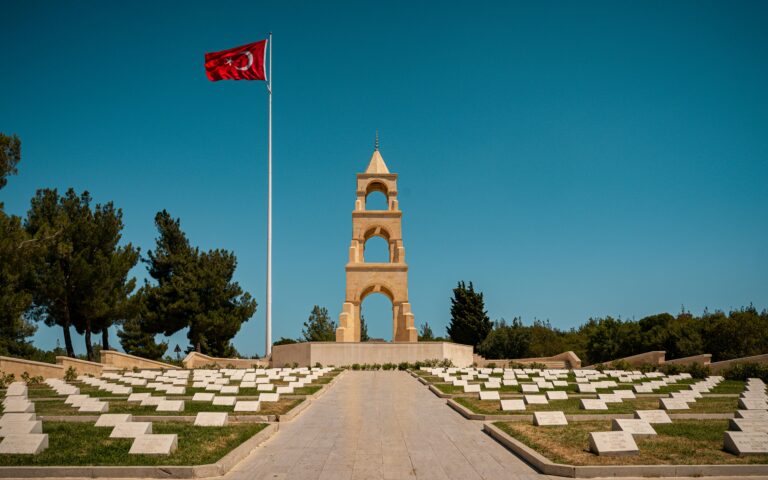
You’ll leave Istanbul early and drive southwest to the Gallipoli Peninsula, where the 1915 campaign left over 100,000 dead and permanently changed the national identities of Turkey, Australia, and New Zealand. Your guide walks you through the landing beaches, the trenches, the cemeteries, and the museum — not as a checklist, but as a connected narrative that makes sense on the ground.
After the ferry crossing to Canakkale, you’ll spend the night in this compact harbor town on the Dardanelles. Day two takes you to Troy — nine layers of civilization stacked on top of each other across 4,000 years, from the Bronze Age city that inspired Homer to the Roman settlement that came centuries later.
This is a round-trip from Istanbul. You leave the city, spend one night by the strait, and return the same way. Private vehicle, licensed guide, every entrance fee and ferry crossing covered. You bring comfortable shoes and whatever questions you have — your guide handles the rest.
Early morning pickup from your Istanbul hotel (typically around 6:00–6:30 AM). The drive to the Gallipoli Peninsula takes approximately four hours, with a comfort stop along the way.
Your guide leads you through the key sites of the 1915 campaign in chronological and geographic order:
Ferry across the Dardanelles to Canakkale. Check in and explore the waterfront at your own pace.
After breakfast, drive to the archaeological site of Troy — about 30 minutes from Canakkale.
Troy is not a single city. It is nine cities, built on top of each other over 4,000 years. Your guide walks you through the layers: the Bronze Age fortification walls (Troy II, where Schliemann controversially claimed to find “Priam’s Treasure”), the city most likely connected to Homer’s Iliad (Troy VI or VII, depending on which archaeologist you ask), and the Roman-era settlement (Troy IX) that survived into the early Byzantine period.
You’ll see the ramp gate, the sacrificial altars, the defensive walls, and the reconstructed Trojan Horse that marks the entrance. The guide connects the mythology to the archaeology — what we know, what we think we know, and what Schliemann got wrong.
After Troy, begin the return drive to Istanbul. Expect an evening arrival, with your driver dropping you at your hotel or the airport.
This itinerary works well for:
The Gallipoli Peninsula and Canakkale are among the most visited memorial and archaeological sites in the country, drawing visitors from Australia, New Zealand, and Europe year-round. You travel in a private vehicle with a licensed guide who knows the Dardanelles region firsthand — no public transport, no navigating unfamiliar roads on your own.
Light to moderate. Gallipoli involves walking between memorial sites on mostly flat to gently rolling terrain — some paths are unpaved. Troy is a compact site with some uphill sections. Comfortable walking shoes are recommended but no special fitness is required.
Yes. Want to spend more time at specific Gallipoli memorials? Add a stop in Canakkale? Skip Troy and extend Gallipoli to a full day and a half? Tell us your priorities and we’ll adjust.
The dawn service at ANZAC Cove draws thousands of visitors from Australia, New Zealand, and beyond. If you want to attend, plan well ahead — accommodation and transport book out months in advance. We can arrange the logistics, but early booking is essential for this date.
April through June and September through November. Spring is particularly meaningful at Gallipoli, with wildflowers covering the hillsides above the coves. Summer is hot. Winter is quiet but can be cold and wet on the peninsula.
From
€
/per person