The Great Theater at Ephesus is the first thing you see and the last thing you forget. It sits at the western end of the ancient city’s main axis — the Marble Street — carved into the slope of Mount Pion (Panayır Dağı), its 25,000 seats rising in a semicircle from the orchestra floor to a height of approximately 30 meters. When you stand at the top row and look down, the scale registers physically: this space held the entire adult population of one of the Roman Empire’s largest cities. When you stand at the center of the orchestra and speak, the acoustics carry your voice to the upper rows without amplification. The engineering that achieved both — structural and acoustic — was completed in the first century AD and has not been improved upon in the two thousand years since.
The theater was not only a performance venue. It was Ephesus’s assembly hall, its political arena, and occasionally its site of public confrontation. The most famous incident occurred around 54 AD, when the Apostle Paul’s preaching against the worship of Artemis provoked a riot among the city’s silversmiths, who made their living selling silver shrines of the goddess. The crowd dragged Paul’s companions into the theater and chanted “Great is Artemis of the Ephesians” for two hours. The account is in the New Testament, Acts 19:23-41, and it is one of the most vivid descriptions of civic life in the ancient world.
The Structure
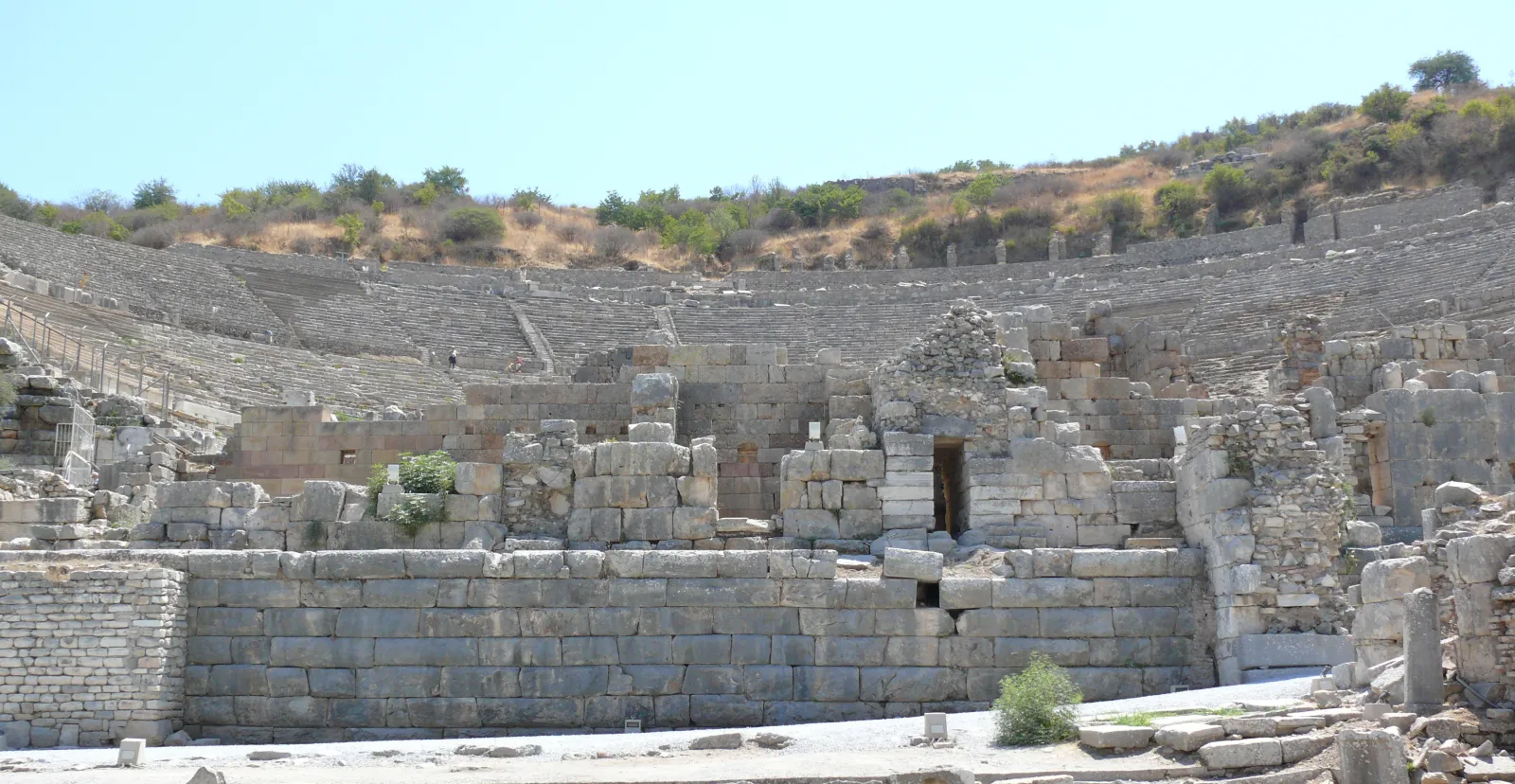
The theater was originally built in the Hellenistic period (third century BC) but was substantially enlarged and rebuilt under the Roman emperors Claudius, Nero, and Trajan between approximately 41 and 117 AD. The Roman expansion tripled the seating capacity and added the elaborate stage building (scaenae frons) — a multi-story facade of columns, niches, and statuary that served as backdrop and sound reflector for performances.
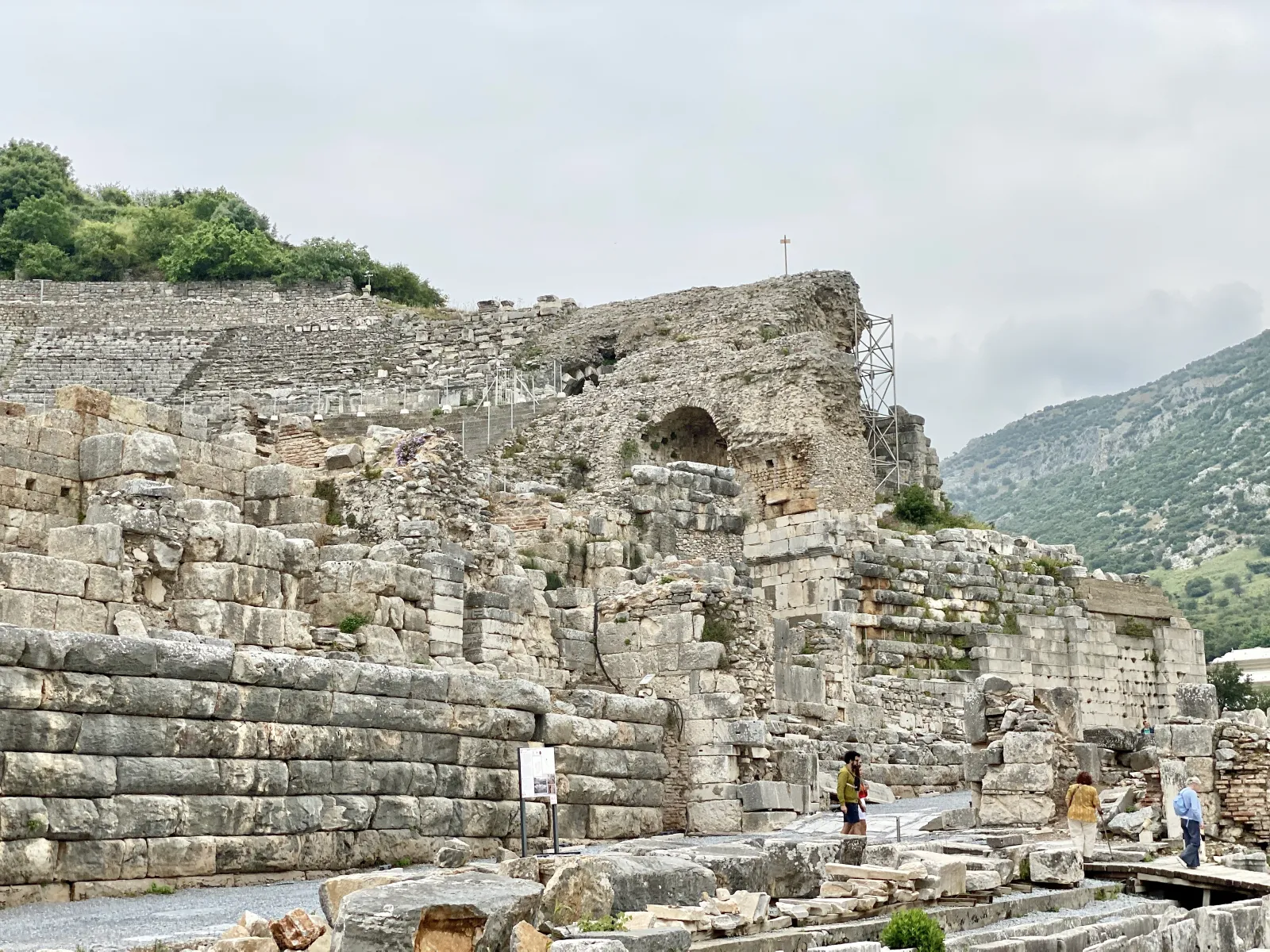
The seating is divided into three horizontal sections (diazomata), each separated by a walkway, and into vertical wedges (cunei) separated by stairways. The lowest section was reserved for dignitaries and priests. The middle section served the general citizenry. The upper section, added during the Roman expansion, extended the capacity to its maximum. Stone seats were carved with inscriptions marking reserved sections for guilds, associations, and civic officials — the ancient equivalent of corporate boxes.
The orchestra — the circular floor at the base — measures approximately 25 meters in diameter. In the Greek period, the chorus performed here. In the Roman period, it was adapted for gladiatorial combat and animal fights, with a wall added around the perimeter to protect front-row spectators. Drainage channels beneath the orchestra carried away water — the space could be flooded for aquatic spectacles, a feature documented at several major Roman theaters.
The stage building has partially collapsed, but the remaining fragments show three stories of columns in the Corinthian order, with niches that held statues of gods, emperors, and benefactors. Five doorways connected the stage to backstage areas. The facade functioned acoustically as well as visually — the columns and niches broke up sound reflections, distributing the performers’ voices evenly across the seating tiers.
The Acoustics
Stand at the center of the orchestra and clap your hands. The sound reaches every seat. Drop a coin on the stone floor. The click is audible at the top row. This is not folklore — it is engineering. The semicircular seating geometry focuses sound toward the upper rows. The stone surfaces reflect rather than absorb. The slope of the hillside, which the builders used rather than fought, creates a natural amplification chamber. The stage building’s facade added controlled reflection.
Modern acoustic studies of ancient theaters, including Ephesus, have shown that the limestone seating surfaces act as acoustic filters — they suppress low-frequency background noise (wind, crowd shuffling) while reflecting the higher frequencies of the human voice. The effect is that speech carries clearly even in a space designed for 25,000 people. No technology was required. The geometry and the material did the work. When I bring travelers to this theater, I always ask one person to stand at the center of the orchestra and speak in a normal voice — everyone else climbs to the top row. The look on their faces when they hear the words clearly is the moment Ephesus becomes real.
The Harbor Street
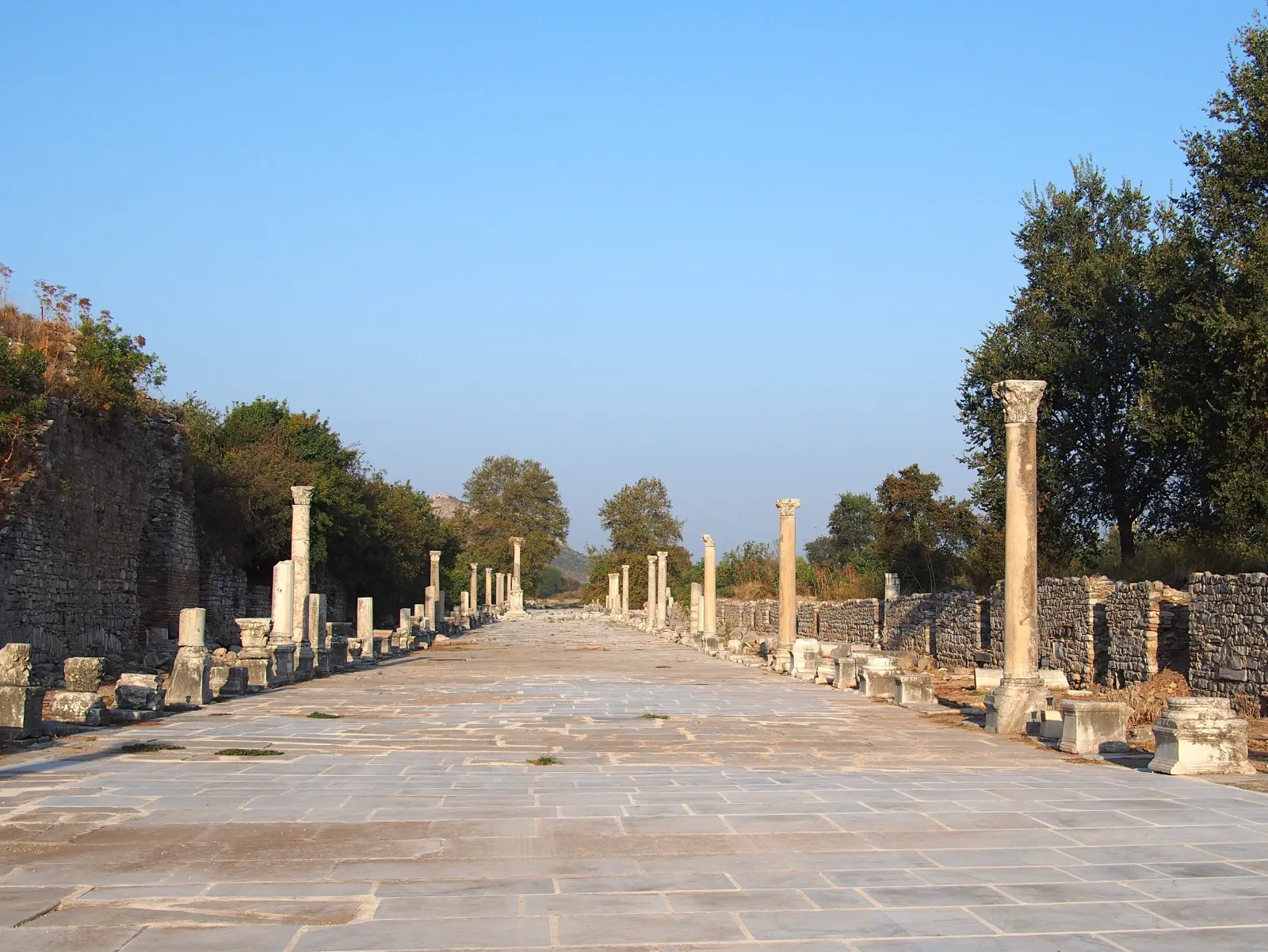
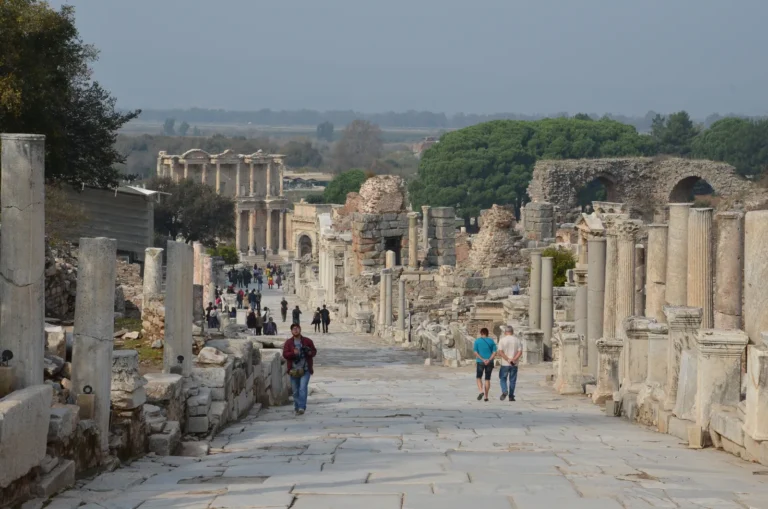
The theater faces west, and its main entrance opens onto Harbor Street (Arcadiane) — a 530-meter colonnaded avenue that once ran from the theater directly to the ancient harbor. The street was paved in marble, lined with columns, and lit at night by oil lamps — one of the first street-lighting systems in the ancient world. The harbor has long since silted up (the coastline is now several kilometers to the west), but Harbor Street survives as a wide, column-lined promenade that gives you the approach the ancient audience would have taken: walking from the waterfront toward the theater, the seats rising ahead.
Visiting
The Great Theater is inside the Ephesus archaeological site and is included in the general admission ticket.
Getting there: Ephesus is approximately three kilometers from the town of Selçuk and twenty kilometers from Kuşadası. Most visitors arrive on guided tours from Kuşadası, Selçuk, or İzmir. The main entrance to the archaeological site is at the upper (Magnesia) gate; the theater is near the lower (harbor) gate. Walking the site from the upper gate to the theater takes approximately forty-five minutes to an hour, covering the full length of Curetes Street and the Marble Street. The theater pairs naturally with the Library of Celsus and the Istanbul/Cappadocia/Ephesus itinerary for travelers planning multi-city routes.
How much time: The theater itself takes twenty to thirty minutes — time to climb the seats, test the acoustics, take in the view from the top, and absorb the scale. The full Ephesus site requires two to three hours.
When to go: Early morning (opening time) or late afternoon to avoid the midday heat and the densest tour group traffic. The theater faces west, so afternoon light illuminates the seating and the views toward the former harbor.
Accessibility: The orchestra level is accessible without steps. The seating tiers require climbing ancient stone stairs — steep, uneven, and without handrails. When I guide travelers with limited mobility, I suggest staying at the orchestra level and sending a companion to the upper rows for the acoustic test — you still hear it, but the return voice confirms how far the sound carries.
Official resource: Ephesus Archaeological Museum — Ministry of Culture
Plan Your Ephesus Visit
The Great Theater is where Ephesus stops being ruins and becomes a city — a space built to hold everyone, designed so everyone could hear. If you would like to visit Ephesus with a private guide who can explain the engineering, tell the stories, and shape the route around your pace, tell us what interests you and we will build the day around it.