The cliff face at Myra looks like an apartment building carved by someone who expected their tenants to have wings. Rows of Lycian rock tombs — house-type facades with columns, pediments, and relief carvings — are cut directly into the vertical rock face, stacked several stories high. They have been there for roughly 2,400 years, and they remain among the most visually striking examples of Lycian funerary architecture anywhere on the coast.
At the base of the cliffs, a Roman theater sits in the familiar semicircular shape, its seats looking out at the tombs across a narrow gap. And in the modern town below, a church dedicated to St. Nicholas marks the place where a 4th-century bishop performed the acts of generosity that, over the centuries, transformed him into the most recognized gift-giving figure in the world.
Demre is a small agricultural town on the central Mediterranean coast of Turkey, roughly 150 kilometers southeast of Fethiye. It sits on a flat alluvial plain — the town is famous locally for its greenhouse agriculture, particularly tomatoes — surrounded by the Taurus Mountain foothills. The ancient Lycian city of Myra occupied the hillside above what is now Demre, and its remains are the reason most visitors come.
The Rock Tombs
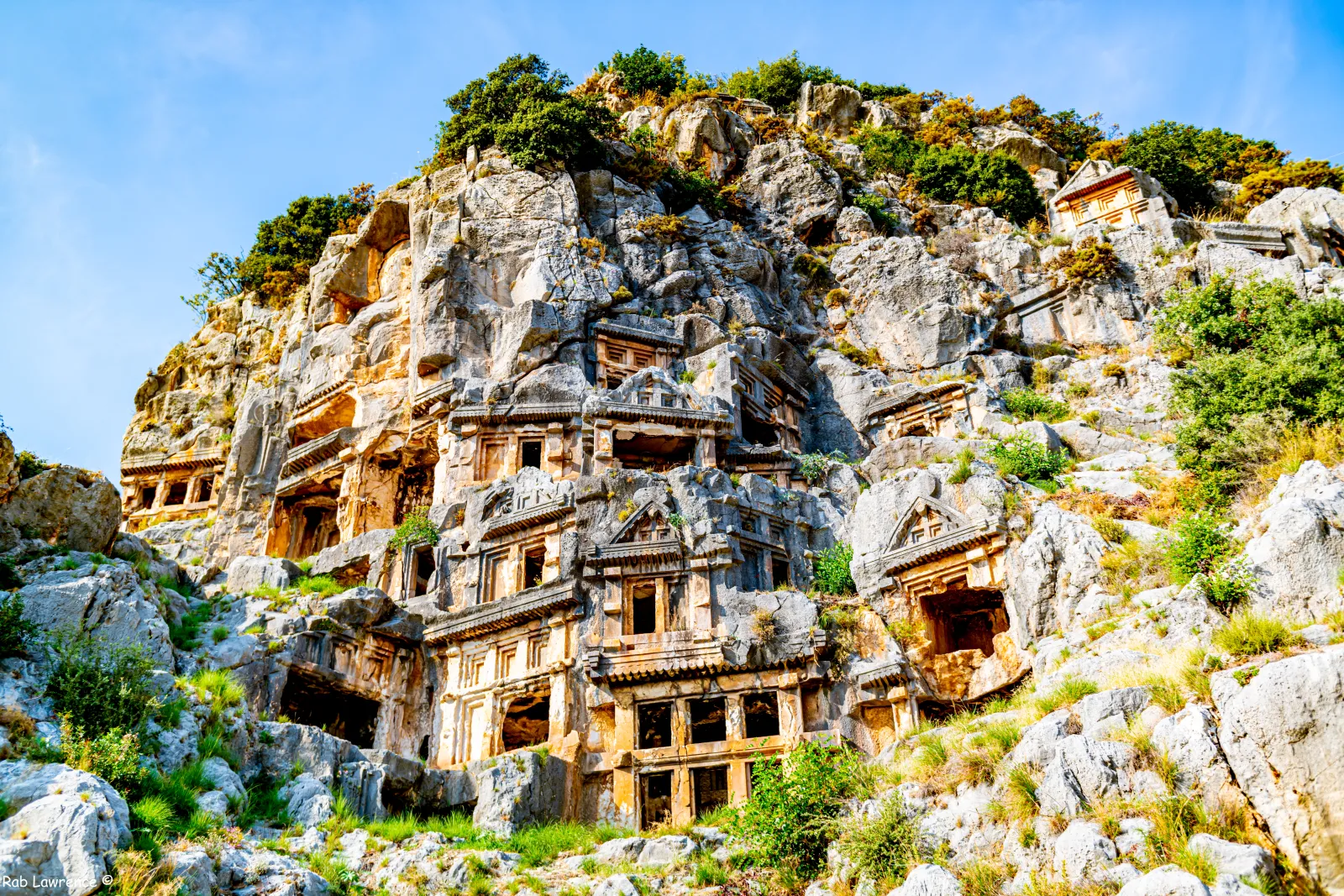
The rock-cut tombs of Myra are carved into two main cliff faces — the river necropolis and the ocean necropolis — with the river necropolis being the more extensive and better preserved. These are not simple cave burials. The Lycians carved elaborate facades into the rock: temple fronts with Ionic columns, triangular pediments, wooden-beam imitation ceilings, and relief panels depicting scenes from daily life, mythology, and battle.
The craftsmanship is precise — the stone is worked to imitate timber construction, with carved beam ends, wooden-plank ceiling patterns, and door frames that replicate domestic architecture in permanent stone.
The tombs date primarily from the 4th century BC, when Myra was a prominent city in the Lycian League — a federation of city-states that practiced an early form of representative democracy, now a UNESCO World Heritage Site. In Lycian culture, the dead were placed in elevated positions, and the grander the tomb, the higher the social status. The cliff face at Myra, with its vertical display of carved facades, functioned as a kind of visible social register: your standing in life was literally etched into the rock for all to see.
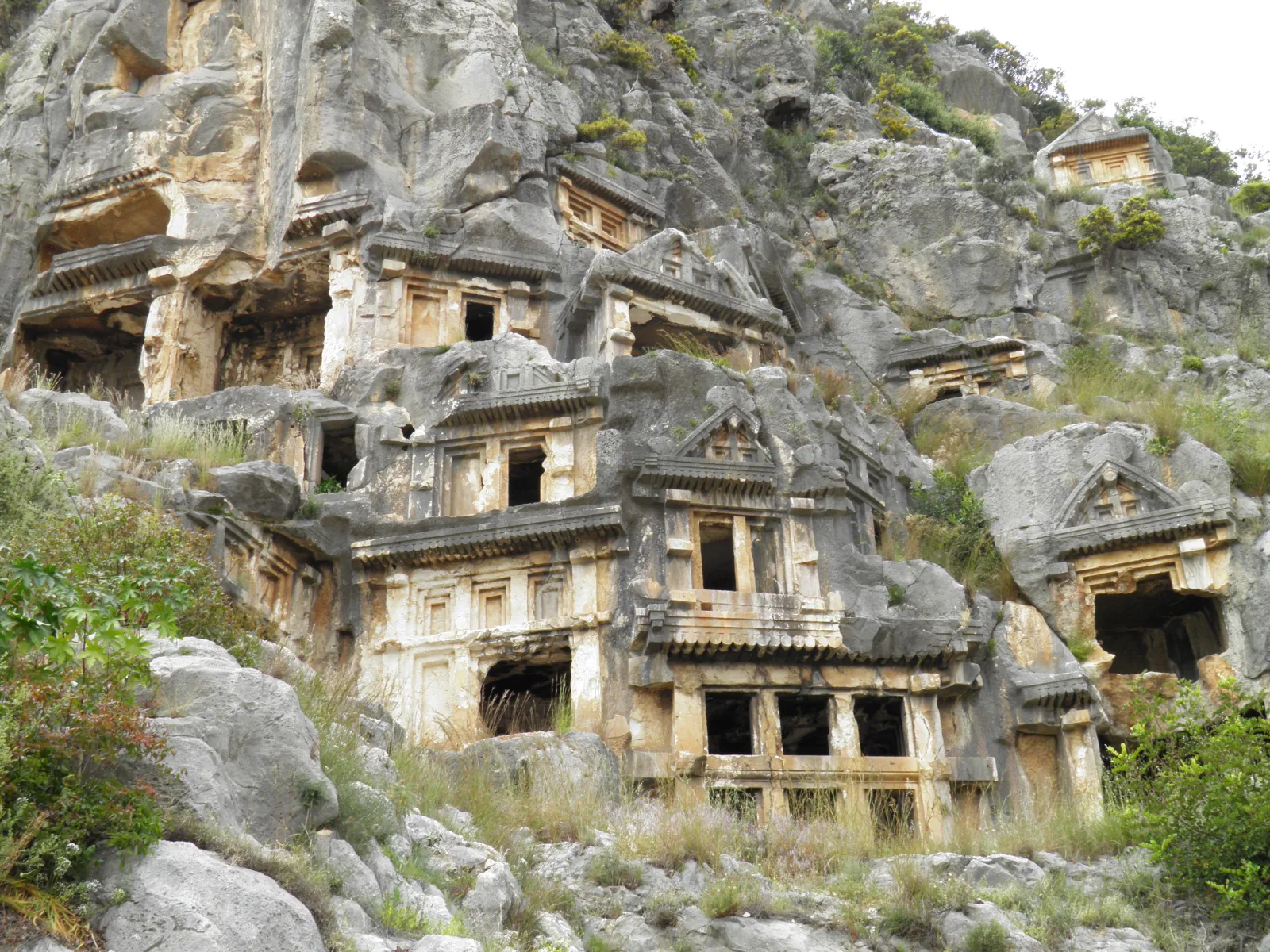
When I bring travelers here, the first reaction is almost always silence — people stand at the base of the cliffs and simply look up. You notice details that photographs do not convey: the variation in scale (some tombs are small single chambers, others are multi-room complexes), the weathering patterns that have softened some facades while leaving others sharp, and the occasional fragment of paint that suggests these tombs were once brightly colored. The Lycians did not leave their dead in bare stone — the facades were painted in reds, blues, and yellows that have mostly vanished over two millennia but occasionally survive in sheltered crevices.
The Roman Theater
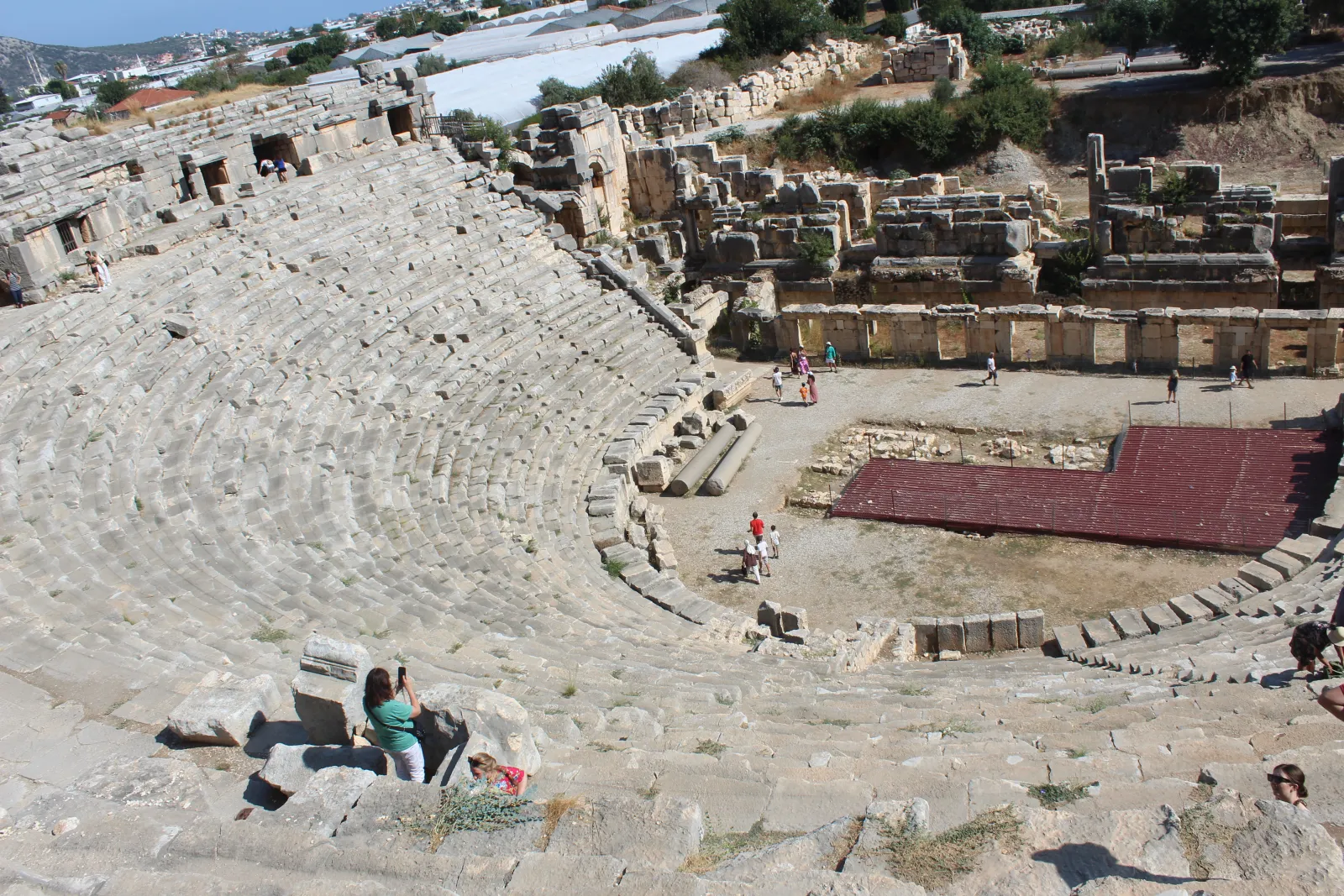
Adjacent to the rock tombs, Myra’s Roman theater is well preserved and gives a clear picture of the city’s scale and prosperity during the Roman period. The theater seats approximately 11,000 — substantial for any ancient city — and features the typical Roman design: a semicircular seating area (cavea) carved into the hillside, an orchestra floor, and a stage building (scaenae frons) that once rose multiple stories with columns, niches, and carved decoration.
The theater was built during the 2nd century AD, when Myra was the capital of the Lycian League under Roman administration. Its size indicates a city of regional importance — this was not a village amphitheater but a major performance and assembly space. Theatrical masks carved in relief on the surviving stage blocks hint at the entertainment that filled these seats: drama, comedy, gladiatorial events, and the public gatherings that defined Roman civic life.
What makes Myra’s theater distinctive is its relationship to the rock tombs. The theater faces the cliff with its rows of carved tombs, creating a visual conversation between the living and the dead — Roman entertainment culture quite literally performed under the gaze of Lycian ancestors. It is an effect that you notice immediately when sitting in the theater seats and looking past the stage toward the rock face.
The Church of St. Nicholas
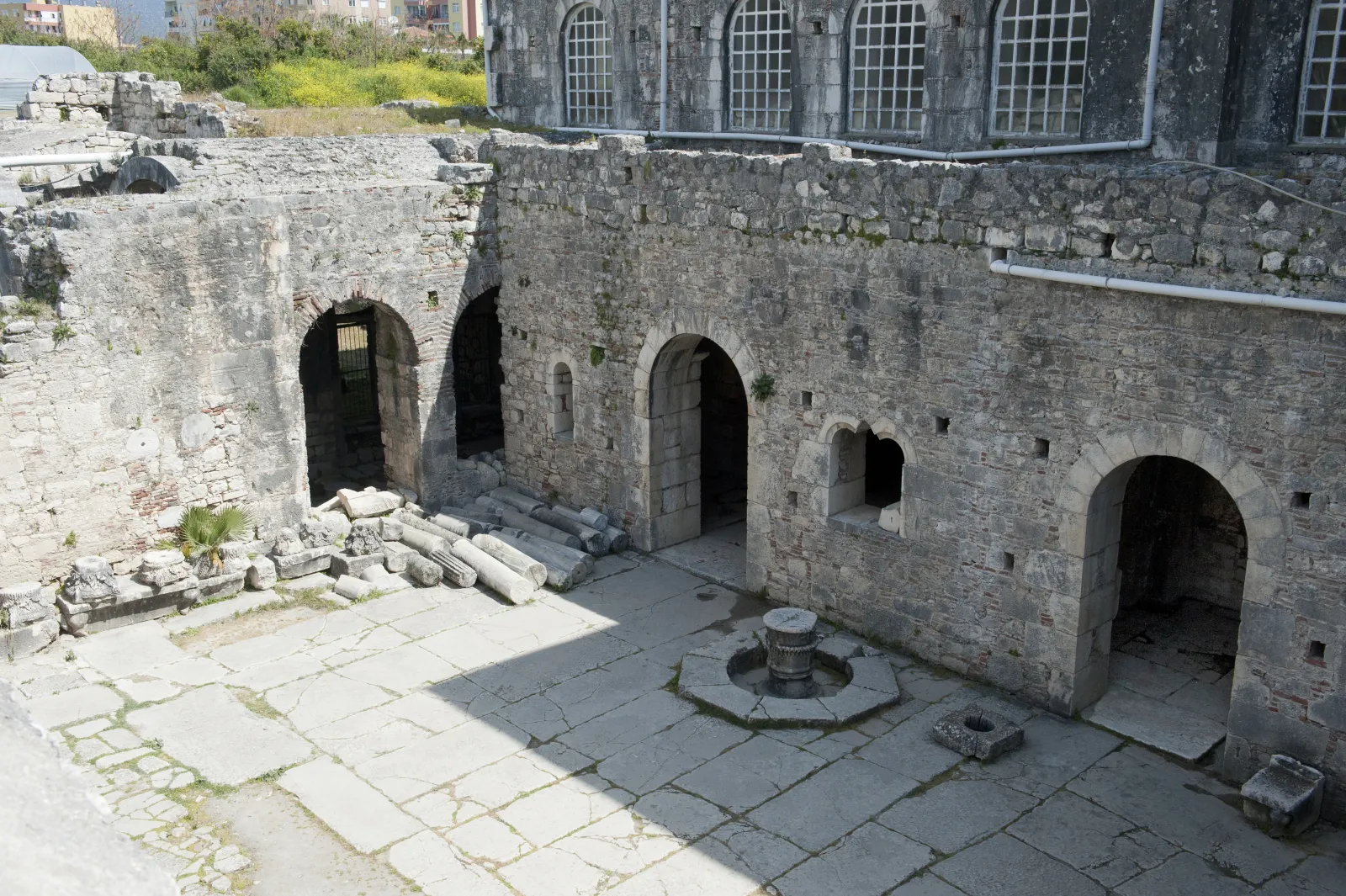
In the center of modern Demre, below the level of the current streets (the town’s ground level has risen over centuries of alluvial deposits), sits the Church of St. Nicholas. This is not a connection to legend — it is a direct historical link. Nicholas was the bishop of Myra in the early 4th century AD. He was born in Patara (another Lycian city, roughly 80 kilometers west) around 270 AD, became bishop of Myra, attended the Council of Nicaea in 325 AD, and died around 343 AD. He was buried in Myra, and the church that bears his name was built over his tomb.
The historical Nicholas was known for anonymous gift-giving — the most famous story involves him secretly providing gold for the dowries of three poor sisters, saving them from destitution. He was also known for protecting the innocent, sailors, and children. Over the centuries following his death, these stories were embroidered, combined with Norse and Germanic winter traditions, filtered through Dutch Sinterklaas customs, and eventually crystallized into the modern Santa Claus figure. The journey from a 4th-century Turkish bishop to a red-suited figure in a flying sleigh is one of the most remarkable transformations in cultural history.
The church itself has been rebuilt several times — the current structure dates primarily from the 8th century, with later restorations. Inside, you can see Byzantine-era floor mosaics, frescoes (some damaged, some partially restored), and the sarcophagus where Nicholas’s remains were kept until 1087, when Italian merchants from Bari removed most of the bones. The sarcophagus remains in place, and ongoing restoration work (a major project has been underway in recent years) continues to uncover and preserve the church’s architectural layers.
The church is below modern street level — you descend steps to enter — which gives it an atmospheric, slightly subterranean quality. The layers of construction visible in the walls tell the story of repeated damage (earthquakes, Arab raids) and reconstruction over 1,700 years.
The Town of Demre
Modern Demre is not a tourist town in the way that Fethiye or Kas are. It is a working agricultural center, and its economy runs on greenhouses — rows of glass and plastic structures that produce tomatoes, peppers, and other vegetables year-round. The visual contrast between ancient Lycian rock tombs and plastic-covered greenhouses is jarring but honest: this is a place where history and daily economic life coexist without pretense.
The town has basic restaurants and cafes but limited tourist infrastructure. Most visitors come for the archaeological sites and the church, spend 2 to 3 hours, and continue to other destinations. For those with more time, Demre’s ordinariness has its own appeal — a cup of tea at a local cafe, a walk through the town center, and the experience of a Turkish agricultural town going about its business without performing for tourists.
Practical Information
Getting there: Demre is on the D400 highway, approximately 150km from Fethiye (about 2.5 hours by car) and 35km from Kas (about 45 minutes). The ancient Myra site is at the northern edge of town, signposted from the center. The Church of St. Nicholas is in the town center.
How much time: Allow 1 to 1.5 hours for the Myra rock tombs and theater, and 30 to 45 minutes for the Church of St. Nicholas. A half-day visit covers both sites comfortably with time for tea in town. The sites are about 2km apart.
When to go: The sites are open year-round. Spring (April-May) and autumn (September-November) offer the most comfortable temperatures for walking the outdoor ruins. Summer is very hot — temperatures in Demre regularly exceed 35°C — and morning visits are strongly recommended. The church is partially shaded and cooler than the outdoor sites.
Entrance fees: Separate entrance fees for Myra archaeological site and the Church of St. Nicholas (each approximately 200-300 TL as of 2025, subject to change). Museum Pass Turkey covers both sites.
Combining with other visits: Demre pairs naturally with Kekova (35km east — sunken city boat tour) for a full day. When I plan a Lycian coast day trip, the most rewarding sequence is Myra and the Church of St. Nicholas in the morning, then a drive to Ucagiz for a Kekova boat tour in the afternoon. Patara (St. Nicholas’s birthplace, with its own beach and ruins) is about 80km west.
Demre brings three distinct layers of history into a single small town — Lycian, Roman, and early Christian — and the St. Nicholas connection adds a dimension that resonates with visitors regardless of their interest in archaeology.
Plan Your Fethiye Visit
If you want us to include Demre and Myra in a day trip from Fethiye, we can build it into an itinerary that suits your pace.
Frequently Asked Questions
Is the Church of St. Nicholas in Demre really connected to Santa Claus?
Yes, directly. St. Nicholas was the historical bishop of Myra (modern Demre) in the 4th century AD. His acts of generosity — particularly anonymous gift-giving to the poor — became the foundation of the Santa Claus tradition over the following centuries. The church in Demre was built over his original tomb. His bones were removed to Bari, Italy in 1087, but the sarcophagus remains in the church.
Are the Myra rock tombs the best in Lycia?
They are among the most visually impressive because of their density, scale, and preservation. The cliff face at Myra has the highest concentration of carved temple-facade tombs in a single location. Other significant Lycian tomb sites include Dalyan (Kaunos), Pinara, Tlos, and Fethiye’s own Amintas tomb — but Myra’s vertical display is the most photogenic and accessible.
How much time do you need in Demre?
A minimum of 2 hours covers both the Myra rock tombs/theater and the Church of St. Nicholas. Three hours allows a more comfortable pace including a tea break. Most visitors combine Demre with other stops — a full day might include Myra in the morning and Kekova boat tour in the afternoon.
Is Demre too far for a day trip from Fethiye?
It is a long day but very doable — about 2.5 hours each way by car. The most efficient approach combines Demre with Kekova (which is on the way) for a full-day excursion: Myra and St. Nicholas Church in the morning, Kekova boat tour in the afternoon, return to Fethiye in the evening. With a private guide and driver, the logistics are straightforward.
Can you see inside the Lycian rock tombs?
Most tombs are not directly accessible — they are carved into cliff faces at heights that prevent casual entry. However, some lower tombs are visible from close range, and you can see into their chambers from the ground. The carved facades, reliefs, and architectural details are fully visible from the walkways below the cliffs. Binoculars can be helpful for appreciating details on the higher tombs.
Can you combine Demre with a Kekova boat tour in one day?
Yes, and it is one of the best day trips on the Lycian coast. Myra and the Church of St. Nicholas take about two hours in the morning. From Demre, it is a 35-minute drive to Ucagiz, where Kekova boat tours depart. The boat tour takes three to four hours. A private guide and driver make the logistics seamless — you finish the day having seen Lycian tombs, a Roman theater, a Byzantine church, and a sunken city, all in one arc along the coast.