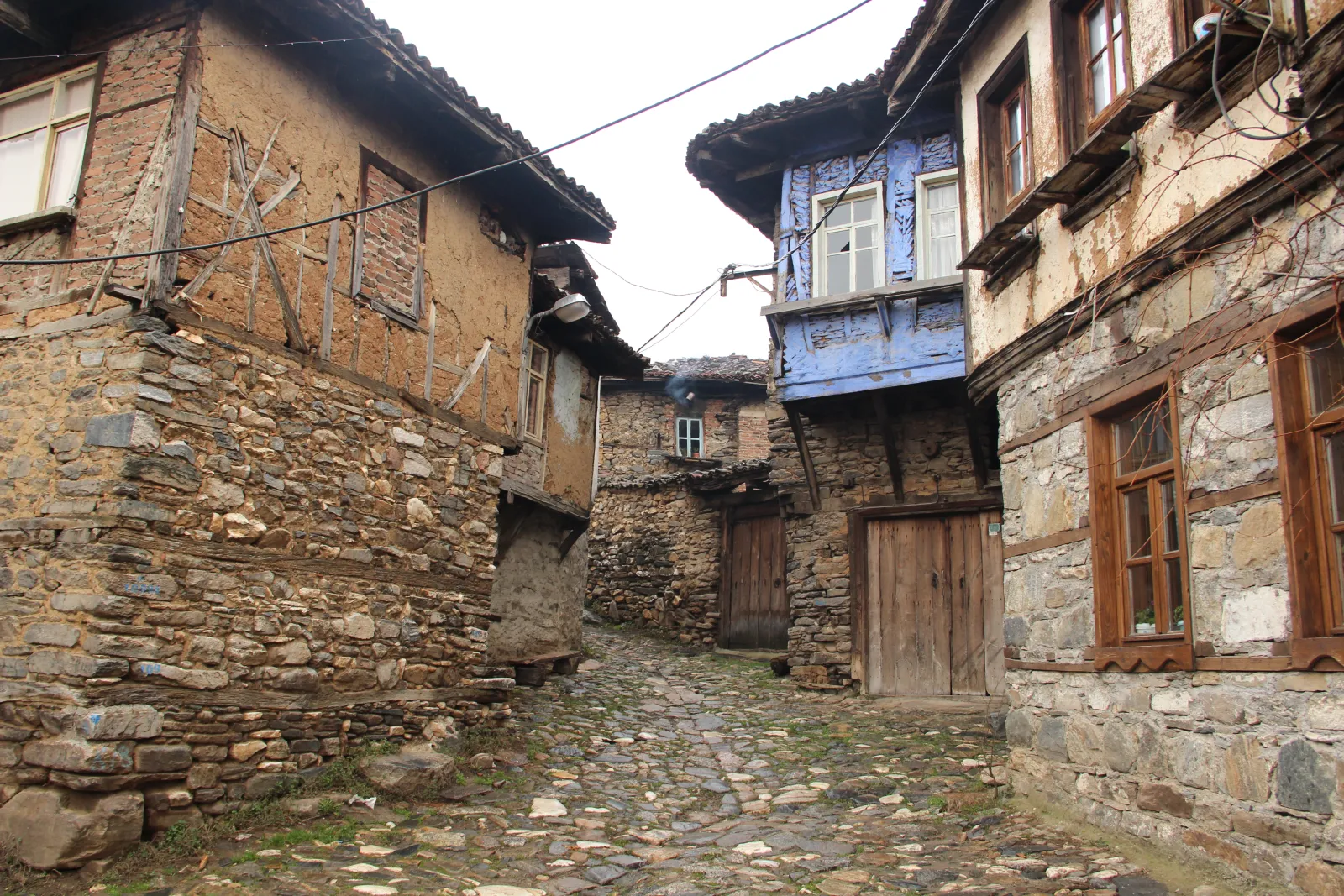
The street is barely wide enough for two people to walk side by side. The houses lean in slightly from both sides, their upper floors extending outward on timber brackets, narrowing the sky to a strip of blue overhead. The walls are a patchwork: stone foundations, timber frames filled with adobe or brick, painted in faded earth tones — ochre, terracotta, dusty blue, the occasional deep burgundy. Grape vines climb the facades. A cat watches you from a windowsill. Somewhere down the street, someone is making gözleme on a wood-fired sac, and the smell of dough and butter reaches you before you see the kitchen.
This is Cumalıkızık, and it has looked more or less like this since the early 14th century.
A Village That Survived
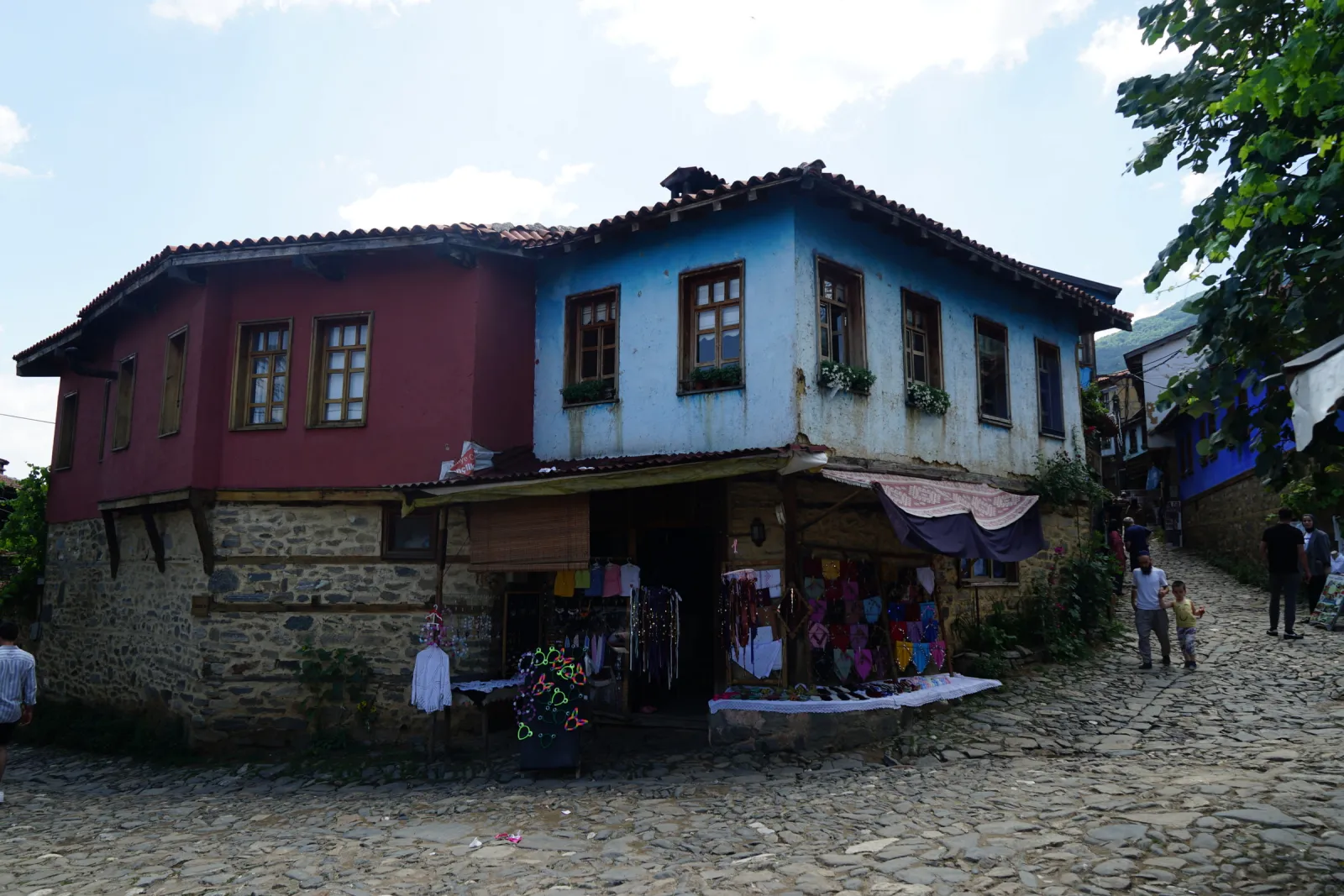
Cumalıkızık is a small village on the lower slopes of Uludağ, about 10 kilometers east of Bursa’s city center. It was founded in the early Ottoman period — most likely in the 1330s or 1340s — as one of several “kızık” villages established to support the newly conquered capital. The Ottoman system allocated villages to specific functions: some provided soldiers, some grew food, some supplied timber. Cumalıkızık’s role and exact founding date are debated by historians, but the settlement has been continuously inhabited since the early Ottoman era.
What makes Cumalıkızık exceptional is not its age — there are older villages in Turkey — but its preservation. The village retains approximately 270 original Ottoman-era houses, of which around 180 are in good to fair condition. The cobblestone streets, the water channels, the timber-frame construction with its characteristic projecting upper stories, and the overall layout of the settlement have survived substantially intact through seven centuries.
This is not a reconstruction or an open-air museum. People live here. About 600 residents call Cumalıkızık home. They live in houses that were built for their ancestors, on streets that were laid out before the Ottomans took Constantinople. The village exists in a state of tension between preservation and daily life — UNESCO-listed heritage that also needs functioning plumbing, which creates a particular kind of authenticity that purpose-built heritage sites cannot replicate.
In 2014, Cumalıkızık was inscribed on the UNESCO World Heritage List alongside the broader “Bursa and Cumalıkızık: the Birth of the Ottoman Empire” designation. The listing recognized the village as one of the best-preserved examples of an early Ottoman rural settlement — evidence of how the Ottoman system organized its territory and housed its people at the empire’s very beginning.
The Architecture: How an Ottoman Village Was Built
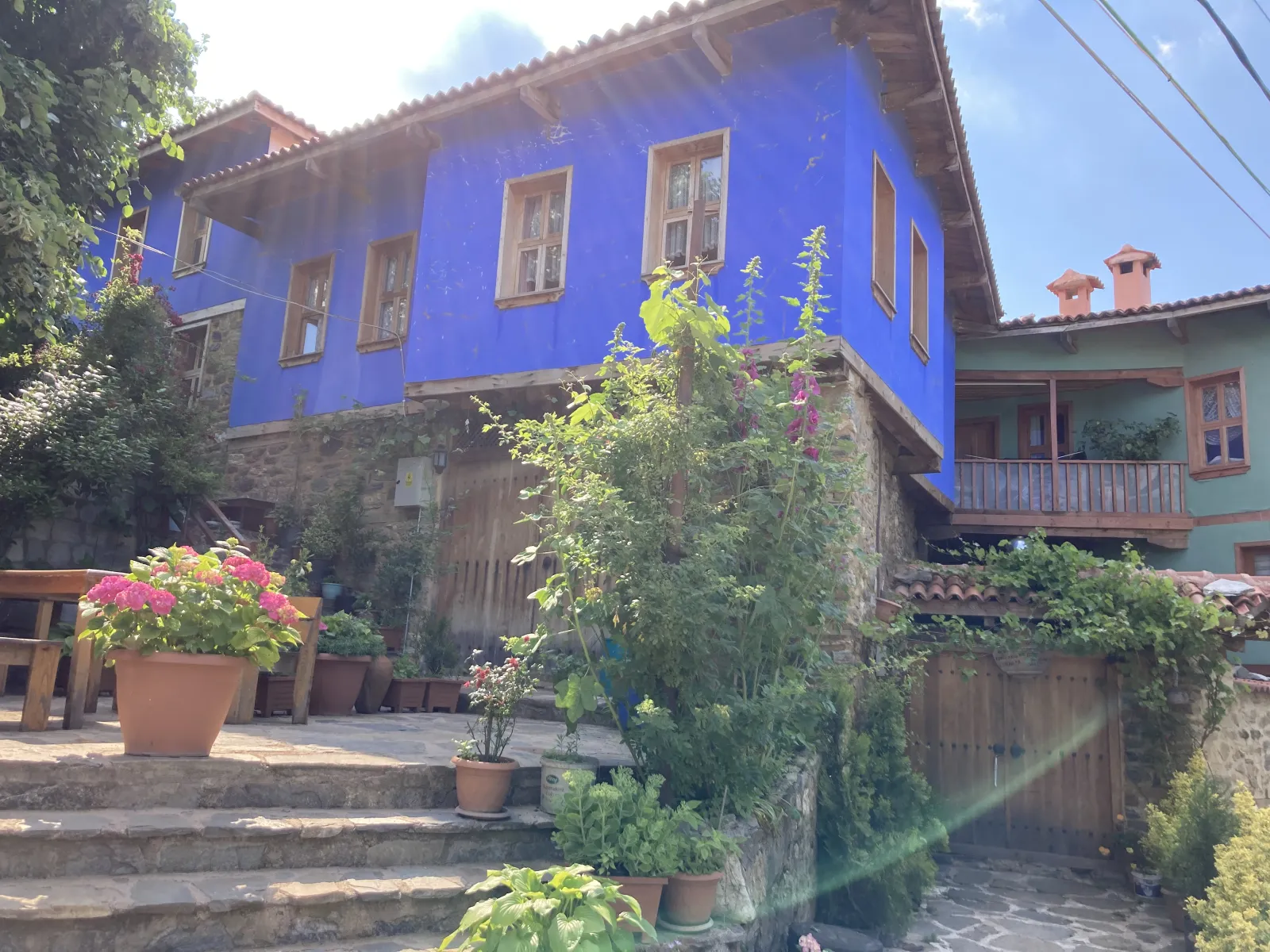
The houses of Cumalıkızık follow a construction logic that was standard across Ottoman Anatolia but is rarely preserved this completely. The ground floor is built of stone — rubble or roughly cut blocks set in mud mortar, forming thick walls that hold heat in winter and stay cool in summer. This floor typically housed storage, animals, and work spaces.
The upper floor — the living quarters — is built of timber frame. The structural skeleton is a grid of wooden beams, with the spaces between them filled with adobe (sun-dried mud brick), fired brick, or wattle and daub. The timber frame is visible on the exterior, creating the striped pattern of wood and filler that gives the houses their distinctive appearance.
The upper stories project outward from the building’s footprint, cantilevered on wooden brackets over the street below. This is not decorative — it serves practical purposes. The projection adds floor space to the living quarters without expanding the building’s foundation. It provides shade to the street below. And in a narrow village where every square meter of ground-level space matters, it allows the houses to be close together at the base while still providing room upstairs.
The roofs are traditionally covered with flat tiles — the wide, overlapping clay tiles that you see across Ottoman-era Anatolia. The facades are plastered and painted, with colors drawn from local earth pigments. The palette is muted: yellows and ochres from iron-rich clays, blues from ground minerals, reds and terracottas from iron oxide. Over time, the plaster wears and the underlying construction becomes visible, adding layers of texture to the facades.
Windows are typically wooden-framed with shutters. Some houses retain their original lattice screens — the kafes — which allowed women to look out without being seen from the street, a common feature of Ottoman domestic architecture. Doors are wooden, often with carved or decorated lintels, and many bear the marks of centuries of use: worn thresholds, patched hinges, replacement planks set into original frames.
Walking the Village
Cumalıkızık is small enough to walk end to end in 20 minutes, but doing it that quickly would miss the point. The village reveals itself in details: the water channel that runs along the main street, fed by mountain springs and used for washing and irrigation; the communal bread oven (fırın) where village women still bake; the small mosque at the center of the settlement; the occasional house where the door is open and you can see through to a courtyard garden.
The main street — the one with the breakfast tables and the small shops — is the village’s commercial spine. This is where the gözleme kitchens operate, where local women sell homemade jams and dried herbs, and where the weekend visitors concentrate. The side streets are quieter and often more interesting. Turn off the main path and you find yourself between houses that have not been touched for tourism — no signs, no painted facades, just the bare architecture of an Ottoman village aging in place.
Some houses have been restored and opened to visitors as small museums or guest houses. The restoration quality varies. The best examples maintain the original materials and proportions while adding discreet modern infrastructure. Others have been over-restored, with fresh paint and new timber that reads slightly too clean against the patina of the surrounding houses. The contrast is educational in its own way — it shows you what “restoration” means in practice and why preservation is more difficult than it looks.
The village sits on a gentle slope, with Uludağ rising behind it to the south. When I plan a Bursa day trip, I always start here in the morning — the mountain air, the sound of running water from the channels, and the views upslope to forested hillsides set the tone for the rest of the day. In spring, the fruit trees in the village gardens bloom — cherry, plum, mulberry — adding color to the earth-toned facades.
The Breakfast Culture
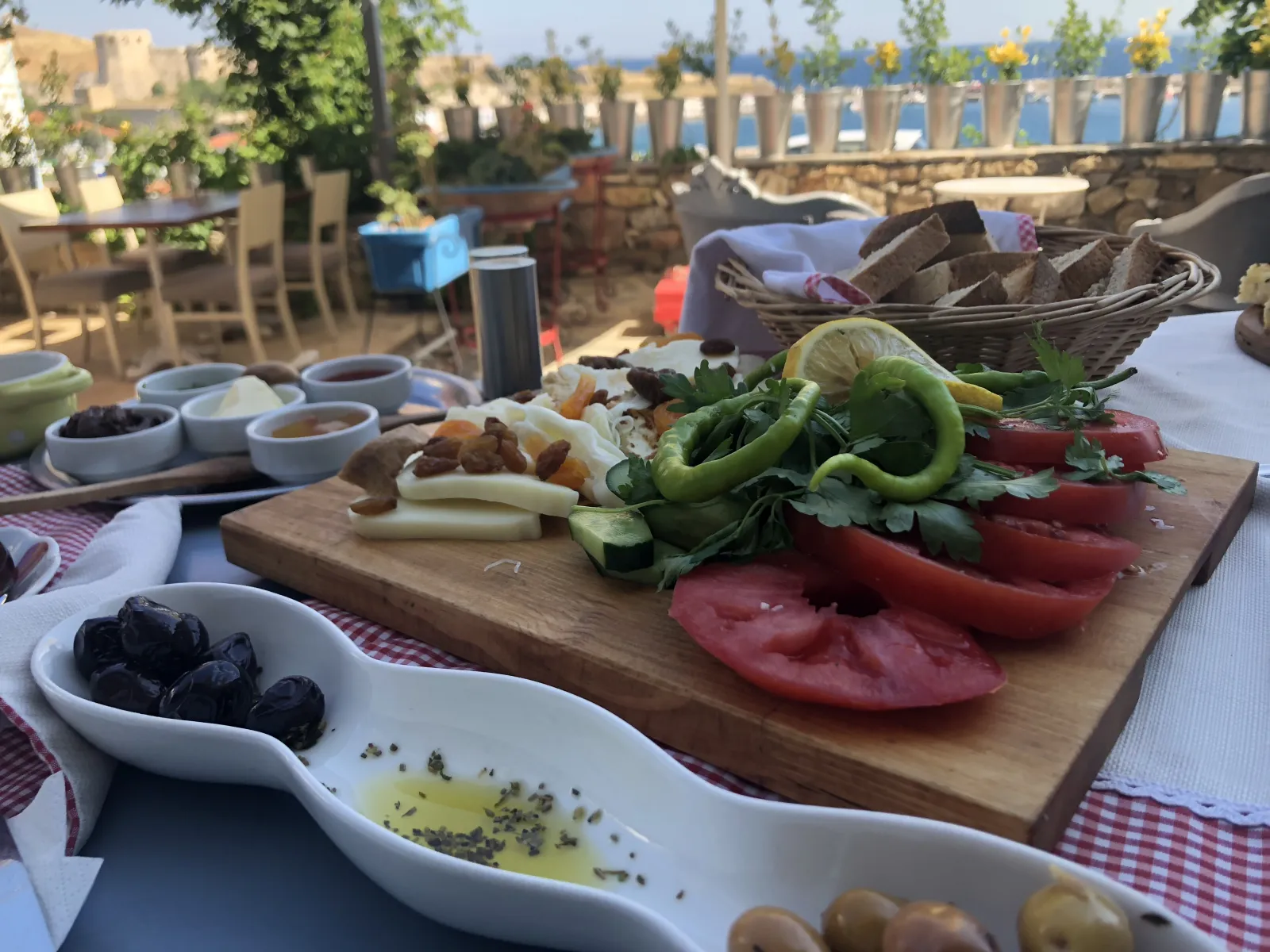
Cumalıkızık is famous throughout Turkey for its breakfast — köy kahvaltısı, village breakfast — and on weekends, families drive from Bursa and beyond specifically to eat here. The breakfast is not a restaurant concept. It is an extension of village food culture: women prepare the food from their own kitchens or from small family-run kitchens along the main street, using ingredients that are either homegrown or sourced from the immediate area.
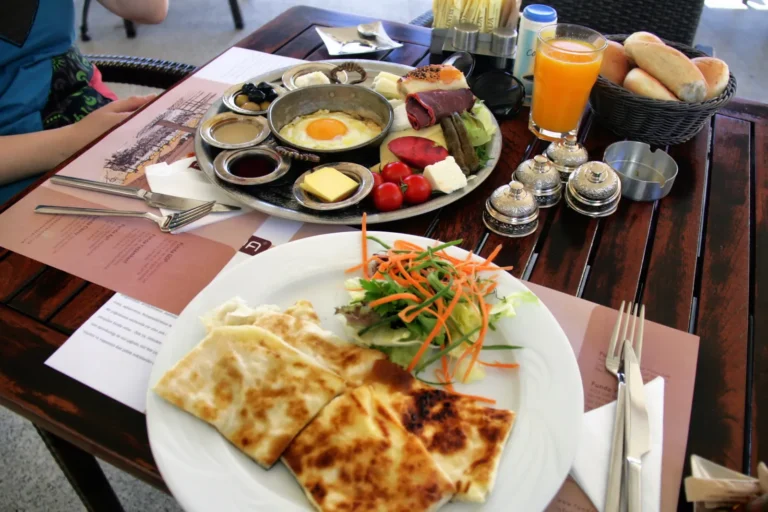
What arrives at your table is a spread. Gözleme — thin flatbread cooked on a convex iron plate (sac) and filled with cheese, spinach, or potato — is the centerpiece. Around it: homemade fruit jams (mulberry, fig, quince, rose), village butter, fresh cream (kaymak), local cheeses, olives, tomatoes and cucumbers, fresh herbs, eggs cooked in butter, and honey from mountain apiaries. The bread is baked that morning. The tea is bottomless.
The experience is as much social as culinary. You sit at wooden tables under grape arbors or in courtyard gardens, surrounded by the architecture of the village, with other tables filling up around you. When I bring travelers here, the breakfast is almost always the part of the Bursa day they talk about most — not the mosques, not the history, but the gözleme and the tea and the unhurried morning in a 700-year-old village. No one is timing your meal. The second and third glasses of tea are assumed.
If you are visiting on a weekday, the village is quieter and the breakfast experience more intimate — fewer tables, less bustle, and often a chance to talk with the women preparing the food. Weekends, particularly Saturday and Sunday mornings in spring and autumn, are lively but busy. Arriving before 10:00 AM on any day gives you the best combination of freshness and calm.
The UNESCO Context
Cumalıkızık’s UNESCO inscription is part of a broader designation: “Bursa and Cumalıkızık: the Birth of the Ottoman Empire.” The listing covers not just the village but the key Ottoman monuments in Bursa — the Grand Mosque, the Green Mosque and Green Tomb, the Muradiye complex, and others. Together, they represent the earliest phase of Ottoman urban and rural planning: the city where the empire was founded and the village system that supported it.
The UNESCO designation has brought attention and some tourism infrastructure — signage, a visitor information point, improved road access — but it has also brought tension. Preservation standards require that alterations to the historic houses be approved and follow heritage guidelines. For residents, this can mean restrictions on what they can do with their own homes.
The balance between living village and heritage site is an ongoing negotiation, and walking through Cumalıkızık you see both sides: houses meticulously maintained alongside houses where the plaster is falling and the timber is aging without intervention.
This is part of what makes the village genuine rather than merely picturesque. It has not been sanitized or theme-parked. It is a real place where real people navigate the complexities of living inside a monument.
Practical Information
Getting there: Cumalıkızık is approximately 10 kilometers east of Bursa’s city center, a 15 to 20-minute drive. There is no convenient public transport for visitors — a taxi, private car, or tour vehicle is the practical option. From Istanbul, Cumalıkızık is included as part of a Bursa day trip: ferry to Mudanya (two hours) plus a 40-minute drive, or via the Osmangazi Bridge (about two and a half to three hours total by car).
How much time: Allow one and a half to two hours. That gives you time for a village breakfast (45 minutes to an hour), a walk through the main and side streets (30 to 40 minutes), and some browsing. If you are photographically inclined, add time — the textures, colors, and light in the narrow streets are worth lingering over.
When to go: Spring (April to June) and autumn (September to November) are the best seasons. The fruit trees are in bloom in spring, and the autumn light is warm and low, which does beautiful things to the earth-toned facades. Summer is warm but manageable if you visit in the morning. Winter can be cold — Cumalıkızık sits near the base of Uludağ, and the village gets snow.
Weekday mornings are quietest. Weekend mornings, especially in good weather, draw significant domestic tourism — the breakfast culture is well-known. If crowds bother you, visit on a Tuesday or Wednesday morning.
Combining with other visits: Cumalıkızık pairs naturally with a broader Bursa day: the Grand Mosque and Koza Han in the city center, the Green Mosque and Green Tomb on the eastern hillside, and Cumalıkızık as a morning start. Starting with breakfast at Cumalıkızık around 9:00 AM, then driving to the Green Mosque by 10:30, and continuing to the Grand Mosque and Koza Han by noon, makes for a well-paced day.
What to bring: Comfortable walking shoes with grip — the cobblestones are uneven and can be slippery when wet. A light jacket in shoulder seasons, as the mountain proximity keeps mornings cool. Cash for breakfast and small purchases — some village kitchens do not accept cards.
Cumalıkızık is not a tourist village in the conventional sense. It is a village where tourism happens, but where the primary reality is still residential — people living in 700-year-old houses, maintaining gardens, raising children, making breakfast. That overlap between heritage and ordinary life is what gives the place its particular quality. You are not observing a recreation of the past. You are walking through a past that is still, against the odds, functioning as a present.
Plan Your Bursa Visit
If you would like to include Cumalıkızık in a private Bursa day trip from Istanbul — starting with village breakfast, continuing through the Ottoman mosques and hans, and returning at your own pace — tell us what interests you and we will build the day around it.
Frequently Asked Questions
Is Cumalıkızık worth visiting if I only have one day in Bursa?
Yes, and it fits well into a full Bursa day. Starting with breakfast at Cumalıkızık in the morning and then moving to the Grand Mosque, Koza Han, and Green Mosque complex gives you both the rural and urban sides of early Ottoman heritage. The village is 15 minutes from the city center, so it does not add significant travel time to the day.
Do I need to book breakfast in advance?
No reservation is needed for weekday visits — you simply choose a table at one of the family-run kitchens along the main street. On busy weekends (especially spring and autumn Saturday mornings), the more popular spots fill up by mid-morning. Arriving before 10:00 AM on weekends ensures you get a table without waiting.
Is the village accessible for people with mobility concerns?
The cobblestone streets are uneven and some sections are steep. There are no handrails or paved sidewalks. The main street is relatively level and manageable for most visitors, but the side streets involve more uneven terrain. Visitors who use mobility aids should plan for limited access beyond the main street. The breakfast experience and the main architectural views are accessible from the primary village road.
How much does breakfast cost at Cumalıkızık?
A full village breakfast for one person typically costs between 150 and 300 Turkish Lira (prices as of 2025), depending on the kitchen and what is included. The spreads are generous — shared plates work well for two people. Tea is usually included or very inexpensive. Cash is preferred at most village kitchens, though some now accept cards.
Is Cumalıkızık an open-air museum or do people actually live there?
People live there. Approximately 600 residents call Cumalıkızık home, and the village functions as a real residential community alongside its UNESCO heritage status. You will see laundry drying from windows, hear conversations from open doorways, and pass residents going about their daily routines. This is not a reconstructed heritage site — it is a living village that happens to be seven centuries old, which is precisely what makes it worth visiting.
Can I combine Cumalıkızık with the main Bursa sights in one day?
Yes, and the combination works well. Start with breakfast at Cumalıkızık around 9:00 AM, then drive 15 minutes to the Green Mosque and Green Tomb by 10:30. Continue to the Grand Mosque and Koza Han by noon. If you are coming from Istanbul as a day trip — by ferry to Mudanya or over the Osmangazi Bridge — the full itinerary fits comfortably into a single day with a private guide handling the logistics.