
Istanbul to Antalya — Twelve Days Along Turkey's Western Arc
Istanbul, Ephesus, Gallipoli, Pamukkale, Antalya, Troy & Fethiye
Overview
This is the western route. While most multi-day Turkey itineraries head inland to Cappadocia, this one follows the Aegean coast south — through the battlefields of Gallipoli, the layered ruins of Troy, the healing temples of Pergamon, and the marble streets of Ephesus. Then it turns toward the Mediterranean: the white terraces of Pamukkale, a full day on the water in Fethiye, and a final stretch along Antalya‘s ancient coastline.
You’ll cover 3,000 years of history across eight destinations, each one with a different story. Gallipoli is about the 20th century and the cost of war. Troy is about myth meeting archaeology — nine cities stacked on top of each other. Ephesus is the Roman Empire at its most ambitious: a city of 250,000 with a library, a theater, and plumbing. And Pamukkale is geology doing something that looks impossible — hot mineral water spilling down white calcium terraces for millennia.
Airport transfers and the drives from Pamukkale to Fethiye and on to Antalya are private. The touring days from Gallipoli to Pamukkale run in small groups with local, licensed guides, and Istanbul and Antalya include free days, with optional guided tours if you want them. It is twelve days designed around the way you actually want to travel.
Day-by-Day Itinerary
Arrival in Istanbul
Twelve days and eight destinations start here — but today is deliberately low-key. A private driver collects you at the airport and brings you straight to your hotel in the Sultanahmet or Taksim area. Take the afternoon to orient yourself: find the nearest tea garden, locate the tram stop, figure out what is walkable from your door. Tomorrow is free, so there is no early start.
Free Day in Istanbul (Optional Old City Tour)
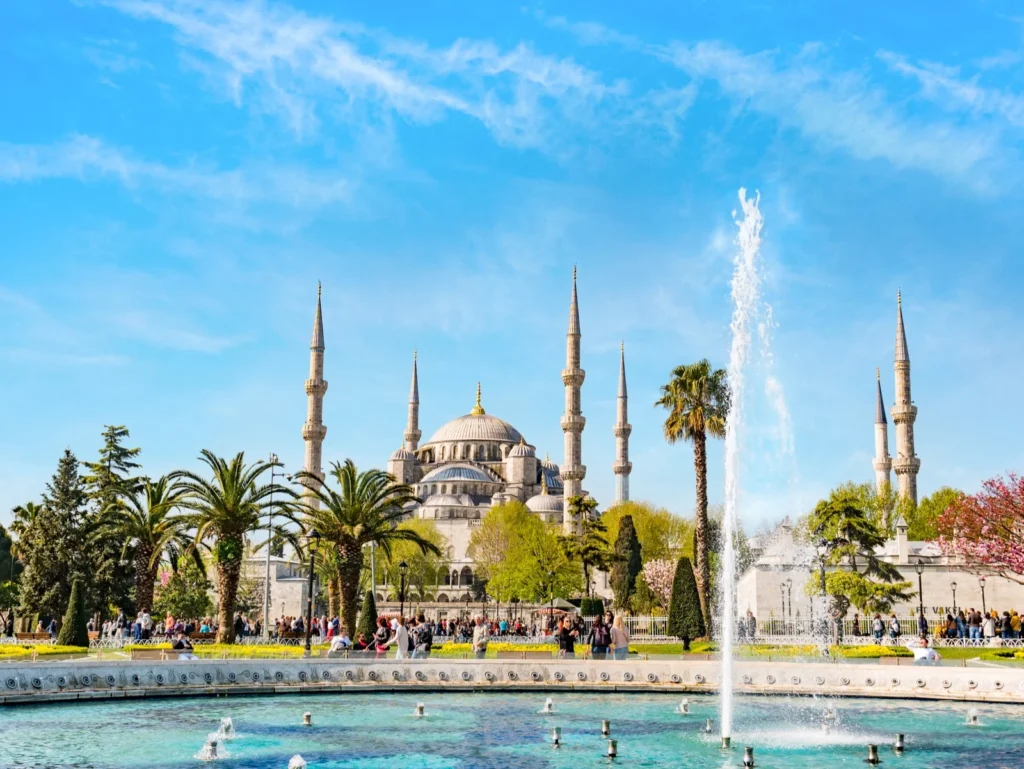
A free day to explore Istanbul at your own pace. The historic core is concentrated in a walkable area: the Hagia Sophia, the Blue Mosque, the Hippodrome and the Grand Bazaar sit close together and are easy to visit on your own.
Optional guided tour (extra cost): a Sultanahmet walking tour with a licensed guide covering the Hagia Sophia, the Blue Mosque, the Hippodrome and the Grand Bazaar. Ask us and we will add it to your booking.
Free Day in Istanbul (Optional City & Bosphorus Tour)
A second free day in Istanbul. Take a public ferry across the Bosphorus, browse the Spice Bazaar, or climb the Galata Tower for a view over the whole city.
Optional guided tour (extra cost): the Basilica Cistern, the Spice Bazaar, a 1.5-hour Bosphorus cruise and the Galata Tower with a licensed guide. Ask us and we will add it to your booking.
Istanbul to Gallipoli; Overnight Canakkale
Early departure from Istanbul. The drive to the Gallipoli Peninsula takes roughly four hours, crossing from Europe into one of the most significant battlefields of WWI.
Your guide walks you through:
- ANZAC Cove — the beach where Australian and New Zealand troops landed on April 25, 1915 — roughly 1.5 km north of the planned target, the result of a compass error that pushed the landing boats into a cove ringed by steep cliffs instead of the wider beach the planners had chosen. That navigational mistake shaped everything that followed.
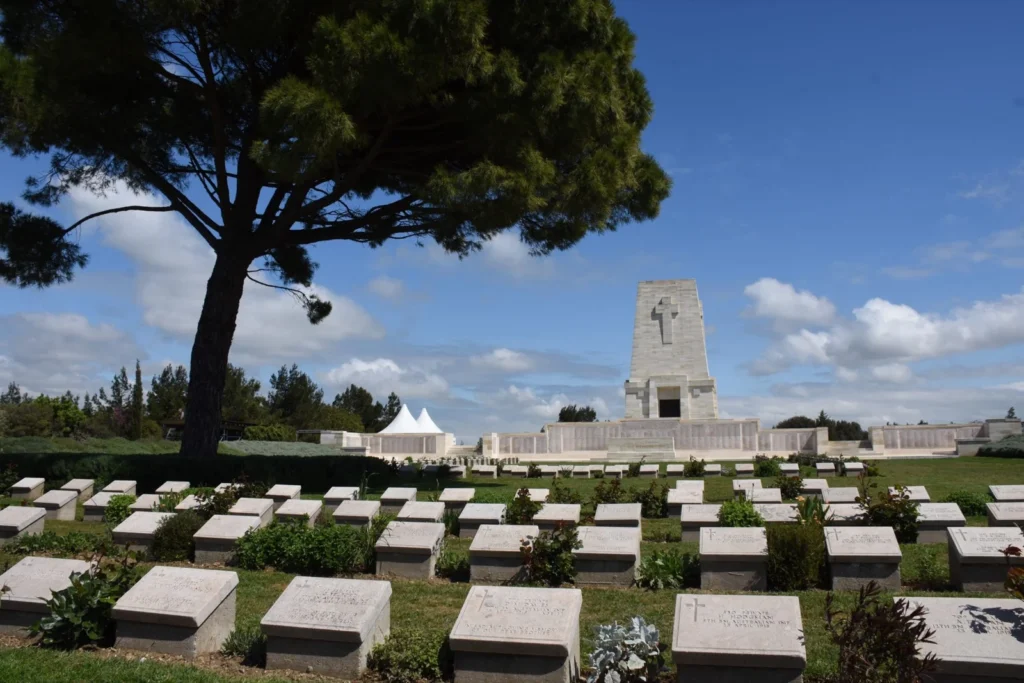
- Lone Pine Cemetery — 1,167 graves, most of them Australian soldiers. The pine tree at the center was grown from a seed sent home by a soldier during the campaign.
- Chunuk Bair — the ridge where New Zealand forces came closest to their objective. The memorial stands at the summit with views across the peninsula.
- Kabatepe War Museum — personal artifacts, letters, weapons, and photographs that put individual faces on the campaign’s 500,000 casualties.
This is not a light day. Your guide provides historical context without dramatization — the landscape and the numbers speak clearly enough.
Troy & Pergamon; Overnight Kusadasi/Selcuk
Two ancient cities in one day, each remarkable for different reasons.
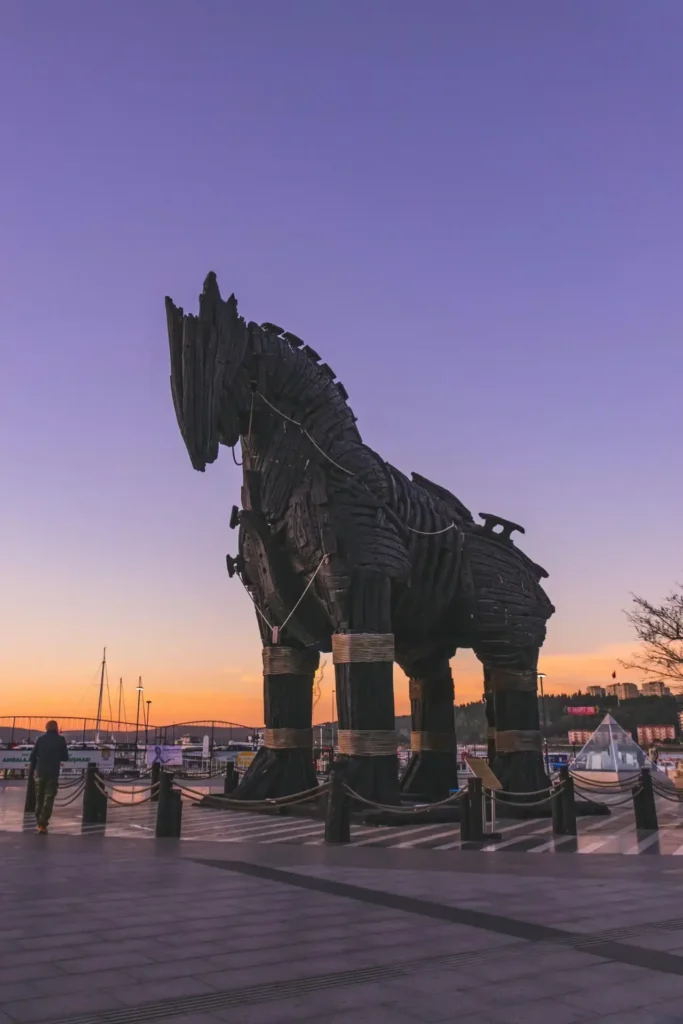
Morning — Troy The archaeological site of Troy contains nine layers of civilization, spanning from 3000 BC to 500 AD. This is where Heinrich Schliemann dug in the 1870s, convinced Homer’s Iliad described a real place. He was right — though he also accidentally destroyed parts of what he was looking for. Your guide explains which layer is which and where the Trojan War likely fits. The replica Trojan Horse at the entrance is a photo opportunity. The ruins behind it are the real story.
Afternoon — Pergamon Drive south to Bergama, the modern town sitting beneath the ancient city of Pergamon. You’ll visit:
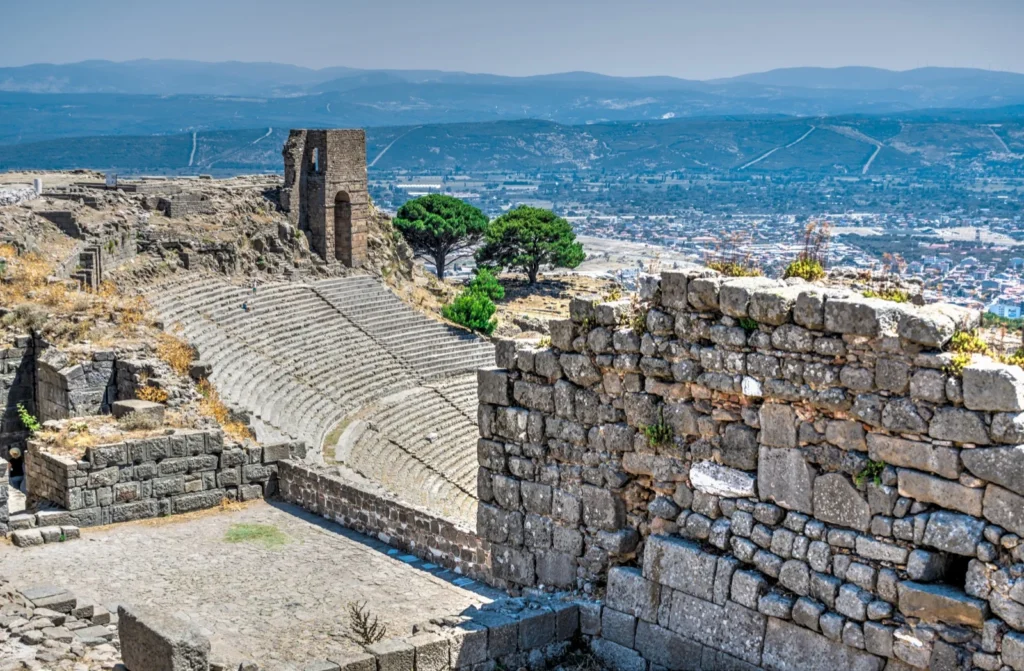
- The Acropolis — perched on a hilltop 335 meters above the plain. The theater, carved into the slope, seated 10,000 and has acoustics you can test yourself.
- The Asklepion — an ancient healing center and one of the first hospitals in the Western world. Patients were treated with water therapy, herbs, dream interpretation, and theater performances. It was essentially a 2nd-century wellness retreat.
Continue south to Kusadasi or Selcuk for the night.
Full-Day Ephesus
A full day dedicated to one of the best-preserved ancient cities in the Mediterranean. At its peak, Ephesus was the second-largest city in the Roman Empire — 250,000 people, marble-paved streets, running water, public baths, and a library that held 12,000 scrolls.
Your guide walks you through:
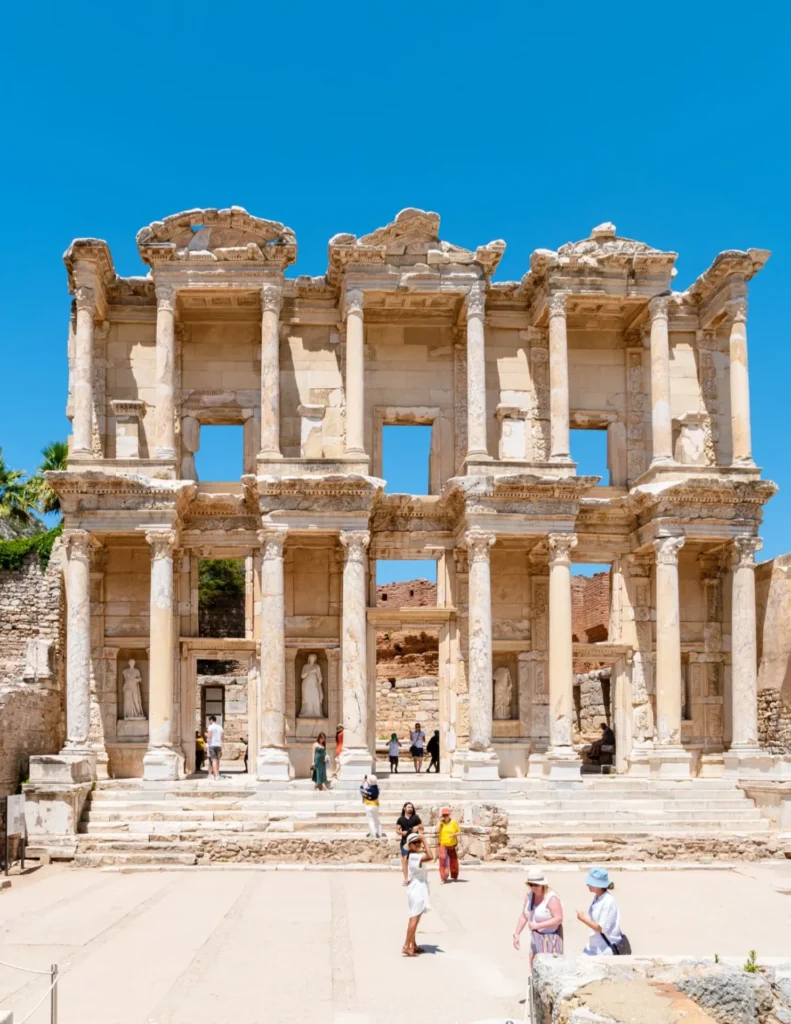
- Library of Celsus — the facade you’ve seen in every Turkey guidebook. Built in 117 AD as both a library holding 12,000 scrolls and a monumental tomb for the Roman senator Celsus. The restored columns frame one of the most photographed structures in the country.
- Great Theater — 25,000 seats, still intact enough to imagine a crowd. This is where the silversmiths of Ephesus rioted against the Apostle Paul, according to the Book of Acts.
- Temple of Hadrian — a small, ornate structure along Curetes Street with a carved Medusa head above the entrance arch.
- House of the Virgin Mary — a small chapel on Mount Koressos where, according to Catholic and Orthodox tradition, Mary spent her final years. Recognized by the Vatican as a pilgrimage site.
- Temple of Artemis — one of the Seven Wonders of the Ancient World. Only a single column remains, but the scale of what stood here (four times larger than the Parthenon) is worth understanding.
Pamukkale & Hierapolis; Transfer to Fethiye
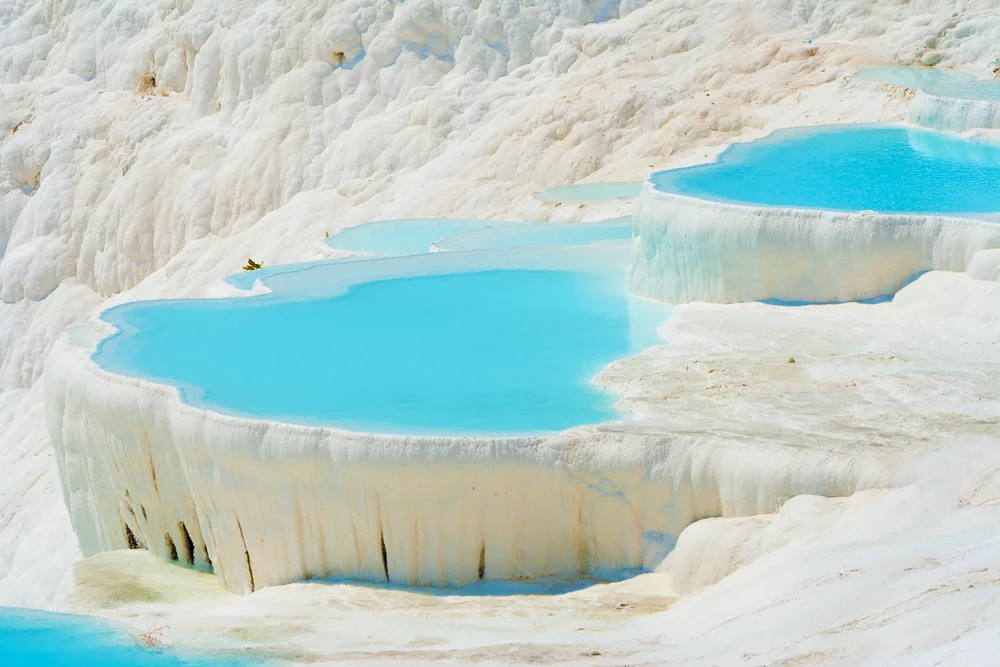
Morning drive to Pamukkale — roughly three hours from Kusadasi. If you can time it for late afternoon, the softer light brings out the contours of each terrace pool and the crowds thin noticeably after midday tour buses leave. The white formations are built by thermal water depositing calcium carbonate as it cools on the way downhill. You walk barefoot across the travertines as warm water pools around your ankles.
Above the terraces sits Hierapolis, a Greco-Roman spa city where people came for the thermal waters 2,000 years ago. The necropolis stretching along the road contains over 1,200 tombs — one of the largest ancient cemeteries in Anatolia.
Optional: Cleopatra’s Pool — swim among sunken Roman columns in naturally carbonated thermal water at 36°C. There is a separate entrance fee.
After Pamukkale, your private driver takes you to Fethiye (approximately 3 hours). You’ll arrive in time for dinner along the harbor.
Fethiye Boat Tour
A full day on the water — your choice of route:
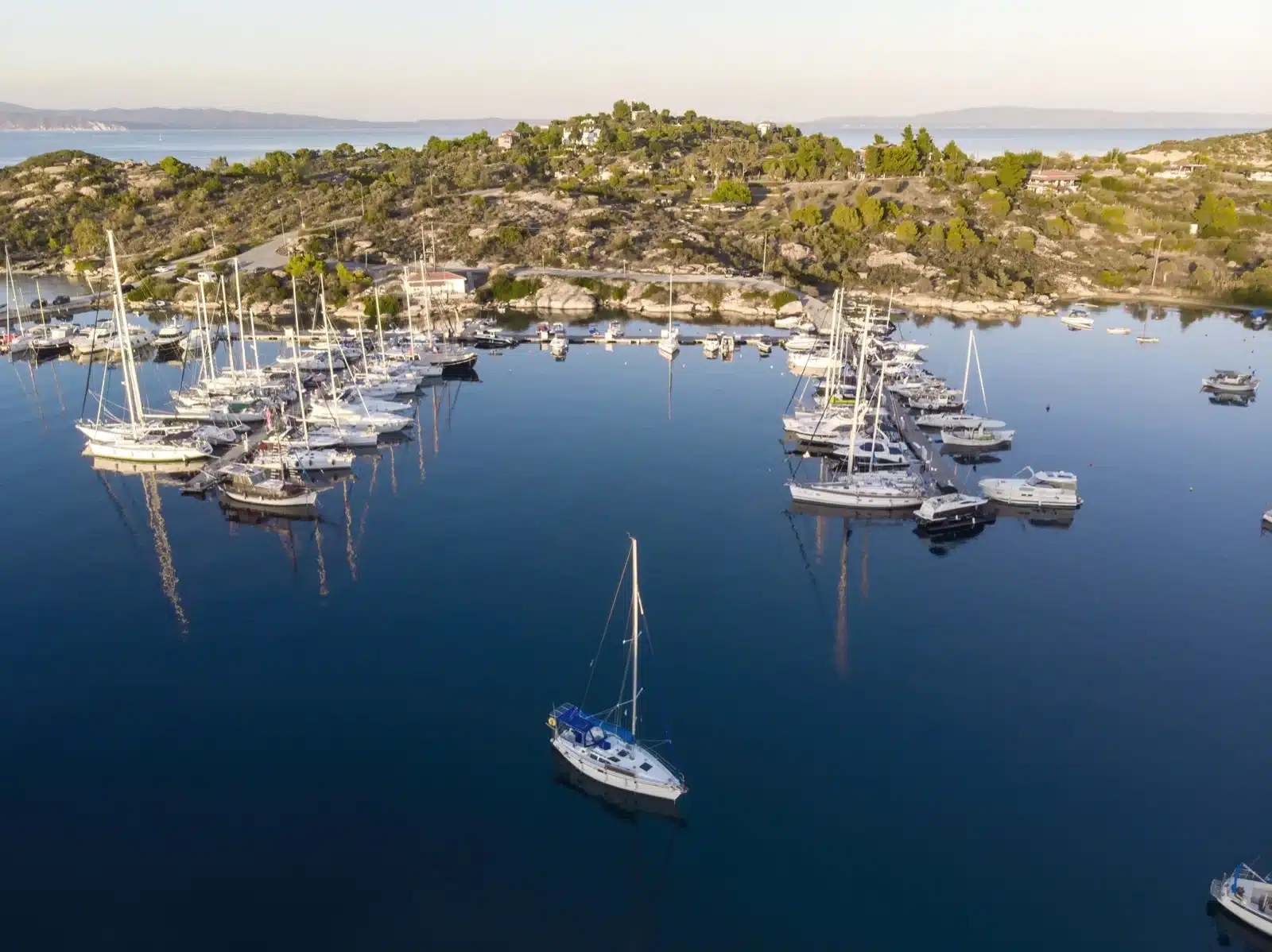
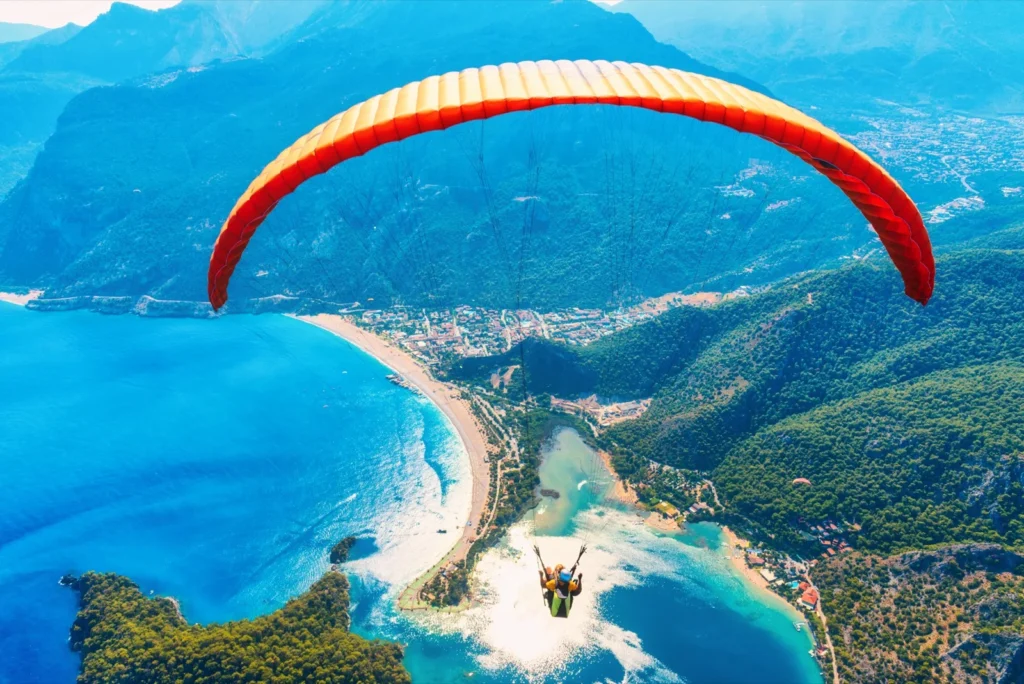
Option A — Oludeniz & Blue Lagoon Cruise to Oludeniz, where the turquoise lagoon sits inside a protected bay. You’ll swim, anchor in quiet coves, and have lunch on board. The paragliders launching from Babadag Mountain above provide the backdrop.
Option B — 12 Islands Cruise A classic Fethiye route through the offshore islands. Stops for swimming in sheltered bays, snorkeling over rocky reefs, and a freshly prepared lunch on deck. The boat anchors at several islands — you swim to shore or stay on board, your choice.
Both options include lunch on board and run approximately 6-7 hours.
Private Transfer to Antalya
Your driver picks you up from your Fethiye hotel for the three-hour coastal drive to Antalya. The route follows the D400 highway through pine forests and along the Mediterranean — worth staying awake for.
Check in to your Antalya hotel and spend the rest of the day at your own pace. The old town harbor is walkable, the clifftop parks overlook the sea, and the neighborhood restaurants serve some of the best kebabs on the coast.
Free Day in Antalya (Optional Guided Tour)
A free day on the Mediterranean. Walk the cobblestone lanes of Kaleici, the walled old town, pass through Hadrian’s Gate, or spend the afternoon by the sea.
Optional guided tours (extra cost): Antalya Old City & Coast (Kaleici, the Archaeological Museum and the Duden Waterfalls) or Aspendos, Perge & Side, both with lunch. Ask us and we will add one to your booking.
Flight Antalya to Istanbul; Free Evening
Arrive in Istanbul and transfer to your hotel. The rest of the day is free. Revisit a favorite neighborhood, pick up last-minute purchases from the bazaars, or simply enjoy a final Turkish breakfast on a terrace overlooking the Golden Horn.
Departure
Breakfast at your hotel. Your driver picks you up 3-4 hours before your international flight for a smooth airport transfer. Twelve days, eight destinations, zero logistics you had to handle yourself.
What's Included
- 11 nights accommodation in 4-star hotels with daily breakfast
- Domestic flight: Antalya to Istanbul
- Private airport transfers and private transfers from Pamukkale to Fethiye and Fethiye to Antalya
- Small-group transportation in air-conditioned vehicles on touring days
- Professional licensed English-speaking guides on all tour days
- Entrance fees to all sites on the itinerary
- Lunches on guided tour days
- Fethiye boat tour with lunch on board
- 24/7 local support throughout your trip
Not Included
- International flights
- Dinners and drinks
- Optional experiences: Cleopatra's Pool entrance, paragliding in Oludeniz
- Optional guided tours in Istanbul (Days 2 and 3) and Antalya (Day 10)
- Personal expenses
- Travel insurance
- Guide and driver gratuities (optional, appreciated)
Who Is This Tour For?
This itinerary works well for:
- ANZAC descendants and WWI history travelers — Gallipoli gets the full afternoon it deserves here, with a guide who knows ANZAC Cove, Lone Pine, and Chunuk Bair at ground level, not just from a textbook
- Archaeology and ancient civilization enthusiasts who want Troy, Pergamon, Ephesus, and Hierapolis in a single route — four distinct eras of the ancient world, each with its own guide-led context
- Retired couples with the time to move at a comfortable pace — twelve days across eight destinations means no 5 AM starts to catch a bus, and a boat day in Fethiye built in as a natural reset
- Travelers who chose the Aegean over Cappadocia — this is the western route, following the coast south through battlefields and ruins instead of heading inland to the fairy chimneys
Frequently Asked Questions
The 13-day tour heads east to Cappadocia (fairy chimneys, balloon flights, underground cities) and then south along the Mediterranean. This 12-day tour heads west instead — through Gallipoli, Troy, and Pergamon along the Aegean coast before joining the same southern route at Ephesus. If you want western Turkey’s war history, Homeric archaeology, and Aegean coastline, this is the route. If you want Cappadocia’s volcanic landscape, take the 13-day option.
The western Turkey route — Istanbul, the Dardanelles, the Aegean coast, Pamukkale, Fethiye, and Antalya — follows a well-traveled tourism corridor with reliable infrastructure throughout. Your guide carries a local phone and is reachable at any point during the day, the drives from Pamukkale to Fethiye and on to Antalya are private transfers with a dedicated driver, and the Gallipoli to Pamukkale stretch runs with a small-group tour.
Moderate. Most days involve 2-4 hours of walking on uneven terrain, cobblestones, or archaeological sites. The Pergamon Acropolis involves a hill climb (there is a cable car option). Pamukkale is walked barefoot on wet travertines — manageable but worth noting. Fethiye and the transfer days are easy. We can adjust the pace or skip sections based on your comfort level.
That is the whole point. Want to add a day in Fethiye for paragliding? Spend an extra night in Kusadasi? Swap the 12 Islands cruise for a day trip to the Lycian rock tombs? Tell us what matters to you and we will redesign the itinerary around it.
April through June and September through November. The Aegean and Mediterranean coasts are comfortable and less crowded in these months. July and August bring peak heat (35°C+ at Ephesus and Pamukkale) and peak crowds. Spring is ideal for Gallipoli, especially around the April 25 ANZAC Day commemorations.
For the best hotel availability — especially in Fethiye and Kusadasi during summer — 4-6 weeks ahead is ideal. But we have put together trips on shorter notice. Reach out and we will see what is possible.
Gallery
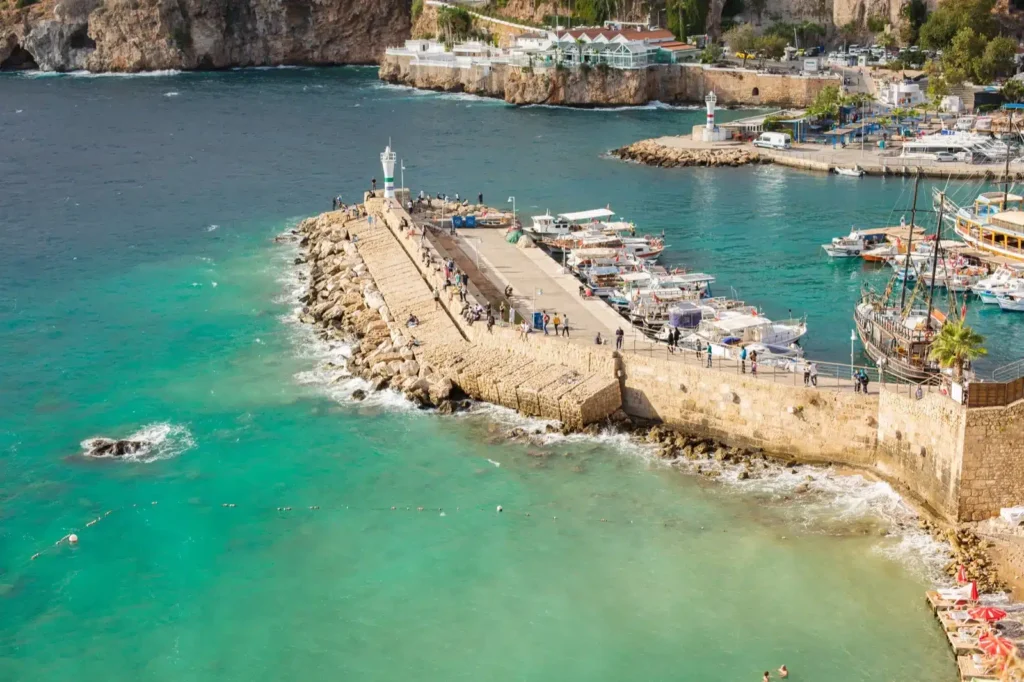
12 Days · Guided Tour
Get Your Personalized Quote
From
$
2303
/per person
You Might Also Like
 8 Days
8-Day Istanbul, Cappadocia & Antalya Tour
You'll start in Istanbul, where your guide walks you through 1,500 years of layered history — from the Hagia Sophia's…
 13 Days
13-Day Turkey Tour
Most Turkey itineraries make you choose: the Mediterranean coast or the ancient ruins. The fairy chimneys or the…