
Istanbul to Fethiye — Battlefields, Ruins & the Turquoise Coast
Istanbul, Ephesus, Gallipoli, Pamukkale, Troy & Fethiye
Overview
This is Turkey’s western arc — the route that follows the Aegean rather than the interior. You’ll start in Istanbul with two full days in the city, then travel south through landscapes that shaped civilizations. Gallipoli, where an entire generation’s story is written into the hillsides. Troy, where nine cities were built on top of each other over 4,000 years. Pergamon, where the ancient Greeks invented parchment because they ran out of papyrus. Ephesus, the best-preserved Greco-Roman city on the Mediterranean.
Then the terrain shifts. Pamukkale‘s calcium terraces glow white against the Anatolian plateau, and the Roman spa city of Hierapolis sits on the ridge above them. From there, a private transfer takes you down to Fethiye on the turquoise coast — where you’ll spend a day on the water, cruising past islands and into sheltered bays.
This itinerary covers more ground than most 10-day tours, but every transfer is handled, every guide is local, and every day is built around your pace. No bus groups. No rigid schedule. Just a well-designed route through some of the most historically dense terrain in the world.
Day-by-Day Itinerary
Arrival in Istanbul
The western arc begins in Istanbul. Your private transfer from the airport drops you at your Sultanahmet or Taksim hotel with nothing to arrange on your end — just look for the nameplate at arrivals. You have two free days in the city ahead, so tonight is for getting your bearings: stroll the cobblestone streets near the hotel, find a sidewalk tea spot, or rest before the itinerary kicks in.
Free Day in Istanbul (Optional Old City Tour)
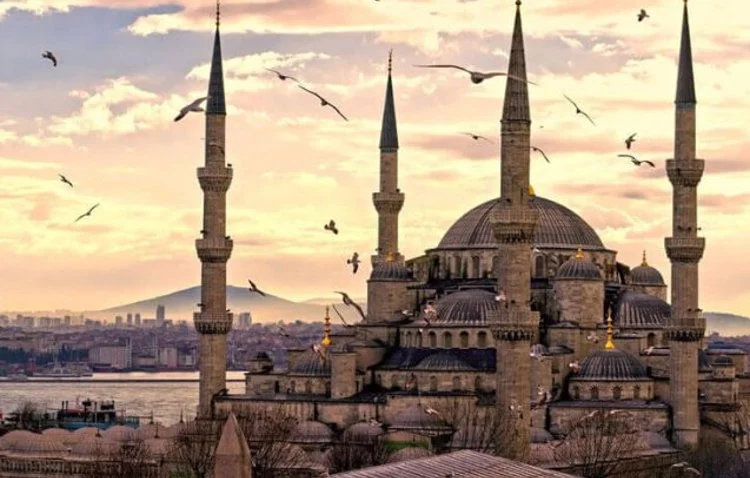
A free day to explore Istanbul at your own pace. The densest historical quarter, with the Hagia Sophia, the Blue Mosque, the Hippodrome and the Grand Bazaar, is compact and easy to walk on your own.
Optional guided tour (extra cost): a Sultanahmet walking tour with a licensed guide covering the Hagia Sophia, the Blue Mosque, the Hippodrome and the Grand Bazaar, with Topkapi Palace as an add-on. Ask us and we will add it to your booking.
Free Day in Istanbul (Optional City & Bosphorus Tour)
A second free day in Istanbul. Take a public ferry across the Bosphorus, browse the Spice Bazaar, or climb the Galata Tower for a view over the whole city.
Optional guided tour (extra cost): the Basilica Cistern, the Spice Bazaar, a 1.5-hour Bosphorus cruise and the Galata Tower with a licensed guide, with Dolmabahce Palace as an add-on. Ask us and we will add it to your booking.
Istanbul to Gallipoli & Canakkale
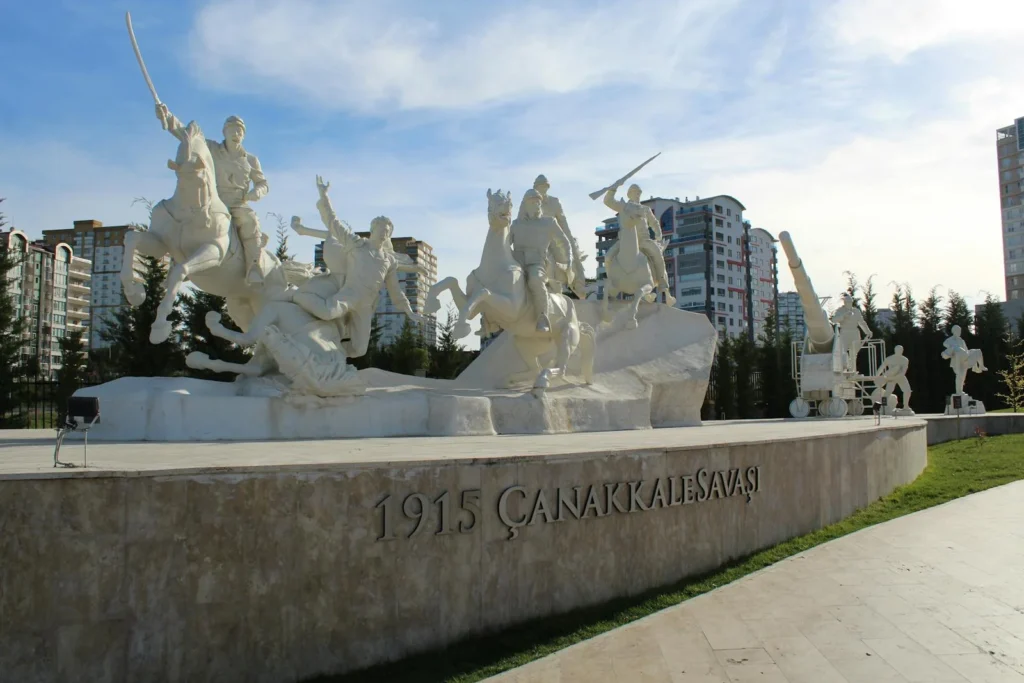
Early morning departure for the Dardanelles. The drive takes roughly four hours, and the landscape changes from urban sprawl to open farmland along the Thracian plains. By afternoon, you’re at Gallipoli — one of the most significant battlefields of the First World War. Your guide walks you through ANZAC Cove, where the first troops landed on April 25, 1915 — the start of an eight-month campaign that lasted until the December evacuation, claiming over 100,000 lives on both sides. You’ll visit Lone Pine Cemetery, where the headstones face the sea, and Chunuk Bair, the ridge that defined the campaign. The Kabatepe War Museum provides the broader context — personal effects, letters, weapons recovered from the trenches.
This is not a quick stop. The guide gives these sites the time and context they deserve.
Troy & Pergamon
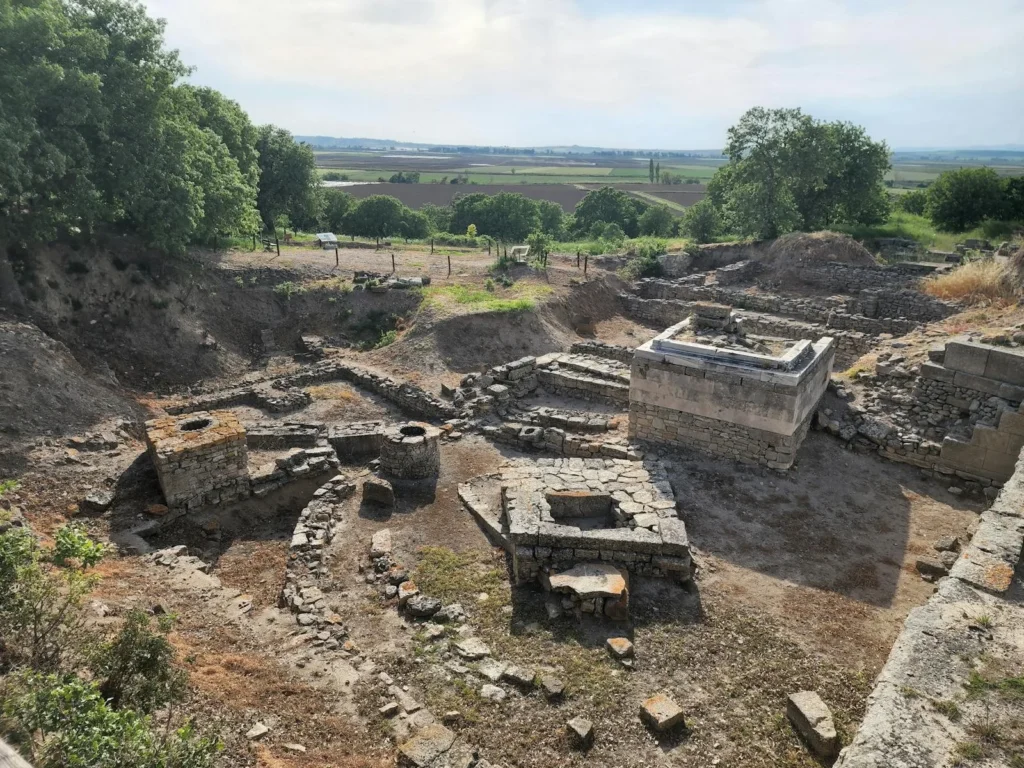
Two of the ancient world’s most important cities in a single day. You’ll start at Troy — the archaeological site where Heinrich Schliemann’s 19th-century excavations revealed not one city but nine, layered on top of each other across 4,000 years. The replica Trojan Horse stands at the entrance, but the real story is in the excavation trenches and the exposed city walls of Troy VI, the layer most scholars associate with Homer’s Iliad.
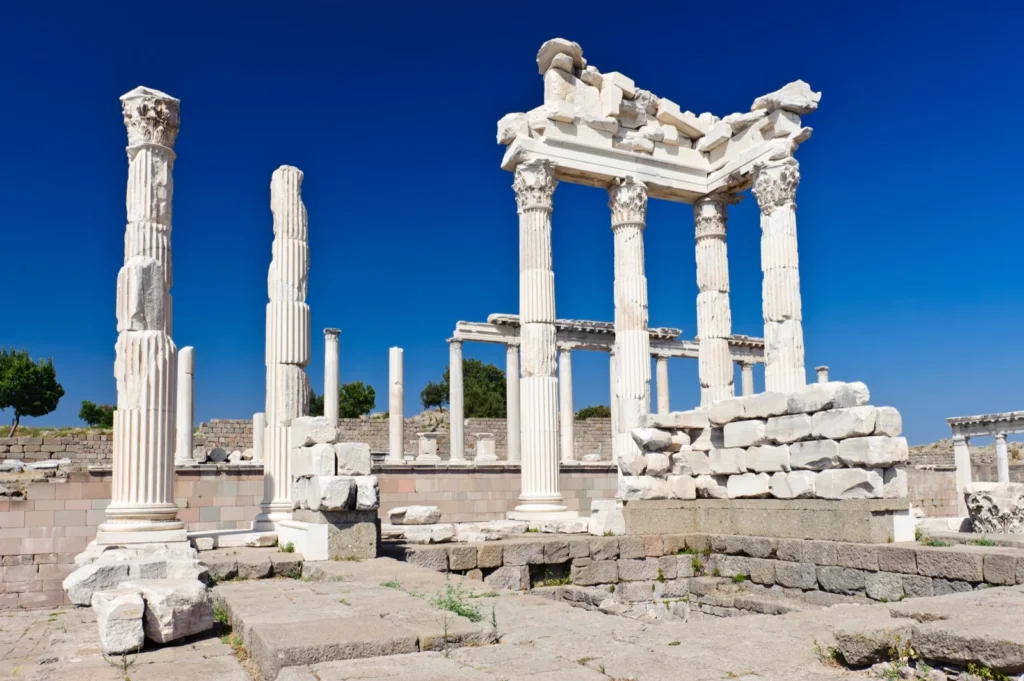
Then south to Pergamon. The Acropolis sits on a hillside 300 meters above the modern city of Bergama — the Temple of Trajan, the steepest theater in the ancient world (10,000 seats cut into the hillside), and the site of the great library that once rivaled Alexandria. You’ll also visit the Asklepion, the ancient healing center where patients were treated with water therapy, dream analysis, and herbal medicine — essentially the world’s first hospital.
Ephesus Full Day
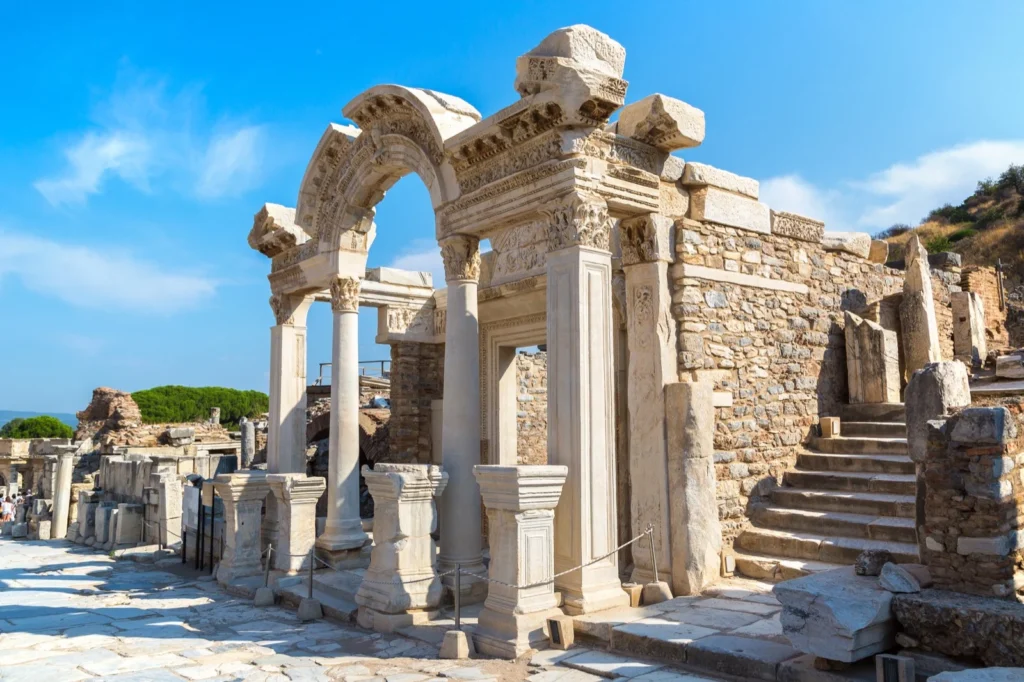
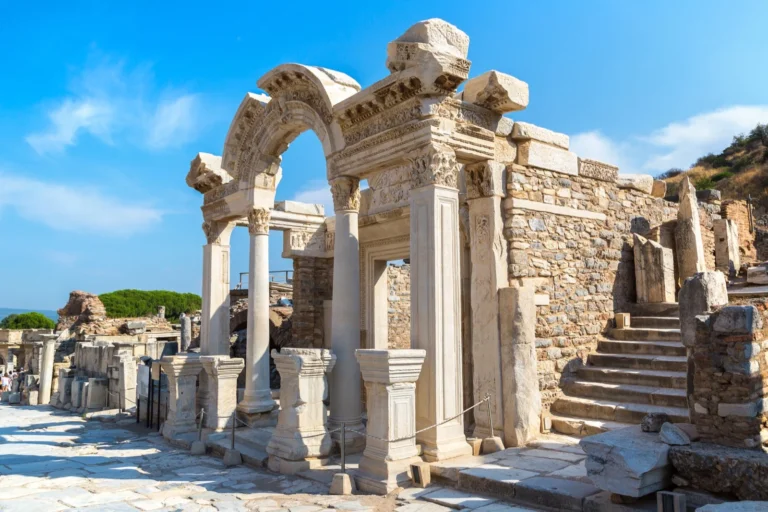
This is the day most travelers plan the entire trip around. Ephesus was the second-largest city in the Roman Empire — population 250,000 at its peak — and the ruins reflect that scale. You’ll walk down the marble-paved main street to the Library of Celsus, where the Roman senator Celsus lies buried in a sarcophagus directly beneath the building his son commissioned in 117 AD to honor him — one of the few figures in the Roman world entombed inside a public library. The Great Theater held 25,000 spectators and faced the harbor — audiences once arrived by boat along a colonnaded road that is now dry land, the sea having silted back nearly five kilometers. Hadrian’s Temple, the Terrace Houses with their preserved mosaics and frescoes, the public latrines, the agora — it takes a full morning to walk it properly.
After Ephesus, you’ll visit the House of the Virgin Mary on Mount Koressos — a small stone chapel where, according to Catholic and Orthodox tradition, Mary spent her final years. The site sits in a quiet forest clearing above the city. Then the Temple of Artemis — one of the Seven Wonders of the Ancient World, now a single reconstructed column standing in a marshy field. The contrast tells its own story.
Pamukkale, Hierapolis & Private Transfer to Fethiye
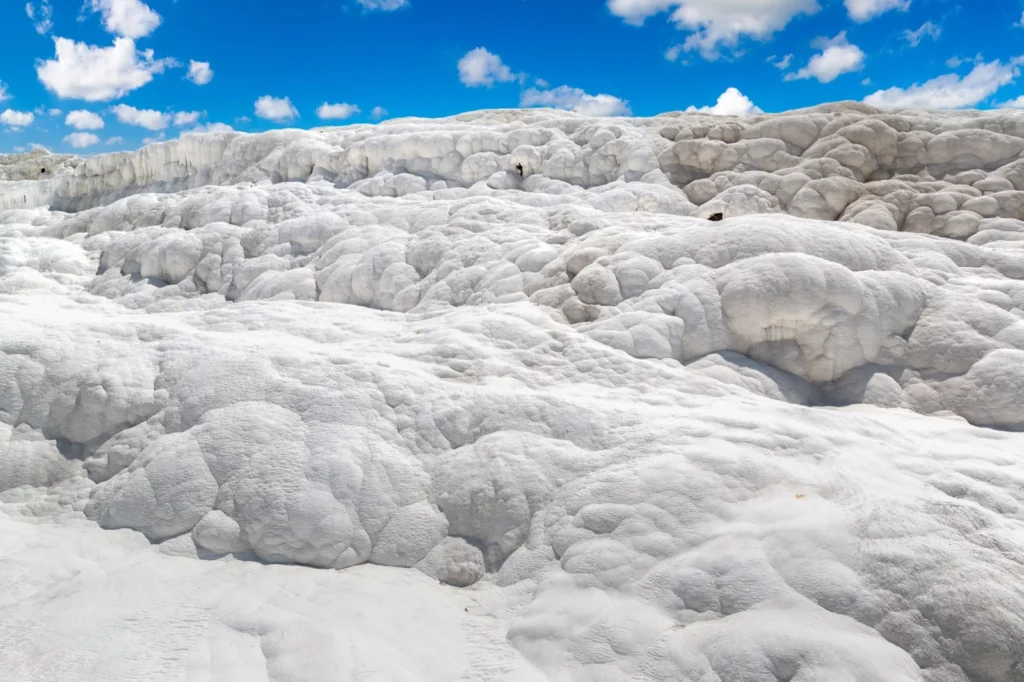
Morning drive to Pamukkale — the “Cotton Castle.” The calcium-rich thermal water flowing down this hillside drew Roman settlers here 2,200 years ago, and the spa city they built — Hierapolis — still stands on the ridge above. You’ll walk the white travertine terraces barefoot (shoes off — this is a protected site), following the same path that ancient visitors took to reach the hot springs at the top. The ancient necropolis here is one of the largest and best-preserved in Anatolia, with over 1,200 tombs stretching along the ridge.
Optional add-on: Cleopatra’s Pool — swim among sunken Roman columns in naturally carbonated 36°C thermal water.
After Pamukkale, a private transfer takes you southwest through the mountains to Fethiye on the Aegean coast — roughly three hours through pine forests and along a winding descent to the sea.
Fethiye Boat Tour
A full day on the water. You’ll choose between two routes:
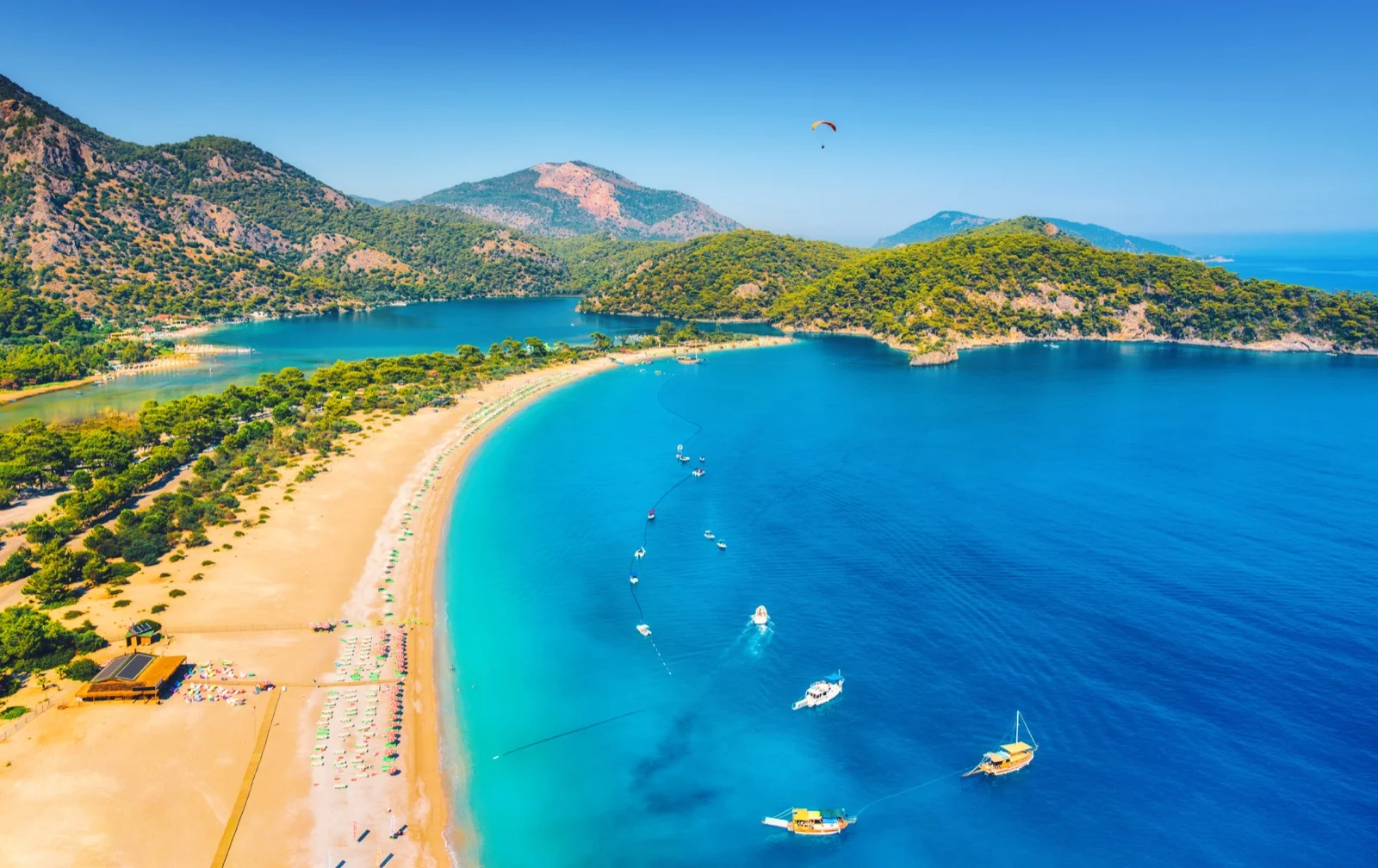
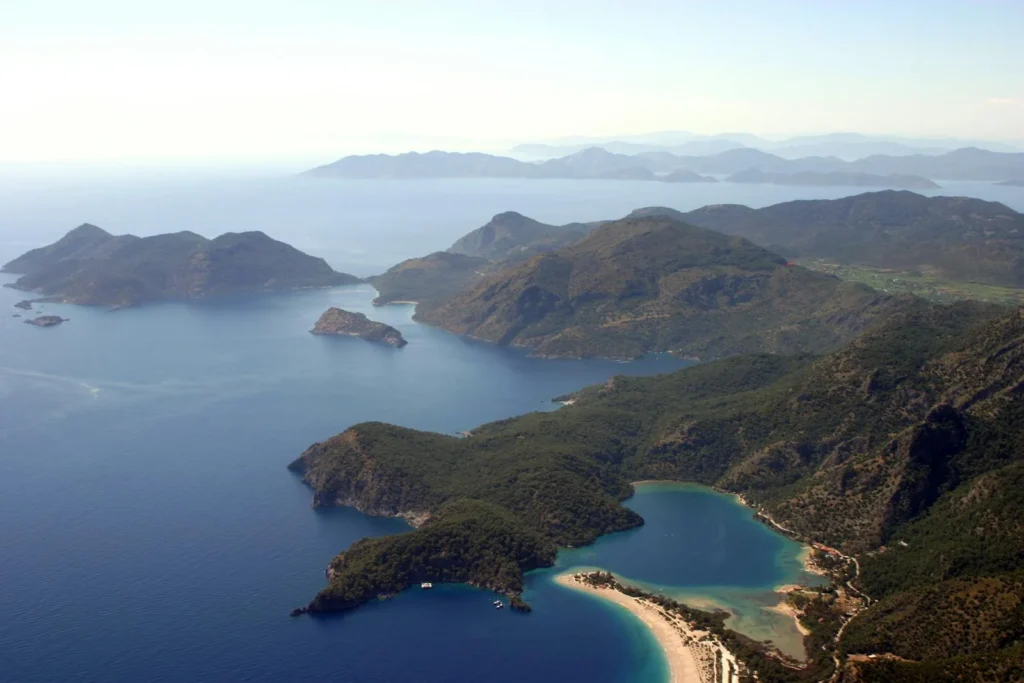
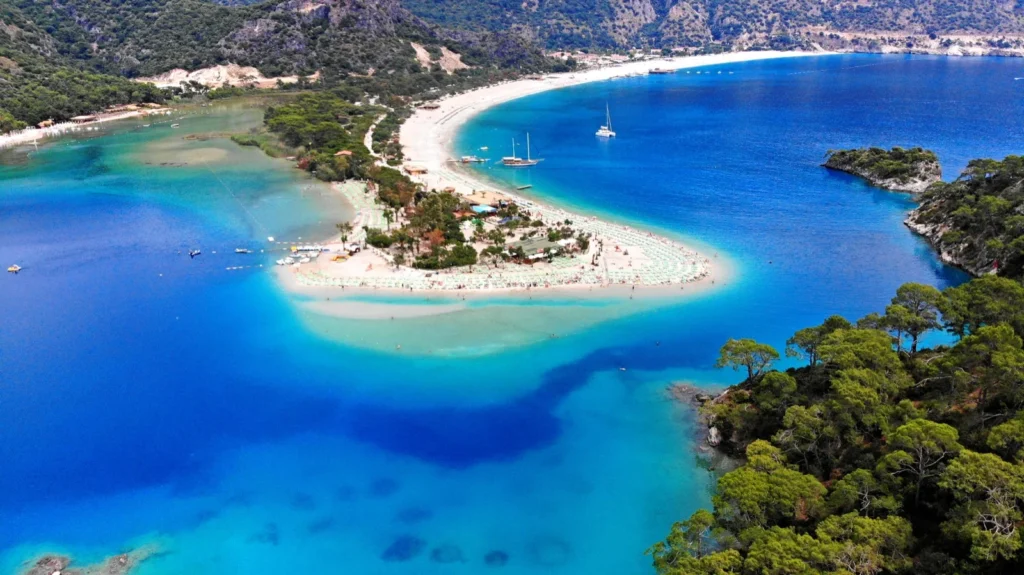
Option A — Oludeniz & the Blue Lagoon Cruise along the coast to Oludeniz, where the turquoise lagoon is sheltered by a sand spit and backed by pine-covered mountains. Swim stops in secluded coves, lunch served on board, and time to float in water so clear you can count the pebbles on the bottom.
Option B — 12 Islands Cruise A longer loop through the scattered islands off Fethiye’s coast — Yassica Islands, Tersane Island (with its ruined Ottoman shipyard), and half a dozen swimming stops in bays only reachable by boat. Lunch on deck, plenty of time in the water.
Both options include lunch on board and return to Fethiye harbor by late afternoon.
Fly Dalaman to Istanbul
Morning transfer to Dalaman Airport for your domestic flight back to Istanbul. Your driver meets you on arrival and takes you to your hotel. The rest of the day is free — a last evening walk through the city, a final dinner on a rooftop terrace, or simply rest before your departure.
Departure
Breakfast at your hotel. Your driver picks you up 3-4 hours before your international flight for a smooth airport transfer. Ten days, seven destinations, no loose ends.
What's Included
- 9 nights accommodation in 4-star or boutique hotels with daily breakfast
- Domestic flight: Dalaman to Istanbul
- All airport transfers and ground transportation in air-conditioned vehicles
- Private transfers from Pamukkale to Fethiye and from Fethiye to Dalaman airport
- Professional licensed English-speaking guides on all tour days
- Entrance fees to all sites on the itinerary
- Lunches on guided tour days
- Fethiye boat tour with lunch on board
- 24/7 local support throughout your trip
Not Included
- International flights
- Dinners and drinks
- Optional experiences: Topkapi Palace, Dolmabahce Palace, Cleopatra's Pool
- Optional guided tours in Istanbul (Days 2 and 3)
- Personal expenses
- Travel insurance
- Guide and driver gratuities (optional, appreciated)
Who Is This Tour For?
This itinerary works well for:
- ANZAC pilgrims who want more than Gallipoli — you get the full battlefield visit, then continue south through Troy, Ephesus, and Pamukkale instead of driving straight back to Istanbul
- Travelers who want the Aegean over Cappadocia — this route follows the western coastline, ending with a boat day off Fethiye’s islands. If you have already seen the fairy chimneys, or they simply do not call to you, this is the alternative
- The Fethiye boat day sells this for couples — after five days of ancient ruins and war memorials, you spend a full day on the water cruising past islands only reachable by sea. The contrast is the point.
- Families with older teenagers who will actually engage with standing where Homer’s Troy once stood, walking the Ephesus theater where St. Paul preached, and swimming off a gulet in Fethiye
Frequently Asked Questions
Every stop on this route — Istanbul, the Gallipoli peninsula, the Aegean coast through Troy and Ephesus, Pamukkale, and Fethiye — sits within Turkey’s primary tourism zones with strong local infrastructure. Airport transfers and the drives from Pamukkale to Fethiye and Fethiye to Dalaman airport are private, and from Gallipoli to Pamukkale you travel with a small-group tour, so you’re never navigating unfamiliar roads or transit systems on your own.
Moderate to active. Ephesus, Pergamon, and Troy involve substantial walking on uneven ancient surfaces — comfortable walking shoes with good grip are essential. The Pergamon Acropolis is on a steep hillside (a cable car is available). Pamukkale requires walking barefoot on wet travertines. The boat day in Fethiye is relaxed. We adjust the pace to match your group — no one gets rushed through a site they want to spend time in.
Yes — every tour is individually designed. Want an extra day in Fethiye? Prefer to skip Gallipoli and spend more time in Istanbul? Want to add a paragliding flight over Oludeniz? Tell us what matters to you and we’ll rebuild the route around it.
April through June and September through November. The Aegean coast is warm without the peak-summer heat, Ephesus and Pamukkale are less crowded, and the light is ideal for the boat day in Fethiye. July and August are hot — particularly inland at Pamukkale and Troy — though the coast stays pleasant.
It’s a private transfer — your own vehicle and driver, roughly three hours through the mountains. No shared bus, no extra stops. You’ll descend from the Anatolian plateau through pine forests to the coast. It’s one of the more scenic drives on the itinerary.
For the best hotel availability, especially in Fethiye and Kusadasi during summer, 4-6 weeks ahead is recommended. But we’ve built trips on shorter timelines — reach out and we’ll work with what’s available.
Gallery
10 Days · Guided Tour
Get Your Personalized Quote
From
$
2042
/per person
You Might Also Like
 4 Days
4-Day Gallipoli, Troy, Pergamon, Ephesus & Pamukkale Tour
This tour covers more historical ground in four days than most travelers see in two weeks. You'll start early from…
 12 Days
12-Day Istanbul to Antalya Tour via Gallipoli, Troy & Ephesus
This is the western route. While most multi-day Turkey itineraries head inland to Cappadocia, this one follows the…