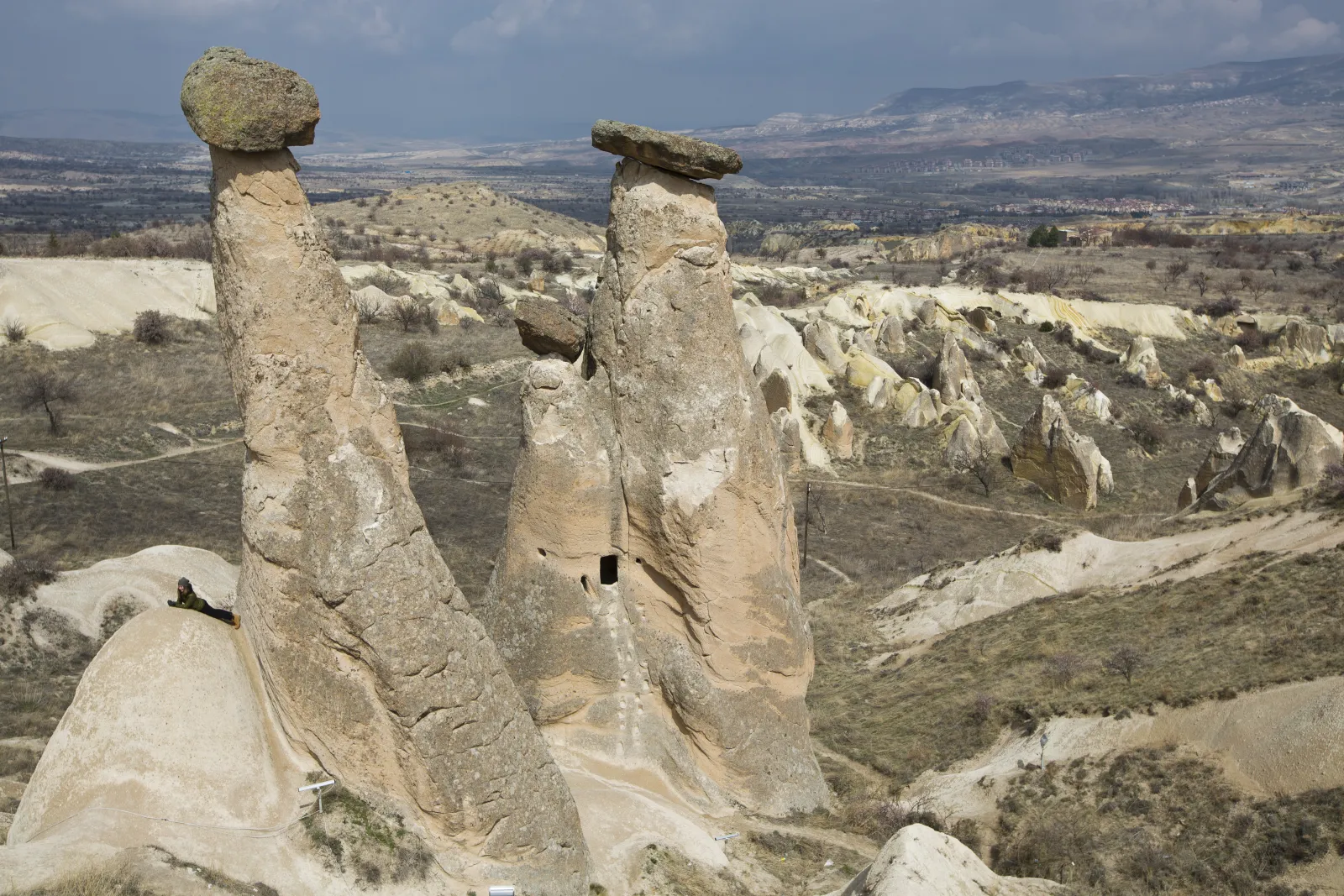
Three tuff columns stand in a row on a hillside near Ürgüp, each capped with a darker slab of basalt that sits like a hat slightly too large for the head beneath it. They are between ten and fifteen meters tall, pale cream in color, and the caps are dark grey — the contrast is clean, the forms are symmetrical, and the three standing together in a line, graduated in height, look almost posed. The Turks call them Üç Güzeller — the Three Beauties — and they are the most photographed fairy chimneys in Cappadocia.
The fame is partly photographic convenience: the three chimneys stand at the edge of a road with a parking area and a viewpoint, making them accessible without a hike. But the fame is also geological. The Three Beauties are a textbook example of differential erosion — the process that created the entire Cappadocian landscape — rendered in its clearest, most readable form. Each chimney is a column of soft volcanic tuff protected from above by a cap of harder basalt. The tuff erodes; the basalt does not. The result is a mushroom shape: a narrow stem of tuff supporting a broad, dark cap. Eventually, the stem erodes enough that the cap falls, the column collapses, and the chimney disappears. The Three Beauties are somewhere in the middle of that process — fully formed, clearly defined, and destined, over millennia, to erode into nothing.
How Fairy Chimneys Form
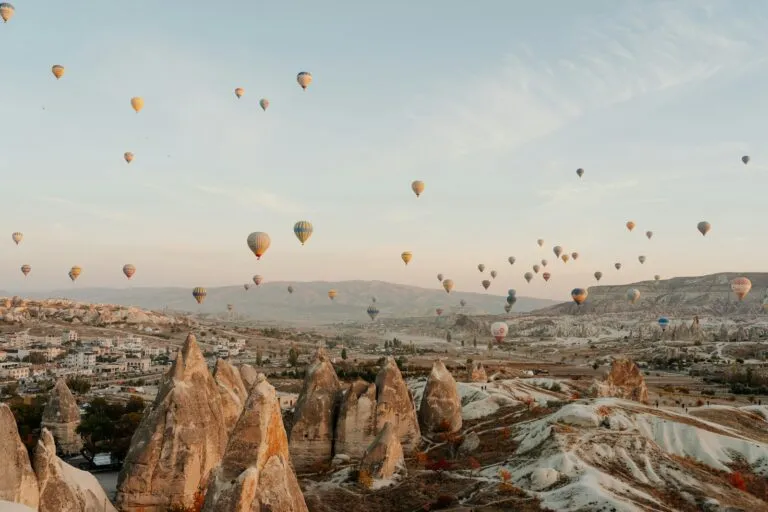
The story begins with volcanoes. Mount Erciyes (3,917 meters), Mount Hasan (3,268 meters), and other volcanic centers on the Anatolian plateau erupted repeatedly between roughly ten million and three million years ago, blanketing the region in thick layers of volcanic ash. The ash compacted under its own weight into tuff — a soft, porous stone that is easy to carve (which is why Cappadocia’s communities lived inside it) and easy to erode (which is why the landscape looks the way it does).
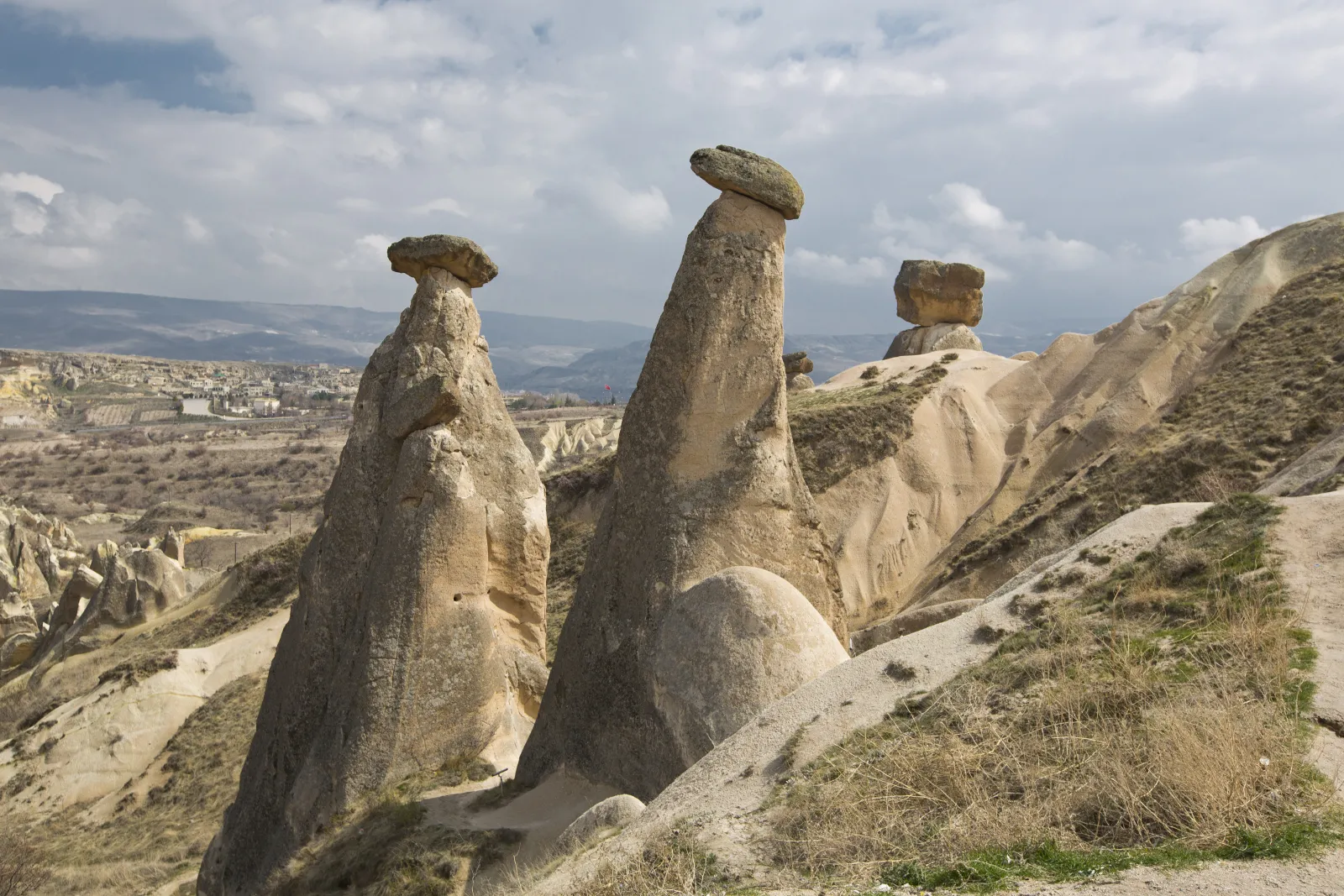
The eruptions deposited different materials at different times. Layers of soft tuff alternated with thinner layers of harder basalt and andesite — volcanic rock that resists weathering far more effectively than tuff. When erosion began — driven by wind, rain, frost, and the occasional earthquake — the soft tuff wore away while the hard caps remained. Where a cap protected the column below, a fairy chimney formed. Where no cap existed, the tuff simply eroded into valleys, slopes, and the gently rolling plateau.
The Three Beauties show this process at its most legible: cap, column, and the contrast between them. You can see where the tuff is narrowing beneath the cap. You can see the weathering patterns on the exposed column surface. You can imagine — correctly — that these formations were once part of a continuous layer of rock, and that the valleys between them are the material that has already eroded away. When I stop here with travelers, I always spend a minute just pointing at the caps — once you see how the dark basalt protects the pale tuff below, every fairy chimney in the region starts to make sense.
Visiting
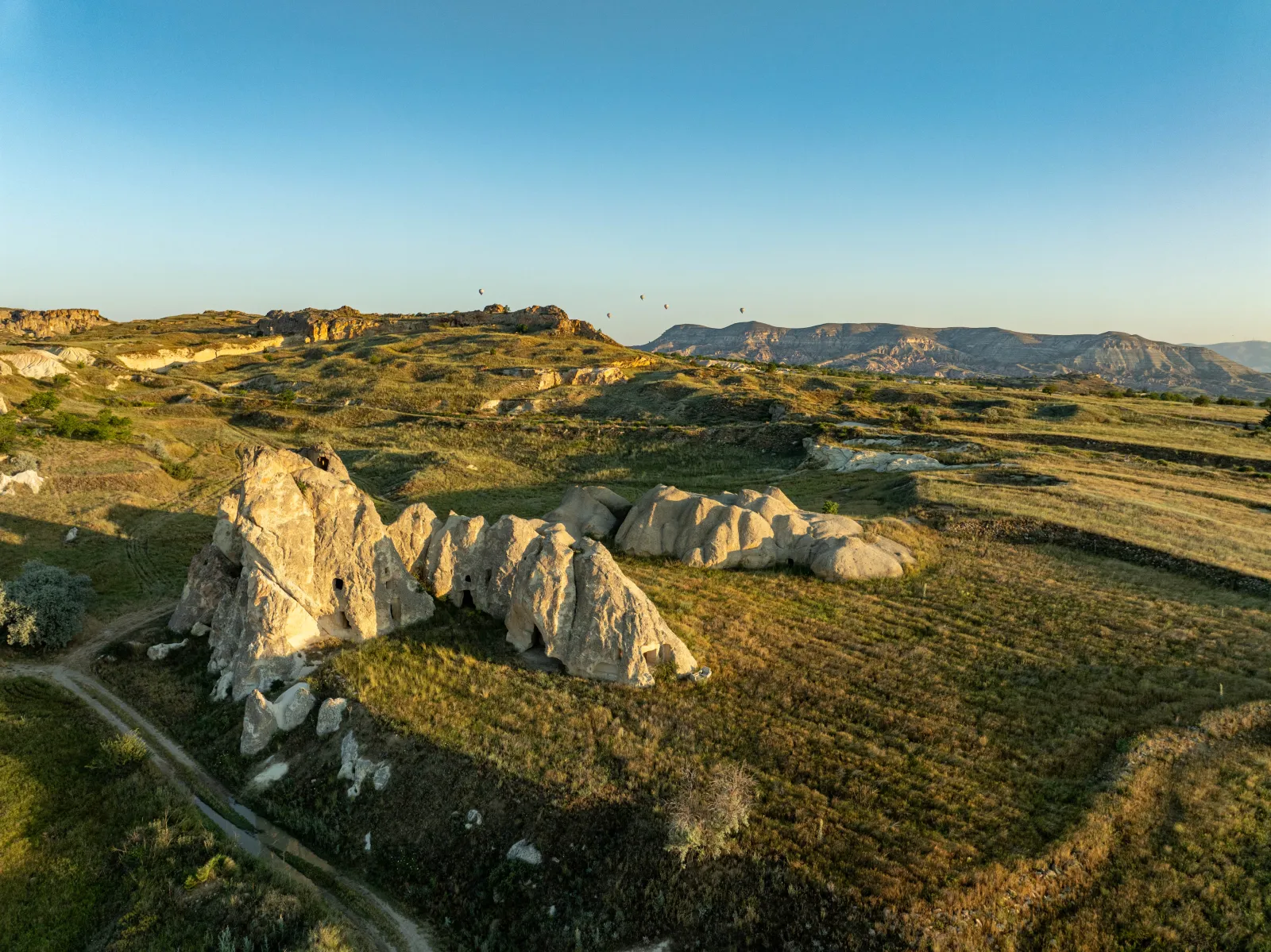
The Three Beauties are on the road between Ürgüp and Göreme, on the South Cappadocia touring route. A small parking area and viewpoint provide direct access — you walk from the car to the formations in two minutes.
How much time: Fifteen to twenty minutes. The formations are right at the viewpoint, and the experience is primarily visual — photographs, a walk around the base, and the geological context if you have a guide.
When to go: Morning light (the formations face generally east) gives the sharpest contrast between the light tuff columns and dark basalt caps. Late afternoon adds warmth to the tuff color. The site is open at all hours and there is no entrance fee.
Official resource: Göreme Historical National Park — UNESCO
Combining with other visits: The Three Beauties are a natural stop between Ürgüp and the Göreme area — a five-minute pause on a route that also includes Pigeon Valley, Red Valley, or Kaymaklı Underground City. They are often the first or last stop on a South Cappadocia tour, depending on the direction of travel. The site fits naturally into a two-day Cappadocia itinerary or as a short detour between Göreme Open Air Museum and Ürgüp.
Plan Your Cappadocia Visit
The Three Beauties are fifteen minutes and a photograph — but they are also the key to understanding everything else you see in Cappadocia. If you would like to explore the landscape with a private guide who can explain the geology behind the scenery, tell us what interests you and we will build the itinerary around it.