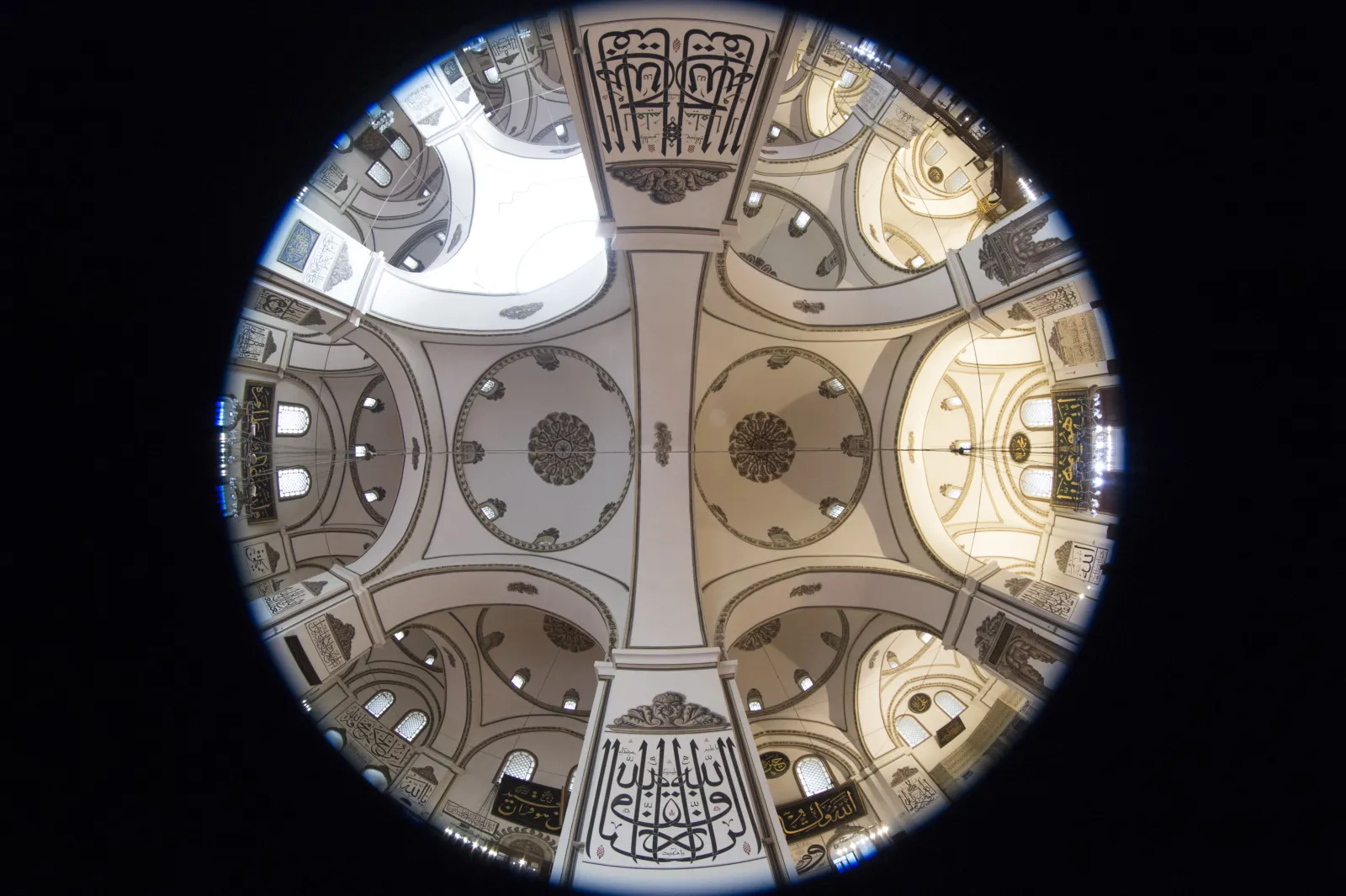
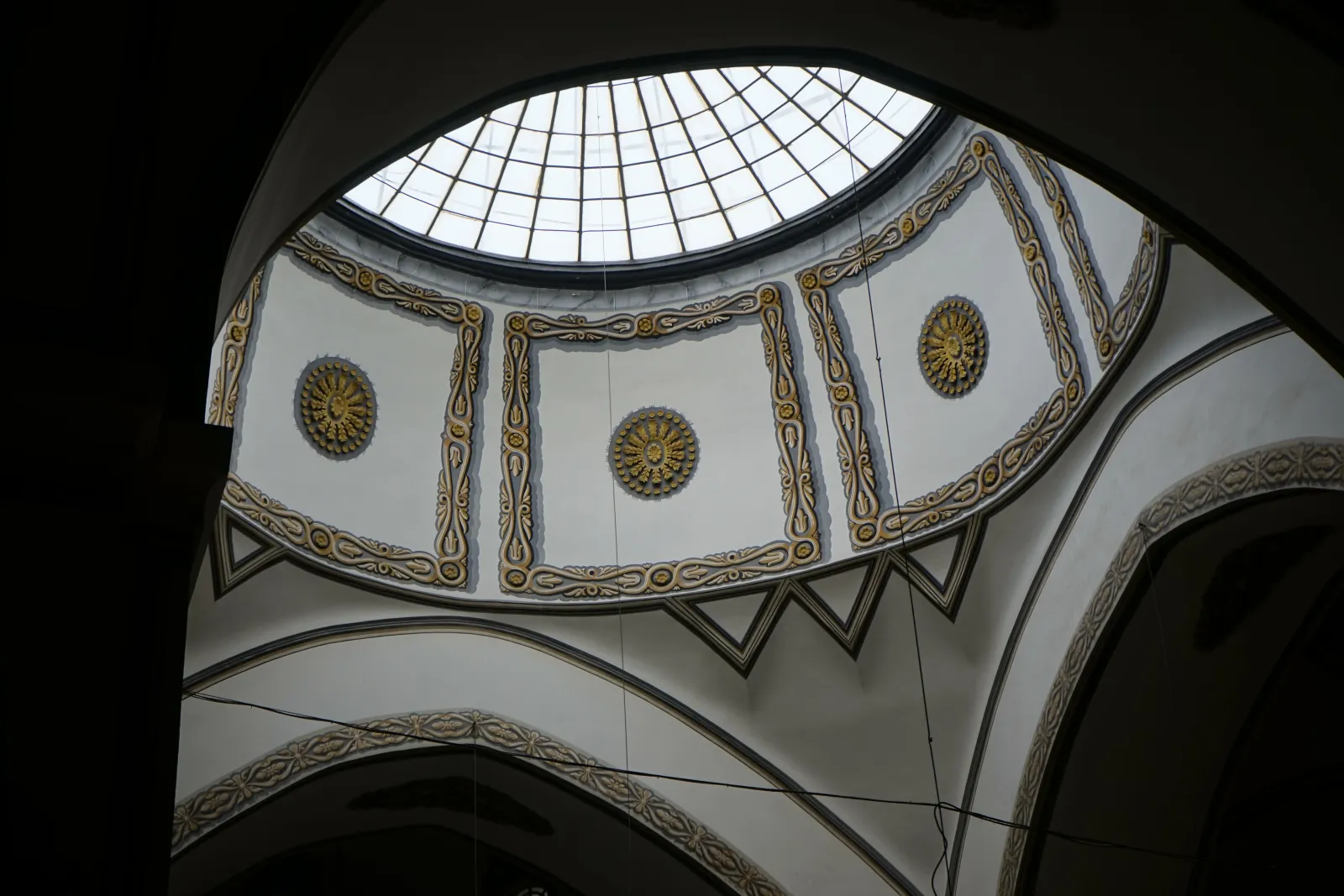
Stand in the center of the Grand Mosque of Bursa and look up. Twenty domes, arranged in a grid of four by five, cover the entire prayer hall. Each one is supported by twelve massive stone pillars that divide the interior into sections without enclosing it — the space is open, continuous, and larger than you expect from the outside. Light enters from windows set high in the walls and from the glass oculus in one of the central domes, falling directly onto a marble fountain below.
The Grand Mosque — Ulu Cami in Turkish — has been standing here since 1399. It was commissioned by Sultan Bayezid I, the fourth Ottoman sultan, and it was built with a promise behind it.
The Story Behind 20 Domes
The story, passed down through Ottoman chronicles, is this: before the Battle of Nicopolis in 1396, Bayezid I vowed to build twenty mosques if God granted him victory over the Crusader army led by King Sigismund of Hungary. The Ottomans won decisively — it was one of the most significant Ottoman military victories of the 14th century — and Bayezid was left with a promise to keep. His advisor, the scholar and architect Ali Neccar, reportedly suggested a more practical interpretation: rather than twenty separate mosques, build one mosque with twenty domes.
Whether the story is literally true or a later embellishment, the result is a building that has no equivalent in Ottoman architecture. The twenty-dome plan was never repeated. Later sultans built larger mosques — the great imperial mosques of Istanbul dwarf Ulu Cami in sheer volume — but none replicated this particular arrangement. The twenty domes give the interior a rhythm: each dome defines a bay, and as you walk through the mosque, the space shifts overhead in a steady, repeating pattern that creates a sense of both enclosure and openness simultaneously.
The architect — traditionally identified as Ali Neccar, though some sources attribute the design to Hacı İvaz Paşa — worked within the constraints of the early Ottoman building tradition. The Ottomans in the 1390s did not yet have the engineering knowledge to span the distances that Sinan would achieve 150 years later. Instead of one vast dome, they distributed the load across twenty smaller ones, each approximately 10 meters in diameter, supported by twelve freestanding pillars of rough-cut stone. The structural logic is straightforward: smaller domes, more supports, distributed weight. The aesthetic effect is anything but simple.
The Indoor Fountain
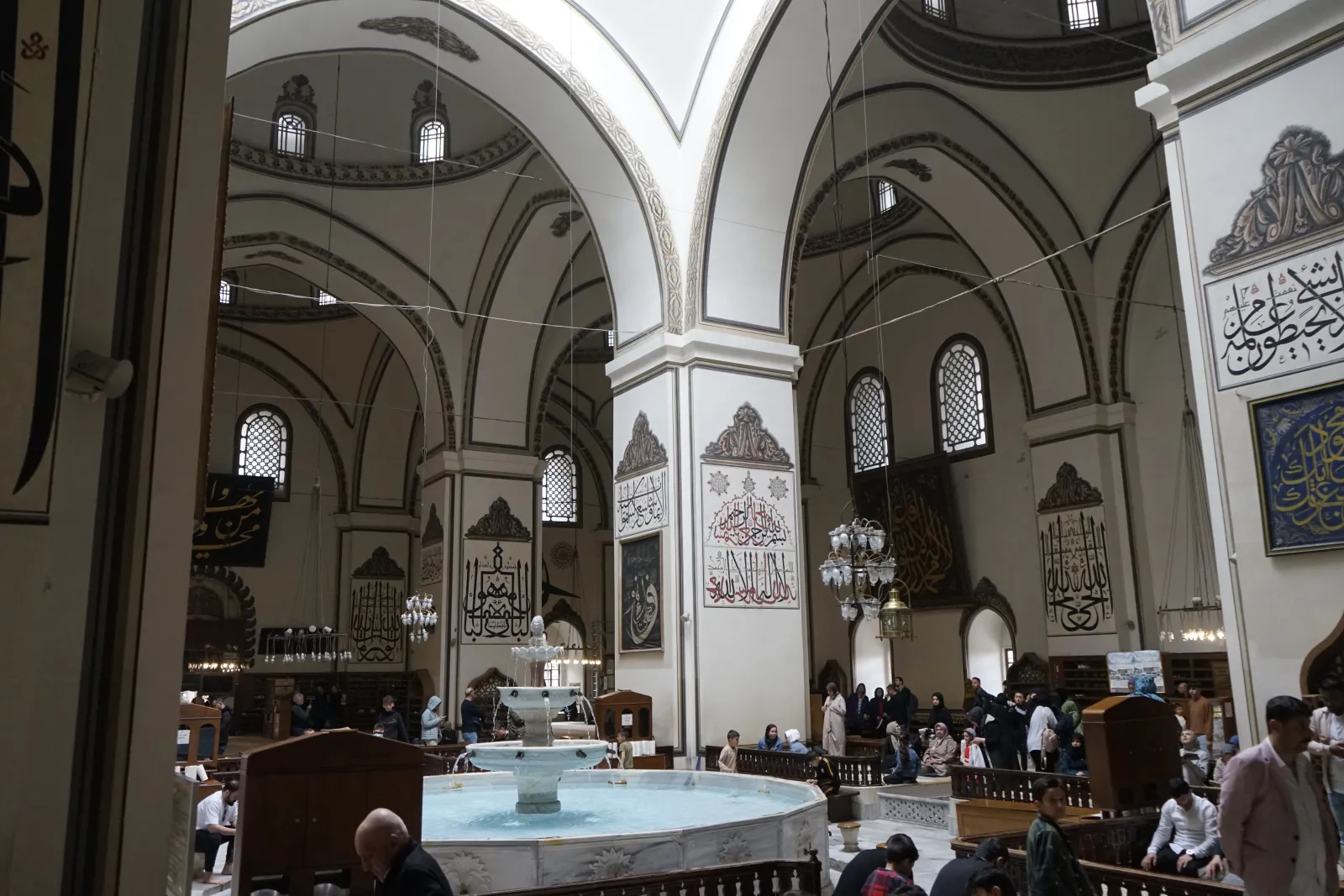
At the center of the mosque, directly beneath one of the domes, sits a şadırvan — a fountain. This dome has a glass oculus at its apex, and the light that enters from above falls onto the water’s surface and the marble pool below. In the early Ottoman period, this fountain served a practical purpose: ritual ablution before prayer. Worshippers would wash their hands, face, and feet here before entering the prayer areas around it.
The fountain is no longer used for ablution — modern facilities outside the mosque handle that function — but it remains in place, and the sound of water is still part of the mosque’s atmosphere. The oculus above it was originally open to the sky, meaning rain would fall directly into the pool. The glass covering is a later addition, preserving the light effect while keeping the interior dry.
There is something about the combination of water and light at the center of a stone building that changes the quality of the space. The fountain acts as a visual anchor — wherever you are in the mosque, you can orient yourself relative to the water and the light above it. Ottoman mosque design understood this instinctively: water, light, and stone in conversation with each other.
The Calligraphy: An Open-Air Gallery on Stone
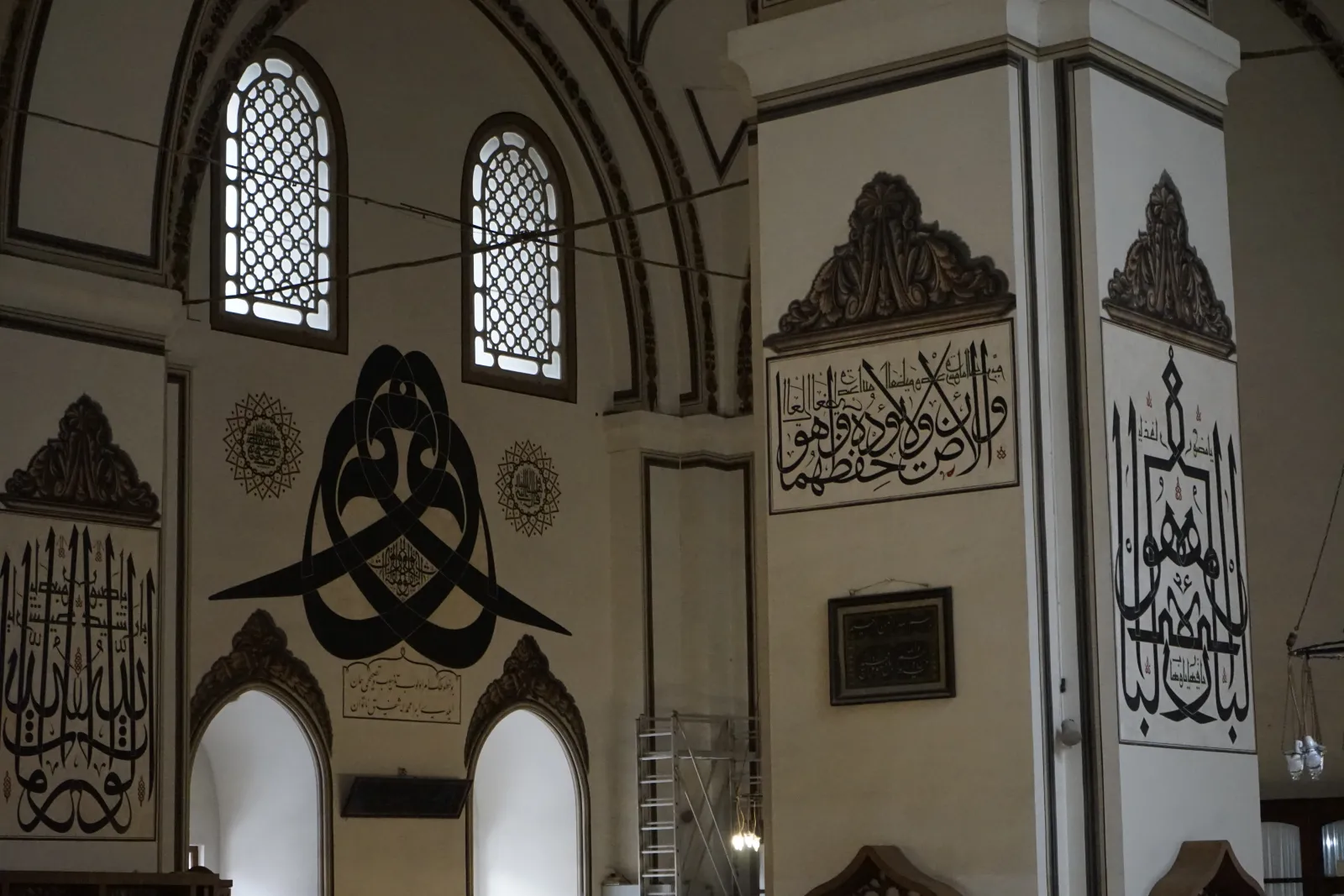
The Grand Mosque is sometimes called the “calligraphy museum” of Ottoman art, and when you step inside, you understand why. The walls, pillars, and upper surfaces are covered in calligraphic inscriptions — Quranic verses, the names of God and the Prophet, devotional phrases — written in a variety of scripts and styles that span centuries.
The calligraphy was not all applied at once. The earliest inscriptions date to the mosque’s construction in the late 14th century. Others were added by successive Ottoman calligraphers over the following five hundred years. The result is a palimpsest: layered generations of calligraphic art on the same walls, in different hands and different styles, each one contributing to a visual density that no single campaign of decoration could have produced.
The scripts include thuluth, a formal style with tall vertical strokes used for monumental inscriptions; naskh, a more compact and readable script; and several varieties of kufic, the angular, geometric script that gives decorative calligraphy much of its visual power. Some inscriptions are painted directly on the stone. Others are carved into wooden panels mounted on the walls. A few are rendered in gold leaf.
One of the most notable inscriptions is a large-scale rendering of the Throne Verse (Ayat al-Kursi), one of the most important verses in the Quran, displayed prominently on the western wall. The calligrapher’s name is recorded on some panels — a mark of the high status that master calligraphers held in Ottoman culture.
When I bring travelers to the Grand Mosque, I find that the calligraphy is what holds their attention longest. You do not need to read Arabic to appreciate it as visual art. The rhythm of the letters, the way curves and verticals are balanced, the discipline of the spacing — these are compositional decisions that communicate even without linguistic comprehension.
The Architecture: Scale and Simplicity
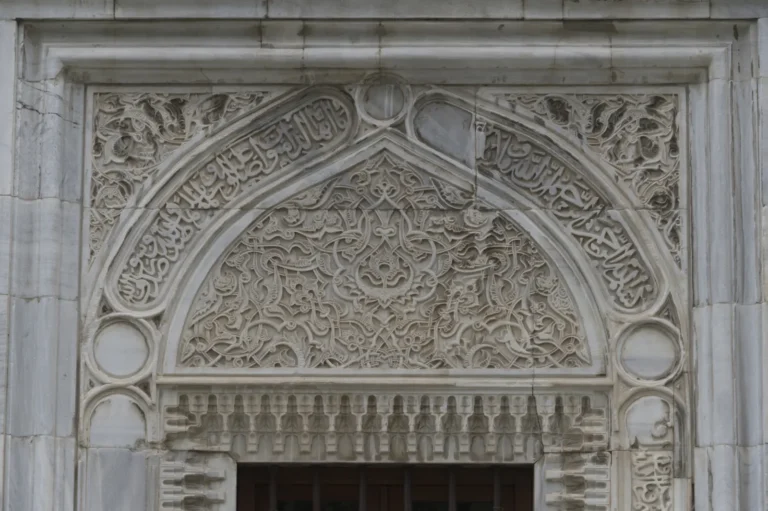
The Grand Mosque covers approximately 5,000 square meters of interior floor space — one of the largest enclosed prayer spaces of the early Ottoman period. The exterior is relatively plain: cut stone walls, buttresses, and a single minaret on the northwest corner (a second was added later). The contrast between the unassuming exterior and the expansive interior is deliberate. Ottoman mosque architecture of this period placed its emphasis inside, where the worshipper would be.
The stone pillars that support the twenty domes are thick — roughly two meters in diameter — and their surfaces are unpolished, giving the interior a solid, grounded quality. Unlike the slender columns of later Ottoman mosques, these pillars make their structural role visible. You can see the weight they carry. This honesty of construction is characteristic of early Ottoman building: the structure is the decoration, or rather, the decoration does not attempt to disguise the structure.
The mihrab — the prayer niche indicating the direction of Mecca — is carved in marble and set into the southern wall. The minbar — the pulpit from which the Friday sermon is delivered — is made of walnut wood, carved with geometric patterns. Both are original to the mosque’s construction and have survived over six centuries of continuous use.
The wooden minbar is a masterwork of its kind. The geometric patterns are achieved through the assembly of small interlocking wooden pieces without nails or glue — a technique called kündekari that requires extraordinary precision. Each piece is individually shaped and fitted together in a three-dimensional puzzle that has held its form for over 600 years.
Bayezid I: The Sultan Who Built It
Sultan Bayezid I — known as Yıldırım, meaning “Thunderbolt,” for the speed of his military campaigns — ruled the Ottoman Empire from 1389 to 1402. His reign was marked by rapid territorial expansion across the Balkans and Anatolia. The Battle of Nicopolis in 1396, which prompted the vow that led to the Grand Mosque, was the high point.
The low point came six years later. In 1402, at the Battle of Ankara, Bayezid was defeated and captured by Tamerlane — the Central Asian conqueror whose empire stretched from India to the Mediterranean. Bayezid died in captivity in 1403, and the Ottoman state fractured into a civil war among his sons that lasted over a decade.
The Grand Mosque, then, was built in the narrow window between Bayezid’s greatest victory and his catastrophic defeat. It is a monument to a moment of confidence — and a reminder that the moment did not last. When you stand inside and look at those twenty domes, you are looking at a promise kept in the brief time a sultan had to keep it.
Practical Information
Getting there: The Grand Mosque is in the heart of Bursa’s historic center, in the Osmangazi district. It sits adjacent to the Kapalı Çarşı (covered bazaar) and within walking distance of Koza Han. If you are coming from Istanbul as a day trip, the ferry to Mudanya (two hours) plus a 30-minute drive to Bursa center is the most comfortable route. The Osmangazi Bridge shortens the driving time from Istanbul to about two and a half hours.
How much time: Allow 30 to 45 minutes inside the mosque. The calligraphy alone can hold your attention for 20 minutes if you walk the full perimeter. The fountain and dome structure are best appreciated from the center of the hall. If you have a guide, the historical context adds depth — the connections between the calligraphic styles, the construction story, and the political circumstances of Bayezid’s reign give the building layers that a quick walk-through misses.
When to go: Weekday mornings between 9:00 and 11:00 AM are quietest. Avoid Friday midday when the mosque fills for congregational prayer. The mosque is open daily, including weekends and holidays, with brief closures during the five daily prayer times (typically 15 to 20 minutes each).
Official resource: Bursa Governorship — Tourism
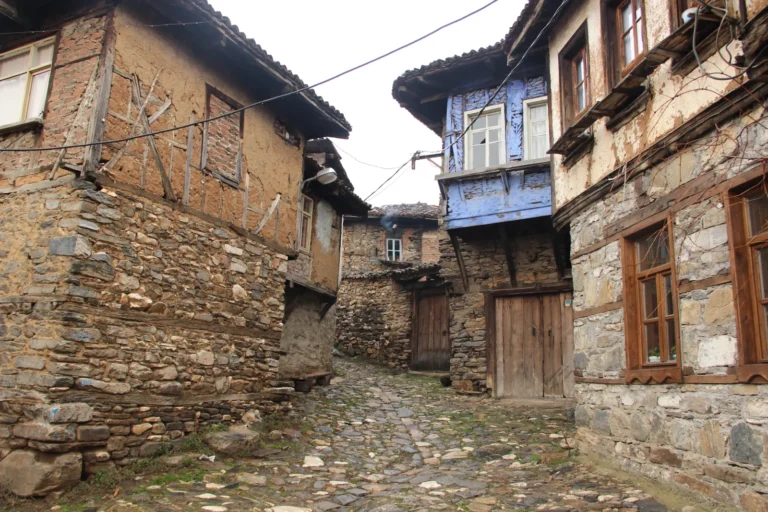
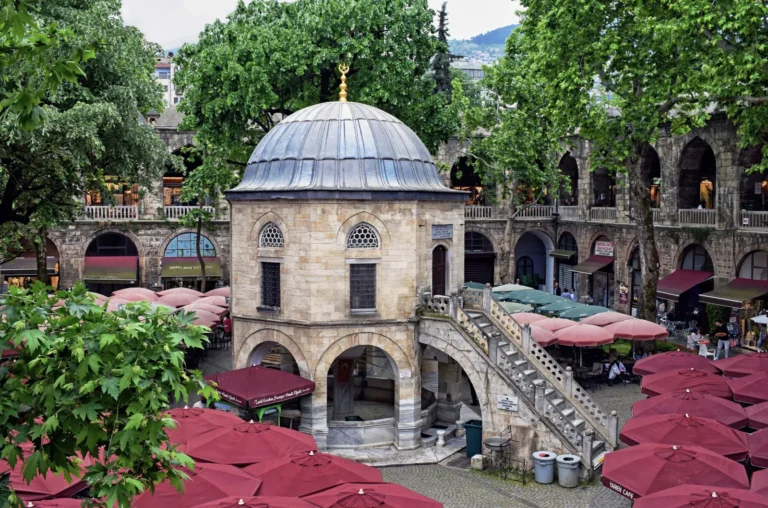
Combining with other visits: The Grand Mosque is the natural starting point for a walking tour of historic Bursa. From here, Koza Han is a two-minute walk. The Orhan Gazi Mosque and Tomb — among the oldest Ottoman structures in the city — are five minutes on foot. The Green Mosque and Green Tomb are a short drive or a 15-minute walk uphill to the east. A morning covering the Grand Mosque, Koza Han, and the Green Mosque complex, followed by lunch in the bazaar quarter, makes for a well-paced half-day. Cumalıkızık village adds an afternoon of 700-year-old Ottoman houses.
Dress code: As an active mosque, modest clothing is required. Women should bring a head covering. Shoes are removed at the entrance. Loaner scarves are sometimes available at the door, but bringing your own is more reliable.
The Grand Mosque of Bursa does not compete with Istanbul’s imperial mosques for size or decorative extravagance. What it offers instead is something those later buildings cannot: the feeling of standing inside the early Ottoman experiment, before the empire knew what it would become. Twenty domes, a fountain catching light from the sky, and six centuries of calligraphy layered onto stone walls. It is one of the most important buildings in Ottoman architectural history, and it sits in the middle of a working city where people still come to pray in it every day.
If you would like to visit Bursa’s Ottoman heritage as part of a private day trip from Istanbul — with a guide who knows the buildings and their stories — tell us what interests you and we will plan the day.