The courtyard is quiet in the morning. A few tea glasses catch the early light on the tables arranged around the central fountain. Pigeons settle on the second-floor balcony railings. Behind the arched doorways that ring the courtyard on two levels, silk merchants are opening their shops — unfolding scarves, arranging bolts of fabric, setting out the day’s display. It is just past nine o’clock, and the routine has the unhurried quality of something that has been happening here, in more or less the same way, for over five hundred years.
This is Koza Han — the Silk Han — in the center of Bursa. Built in 1491 by Sultan Bayezid II, it was the commercial heart of the Ottoman silk trade, the place where raw silk from Iran, China, and the Caucasus was bought, sold, graded, and shipped across an empire. Bursa was the silk capital of the Ottoman world, and Koza Han was the room where the business was done.
Why Bursa and Silk
To understand Koza Han, you need to understand why silk and Bursa are inseparable. When the Ottomans captured Bursa in 1326 — making it their first major capital — the city was already a significant point on the overland trade routes connecting Central Asia to the Mediterranean. Silk was the primary commodity. Raw silk came from Iran and further east, and Bursa’s position at the western end of the overland route made it the natural marketplace where East met West.
By the 15th century, Bursa had become the largest silk trading center in the region. The city’s bazaars handled raw silk, spun silk, and finished silk textiles. The trade was so important that the Ottoman government established regulations specifically governing silk commerce in Bursa — quality standards, pricing controls, and taxation schedules that treated silk as a strategic resource.
Koza Han was built to serve this trade at the highest level. The name itself tells you: “koza” means cocoon in Turkish — the silkworm cocoon from which raw silk is drawn. This was where the raw material was traded before it entered the workshops.
The Building: Ottoman Commercial Architecture
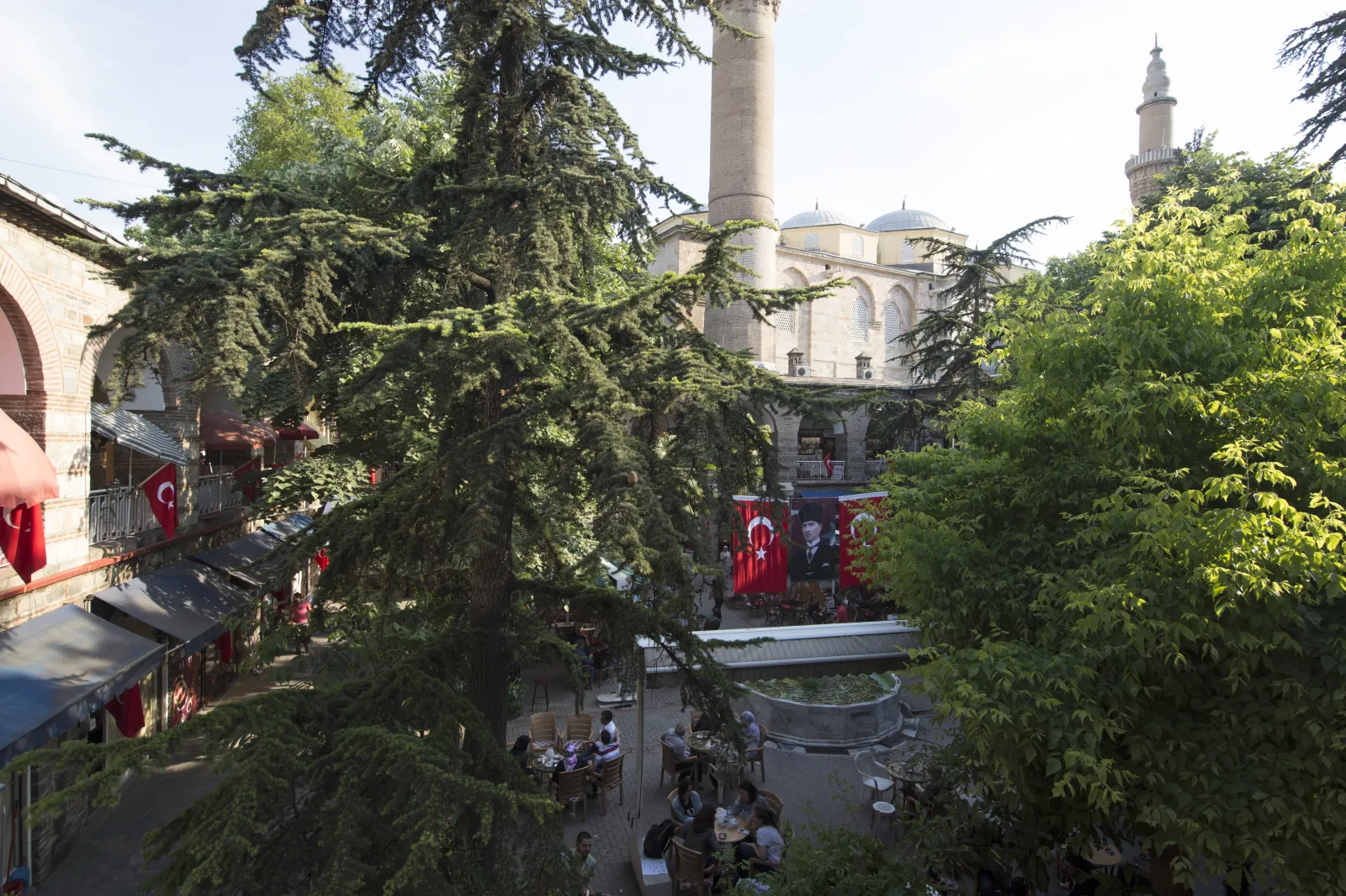
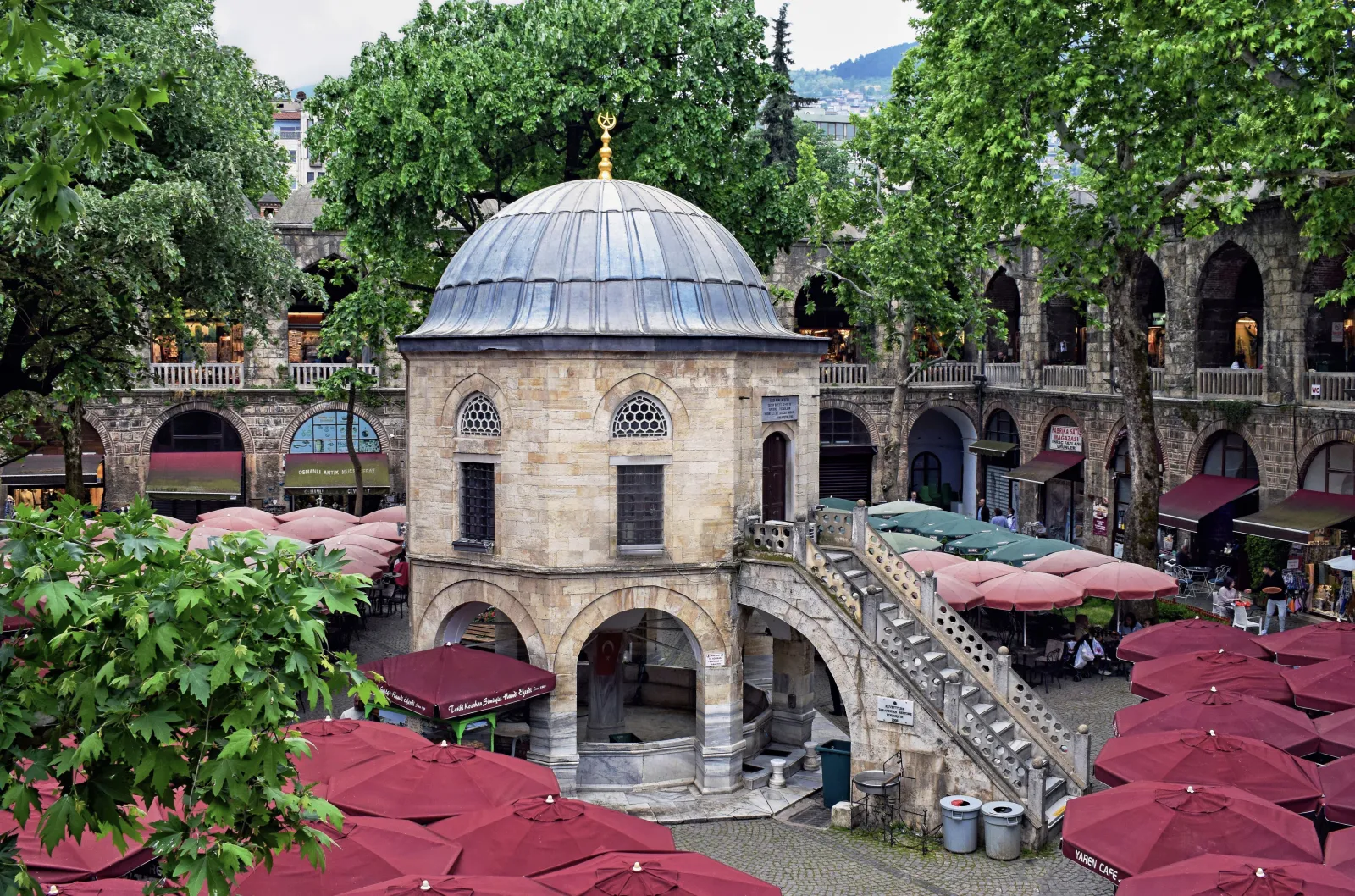
Koza Han follows the classic Ottoman han design — a form that was as standardized and functional as the modern warehouse or office building, but considerably more elegant. The plan is a rectangle enclosing a large open courtyard. Two stories of rooms and shops ring the courtyard behind arched galleries. The ground floor was used for storage and trade — heavy goods, bulk materials, the day-to-day commerce of silk. The upper floor provided lodging for traveling merchants, who would stay for days or weeks while conducting business.
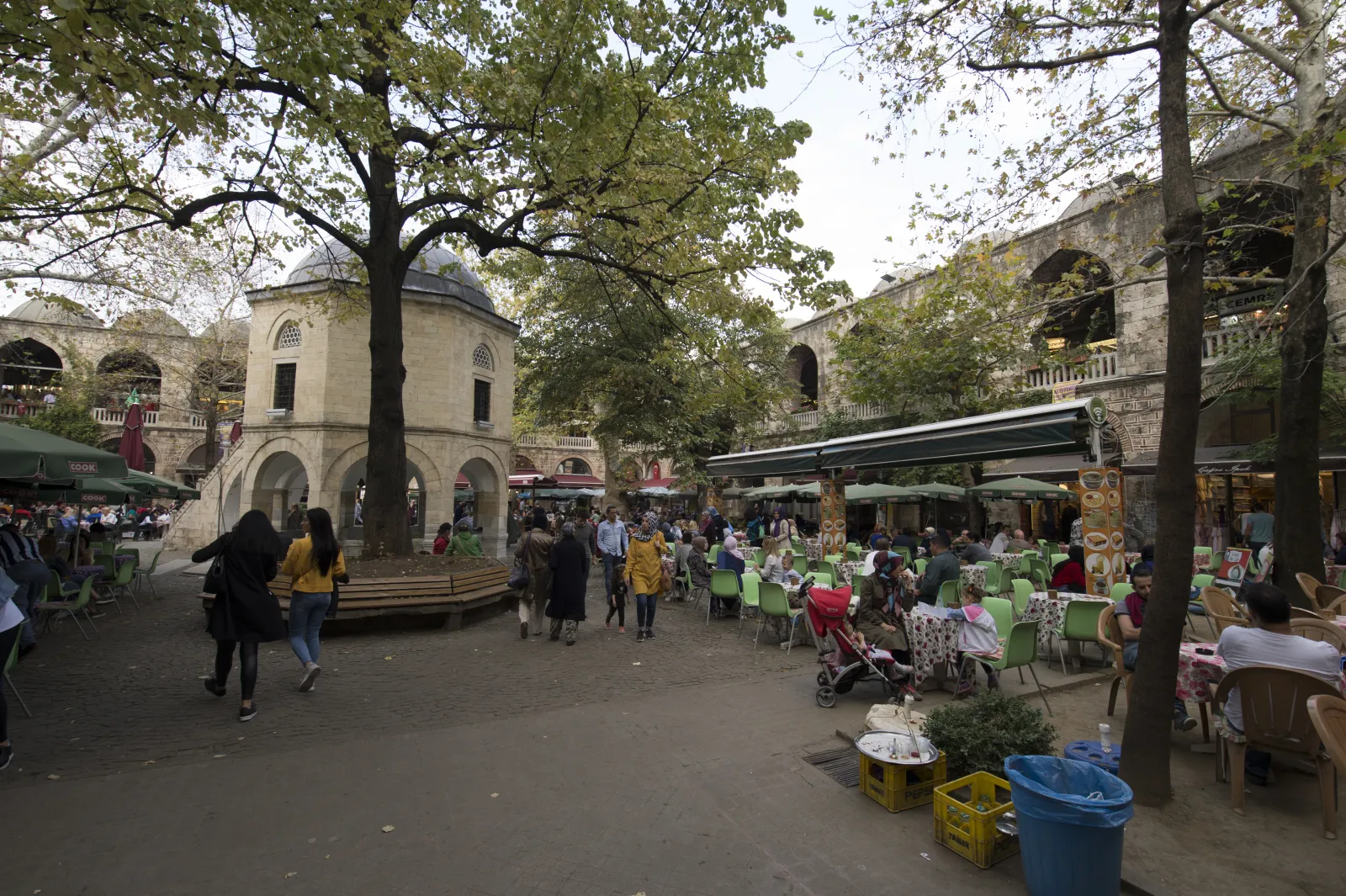
At the center of the courtyard stands a small mosque, elevated on pillars above a fountain. This was not unusual in Ottoman hans — the mosque served the merchants and travelers who lived and worked inside. The fountain provided water for ablution before prayer and, more practically, for the daily needs of the building’s occupants.
The construction is solid: cut stone walls, arched windows, wooden doors, and a tiled roof. The proportions are generous without being grand — the courtyard is large enough to feel open but enclosed enough to feel sheltered. In summer, the courtyard gardens and the shade of the galleries create a microclimate noticeably cooler than the streets outside.
The han has two entrances: one facing the [Grand Mosque (Ulu Cami)](/blog/grand-mosque-ulu-cami-bursa/) and the main bazaar street, the other opening onto a side street. This dual access was practical — merchants needed to move goods in and out without passing through the crowded public areas of the bazaar. The placement of Koza Han, directly adjacent to the Grand Mosque and the commercial center of Ottoman Bursa, was deliberate. It put the silk trade at the civic and spiritual center of the city.
A Day in the Ottoman Silk Trade
Imagine arriving at Koza Han in the 16th century as a silk merchant from Tabriz. You have traveled for weeks along the caravan route through eastern Anatolia, your goods loaded on mules and camels — bales of raw silk, bundled and sealed, representing months of production from Iranian silk farms.
You enter the han, stable your animals in the ground-floor chambers, and carry your goods to the trading floor. A broker — a registered middleman licensed by the Ottoman authorities — inspects your silk, grades it by quality, and negotiates a price with a Bursa textile manufacturer or a European merchant buying for the Venetian or Genoese market. The transaction is recorded by a notary. Taxes are assessed. The silk changes hands.
You sleep upstairs, eat in the courtyard, pray in the small mosque, and when the business is done, you begin the journey home — or move on to the next trading city with the proceeds.
This cycle repeated hundreds of times a year, across dozens of hans in Bursa. But Koza Han handled the premium end of the trade — the finest raw silk, the largest transactions, the merchants with the deepest connections. It was the marketplace of first resort.
The Silk That Dressed an Empire
Bursa silk was not merely a trade commodity. It was a material of state. The Ottoman palace workshops — the Ehl-i Hiref, or community of craftsmen — produced silk textiles for the sultan’s court, including the elaborate kaftans and ceremonial robes that are now among the most prized objects in the Topkapı Palace Museum. The raw material for many of these textiles passed through Bursa, and in many cases through Koza Han itself.
The city’s silk weavers developed distinctive patterns and techniques — the çatma velvet, the kemha brocade, and the seraser, a silk fabric interwoven with gold or silver thread. These textiles were used as diplomatic gifts, sent to foreign courts from Vienna to Persia as demonstrations of Ottoman cultural and economic power. A bolt of Bursa silk was not just fabric. It was a message.
The silk trade also shaped Bursa’s demographics. Armenian, Greek, Jewish, and Persian merchants all maintained communities in the city, drawn by the commerce. The hans accommodated this diversity — they were cosmopolitan spaces by necessity, where language, religion, and origin were secondary to the shared business of trade.
Koza Han Today: What You Find Inside
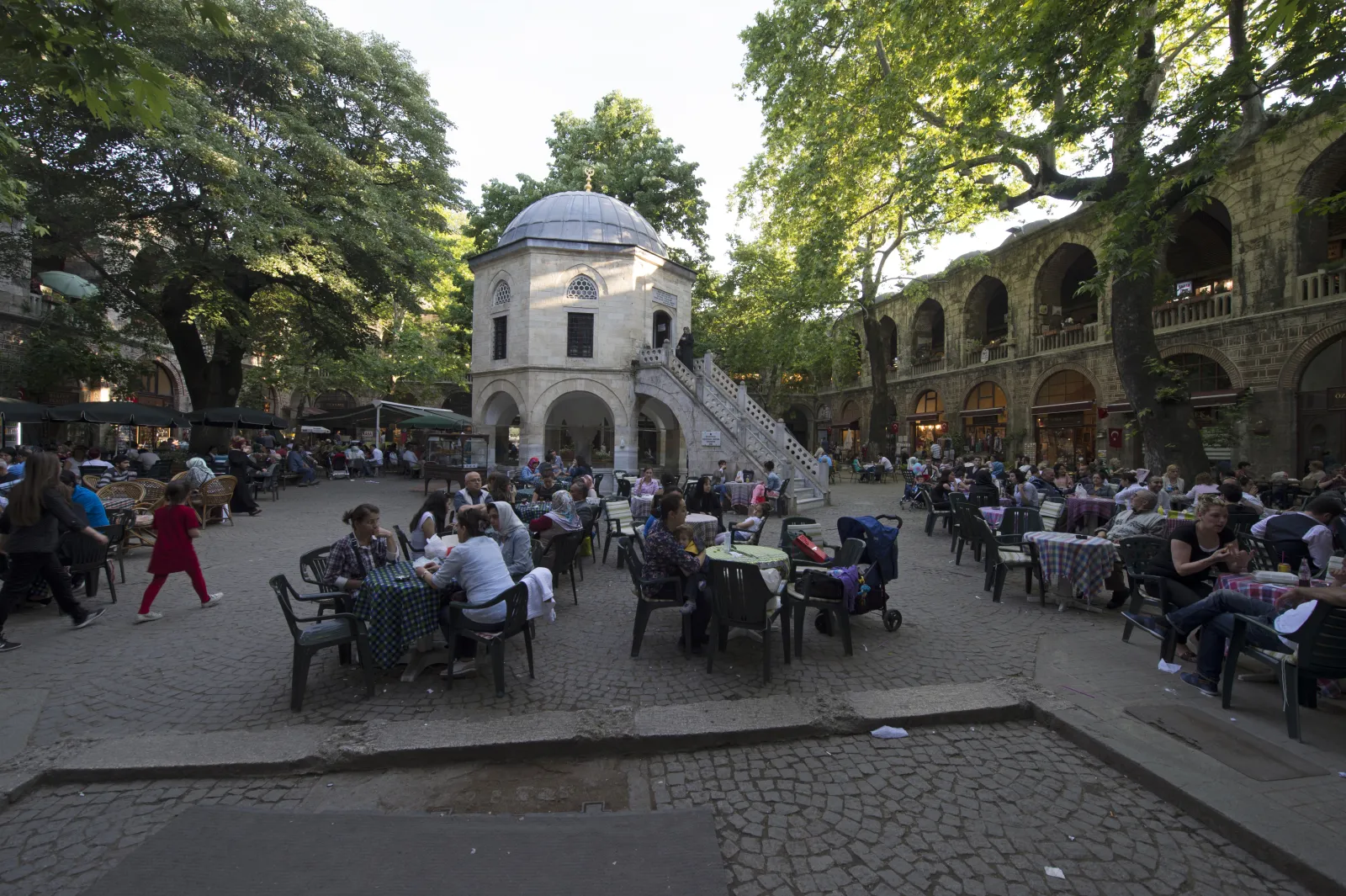
Walk into Koza Han today and the fundamental experience has not changed as much as you might expect. The building is intact. The courtyard is open. The central mosque still stands on its pillars above the fountain. And the shops — nearly all of them — still sell silk.
The ground-floor shops offer finished silk products: scarves, shawls, neckties, fabric by the meter, and small accessories. The quality varies. Some shops sell genuine Bursa silk — heavier, with a particular luster and drape that distinguishes it from synthetic or blended alternatives. Others sell mixed fabrics or imported silk at lower prices. A knowledgeable guide or a willingness to ask questions (“Is this 100% silk? Is it woven in Bursa?”) helps you navigate the difference.
The courtyard tea gardens are one of the quiet pleasures of a Bursa visit. You can sit under the shade of the gallery arches, order a glass of Turkish tea, and watch the life of the han unfold around you. It is not a reconstructed experience. It is a working building where merchants still open their shops every morning, where local customers come to buy silk alongside tourists, and where the courtyard functions as it was designed to function — as a shared public space at the center of commerce.
The upper floor is partially accessible and holds additional shops and, in some sections, offices related to the ongoing silk trade. The views from the upper gallery down into the courtyard give you a sense of the building’s proportions and its architectural logic. When I bring travelers here, I always suggest buying the first tea before visiting any shop — sitting in the courtyard for fifteen minutes first re-sets your sense of pace and turns the rest of the visit into something more relaxed.
Practical Information
Getting there: Koza Han is in the center of Bursa’s historic bazaar district, immediately behind the Grand Mosque (Ulu Cami). If you can find the Grand Mosque — and it is hard to miss — Koza Han is a two-minute walk through the bazaar streets. From Istanbul, the most comfortable day-trip route is the ferry to Mudanya (about two hours) followed by a 30-minute drive, or the Osmangazi Bridge route (about two and a half hours by car).
How much time: Allow 30 to 45 minutes for a relaxed visit — enough time to walk both floors, browse the silk shops, and sit in the courtyard for tea. If you are interested in silk shopping, add another 30 minutes. The courtyard tea stop is worth protecting time for — it is one of the most pleasant places to sit in Bursa.
When to go: Koza Han is open daily, typically from 8:30 AM to 7:00 PM (individual shops set their own hours, and some close earlier). Weekday mornings are quietest. The annual Silk Cocoon Festival (Koza Festivali), usually held in late June or early July, brings additional activity to the han and the surrounding bazaar — if your visit coincides, it is worth seeing.
Official resource: Bursa Governorship — Tourism
Combining with other visits: Koza Han sits at the center of Bursa’s Ottoman heritage district. The Grand Mosque is steps away. The covered bazaar (Kapalı Çarşı) surrounds it. A five-minute walk brings you to the Orhan Gazi Mosque and the foundations of the earliest Ottoman structures in the city. The Green Mosque and Green Tomb are a short drive or a 15-minute walk east. A morning covering the Grand Mosque, Koza Han, and the Green Mosque complex — with lunch in the bazaar — makes for a well-structured half-day. Cumalıkızık village fits an afternoon extension.
What to buy: If you are considering silk, ask about provenance. Genuine Bursa silk is locally woven and has a weight and sheen distinct from imported alternatives. Scarves and shawls are the most practical purchases — packable, lightweight, and available in a range that accommodates both modest budgets and serious investment. Prices for a genuine silk scarf typically start around 200-300 Turkish Lira, with finer pieces considerably more.
There is a temptation to treat Koza Han as a “silk shopping stop” — a box to check on a Bursa itinerary. It is more than that. It is a 15th-century building that is still doing what it was built to do. The merchants have changed, the silk comes from different sources, and the camels have been replaced by delivery trucks. But the courtyard, the fountain, the small mosque on its pillars, and the rhythm of commerce around a shared open space — those have held for five centuries.
If you would like to visit Koza Han and Bursa’s Ottoman heritage as a private day trip from Istanbul — with a guide who can take you through the history, the architecture, and the silk trade at a pace that suits you — tell us what interests you and we will plan the day.