There is a color you will see in Bursa that you will not find anywhere else in quite the same way. It is not the green of nature or paint. It is the green of glazed ceramic tile — turquoise shading into deep emerald, layered and luminous, covering the interior walls of a 15th-century mosque with a density and quality that stops you mid-step.
The Green Mosque — Yeşil Cami — and the Green Tomb — Yeşil Türbe — sit across the street from each other on a hillside in eastern Bursa. They were built between 1419 and 1421 by Sultan Mehmed I, the ruler who reunified the Ottoman state after a decade of civil war following his father Bayezid I’s defeat by Tamerlane in 1402. That context matters. These buildings were not simply acts of piety. They were statements of legitimacy — a sultan proving that the empire was whole again, that order had been restored, that the dynasty’s artistic ambition had survived.
The tiles inside are the proof.
The Green Mosque: A Mosque Like No Other in Ottoman Architecture
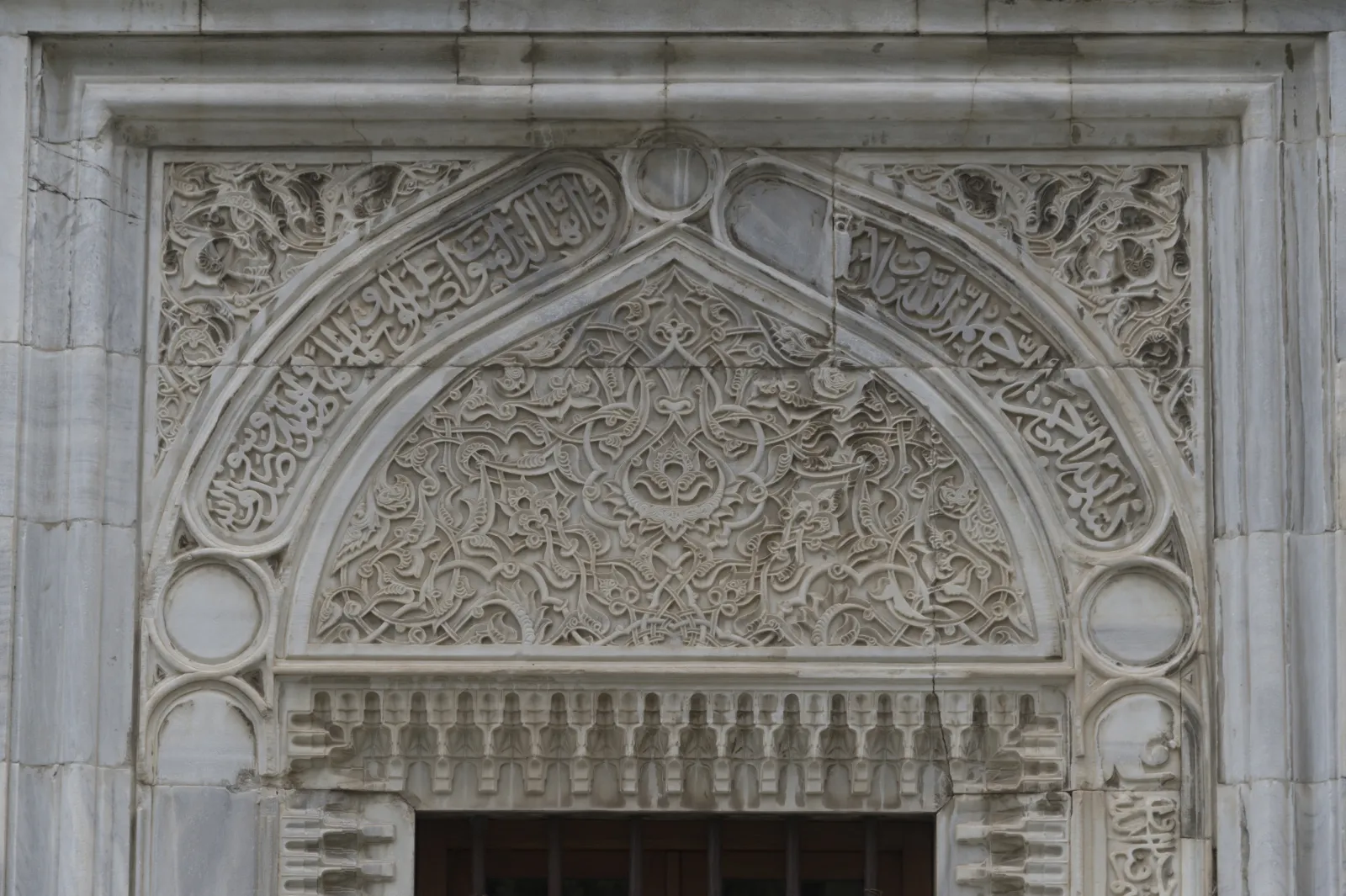
The Green Mosque follows what architectural historians call the T-plan — a form unique to the early Ottoman period. Rather than the single vast prayer hall that defines later imperial mosques in Istanbul, the T-plan arranges rooms symmetrically around a central hall, creating a building that functions as much as a meditative retreat as a place of congregational worship. The floor plan, viewed from above, traces the shape of an inverted T.
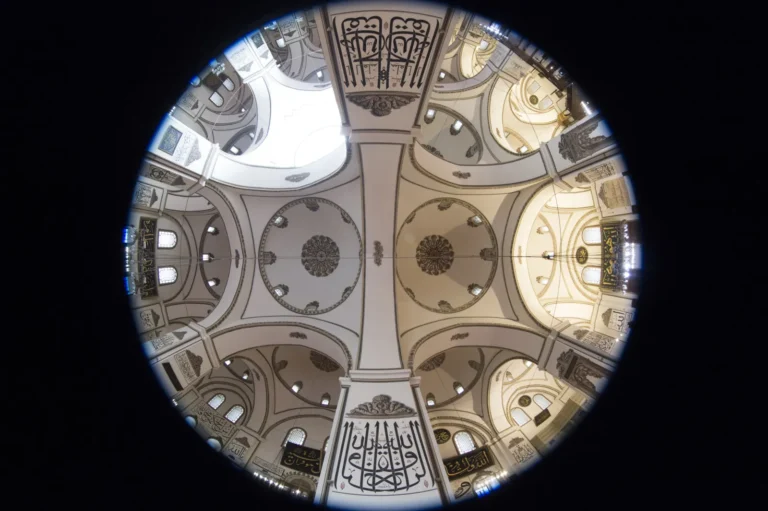
You enter through a carved marble portal into a vestibule, then step into the central hall. Above you, the dome is open to a small oculus — an opening that originally let light and air into the space in a way that connected the interior to the sky. Below the dome, a marble fountain once caught rainwater. The sound of water falling into stone was part of the building’s design.
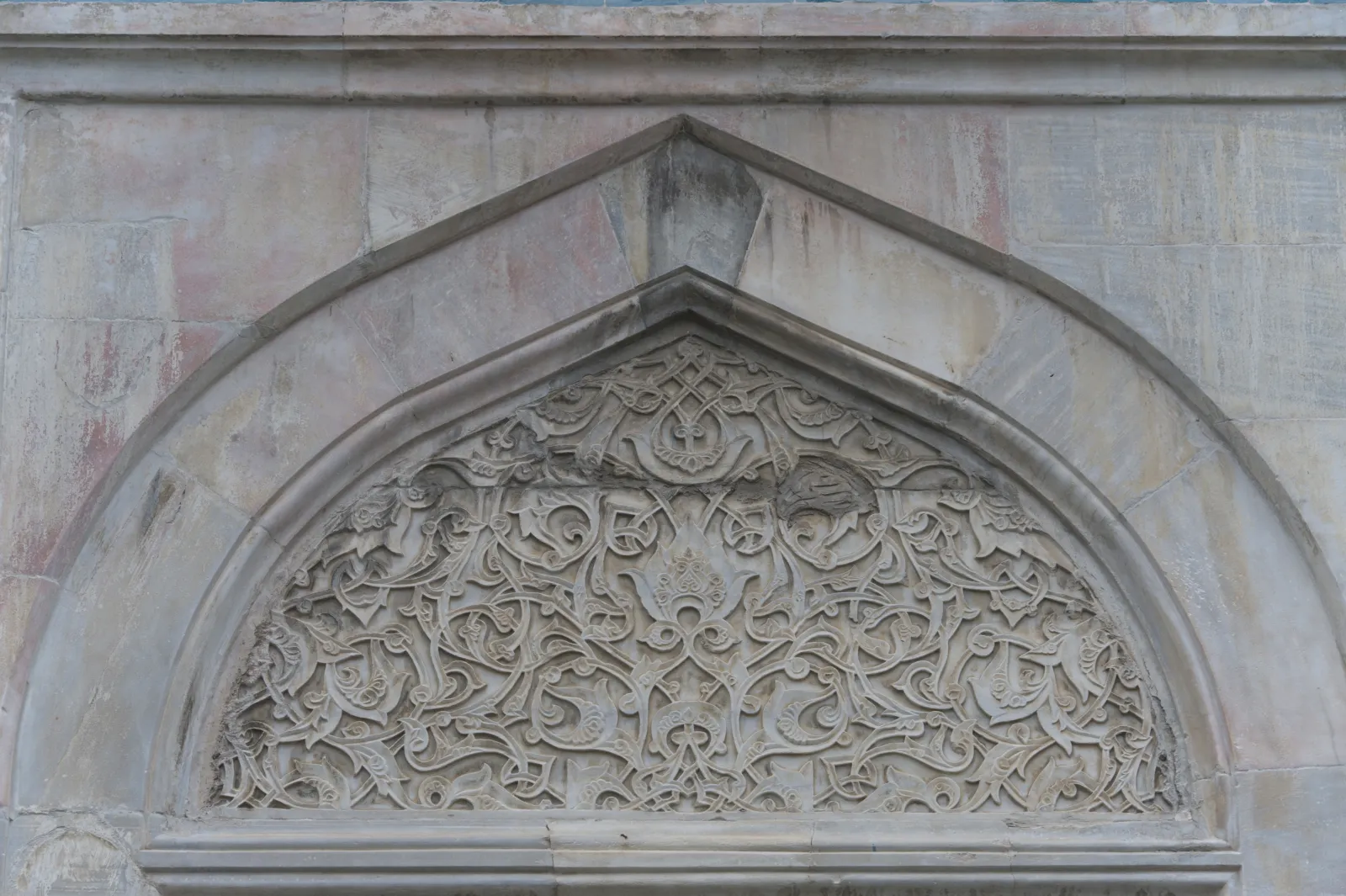
The rooms on either side of the central hall are elevated — you step up to enter them. These side chambers were used for prayer, study, and retreat by the sultan and his court. The imperial loge, the elevated gallery where the sultan himself prayed, sits above the entrance and is reached by a staircase within the walls. The tiles in the imperial loge are the finest in the entire building.
And those tiles. The mihrab — the prayer niche indicating the direction of Mecca — is covered floor to ceiling in glazed ceramic tiles in shades of turquoise, cobalt blue, green, and white, with intricate geometric and floral patterns that interlock without repetition. The technique is cuerda seca — a method where colored glazes are separated by thin lines of a waxy substance that burns away during firing, leaving crisp outlines between each color field. This is not painted decoration. Each tile is individually glazed, fired, and fitted into a composition that covers entire walls.
The tilework at the Green Mosque represents the finest surviving example of early Ottoman ceramic art. It predates the great Iznik tile workshops of the 16th century by nearly a hundred years. What you are looking at is the beginning — the moment when Ottoman craftsmen, drawing on Seljuk and Central Asian traditions, began developing the glazed tile aesthetic that would later cover the walls of Istanbul’s imperial mosques.
The color range is narrower than what came later — the famous tomato red of Iznik tiles had not yet been developed — but within that range, the work is precise, confident, and deeply considered. Every surface that could be tiled has been tiled. The effect is immersive: you are standing inside a room lined with color. When I bring travelers here, I always suggest spending the first minute just standing in the central hall without speaking — the tilework rewards slow looking, and the chatter of a group erases what makes the room work.
The Green Tomb: A Sultan’s Final Statement
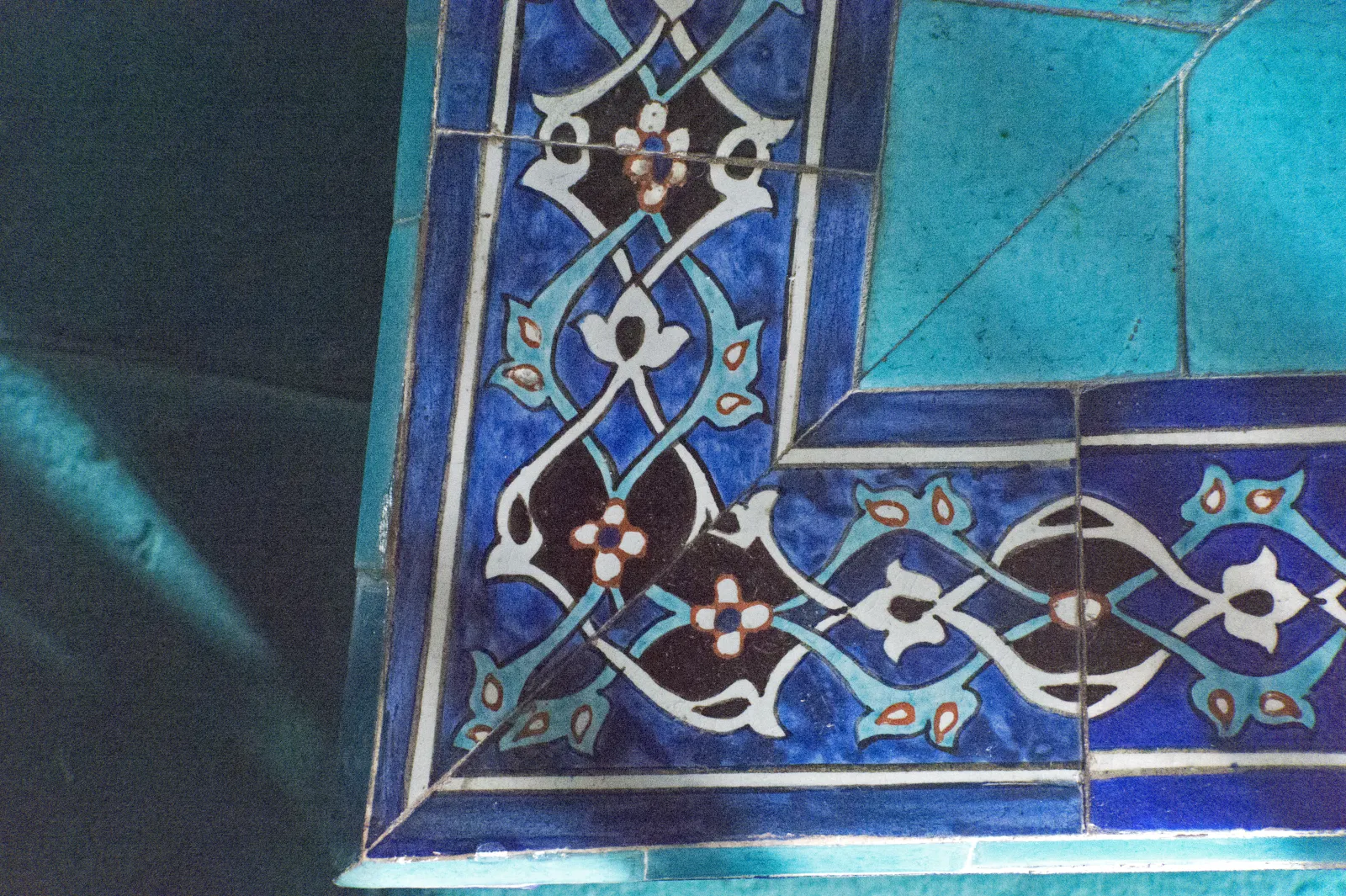
Walk across the street and slightly uphill and you reach the Green Tomb — Yeşil Türbe — the octagonal mausoleum where Sultan Mehmed I is buried. The building is immediately recognizable from a distance because its exterior is covered in turquoise tiles. This is unusual. Most Ottoman tombs are faced in stone. The Green Tomb’s tile-covered exterior was a deliberate choice, linking the building visually and materially to the mosque below.
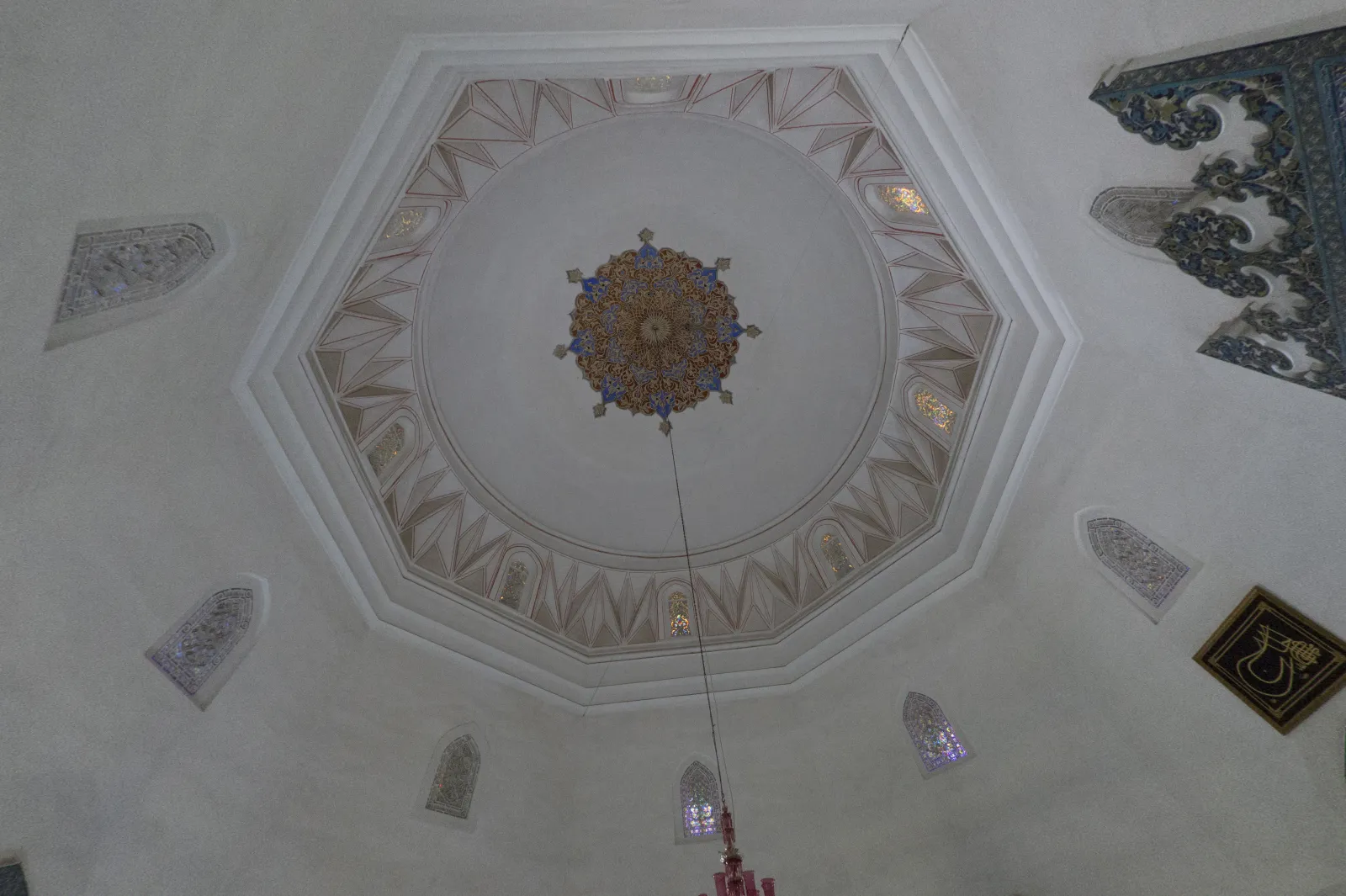
Inside, the tomb is a single octagonal room under a dome. The sultan’s sarcophagus sits at the center, raised on a tiled platform. The sarcophagus itself is covered in tiles — the same cuerda seca technique as the mosque, with the same turquoise and cobalt palette, but here the patterns are more densely worked. Calligraphic inscriptions run along the upper walls, Quranic verses rendered in white on blue in a flowing thuluth script.
The other sarcophagi in the room belong to members of the sultan’s family — his sons and other relatives. The room is smaller than you expect, which makes the tilework feel closer, more intimate. Where the mosque’s tiles create an expansive, immersive environment, the tomb’s tiles create something more personal — a final room, decorated with the best the empire could produce.
The current exterior tiles are largely 19th-century replacements — the originals were damaged by the 1855 Bursa earthquake. The interior tiles, however, are substantially original. The difference in quality between the two is visible if you look carefully: the interior tiles have a depth and luminosity that the replacements approximate but do not quite match.
The T-Plan: A Lost Ottoman Form
The T-plan mosque is worth understanding because it disappeared. After the Ottoman capital moved from Bursa to Edirne and then to Istanbul, the imperial mosque form evolved toward the vast single-domed prayer hall — Hagia Sophia‘s influence pulling Ottoman architecture in a different direction. The T-plan, with its intimate chambers and its emphasis on retreat and meditation rather than congregational scale, was left behind in the early capitals.
Bursa has several T-plan mosques — the Green Mosque is the finest, but the Muradiye Mosque complex and others in the city follow similar principles. Visiting Bursa gives you access to this early chapter of Ottoman architecture in a way that Istanbul cannot. Istanbul shows you what the Ottomans became. Bursa shows you where they started.
The Green Mosque was never fully completed. Sultan Mehmed I died in 1421, the same year the mosque was finished, and some of the planned decorative work — particularly on the exterior — was left undone. The architect, Hacı İvaz Paşa, had designed a more elaborate portal and facade than what was ultimately built. What survives is remarkable for what it is. What was planned would have been even more so.
The Craftsmen Behind the Tiles
The master craftsman responsible for the tilework is known — his name, Mehmed the Mad (Mecnun), is inscribed on the mihrab. This is rare for the period. Ottoman craftsmen did not routinely sign their work, and the fact that Mehmed’s name appears on the most important surface in the building tells you something about the esteem in which he was held.
The workshop that produced the tiles was based in Bursa, drawing on artisan traditions from Tabriz and Samarkand — cities whose craftsmen had come to Anatolia in the wake of Tamerlane’s campaigns. The Central Asian influence is visible in the color palette and the geometric programs, which share DNA with Timurid tilework in present-day Uzbekistan. The Green Mosque sits at a crossroads of artistic traditions: Seljuk, Central Asian, and the emerging Ottoman synthesis that would define the next four centuries.
Practical Information
Getting there: Bursa is approximately 150 kilometers south of Istanbul. The most scenic approach is by ferry from Istanbul’s Yenikapı terminal to Mudanya (about two hours), then a 30-minute drive to Bursa. Alternatively, the fast ferry to Yalova (one hour) plus a 45-minute drive through the mountain road is slightly quicker. By car or private transfer from Istanbul, the drive takes about two and a half hours via the Osmangazi Bridge.
How much time: Allow 45 minutes to an hour for the Green Mosque and Green Tomb together. The buildings are small enough to see thoroughly in that time, but the tile details reward slow looking. Budget additional time if you want to visit the nearby Bursa Turkish and Islamic Arts Museum, which occupies the former madrasa of the Green Mosque complex.
When to go: Weekday mornings are quietest. The mosque is an active place of worship, so Friday midday prayer times mean limited tourist access. Spring and autumn are the most comfortable seasons for a Bursa visit. Summer is warm but not oppressive. Winter can be cold — Bursa sits at the foot of Uludağ, and the city gets genuine winter weather.
Official resource: Bursa Governorship — Tourism
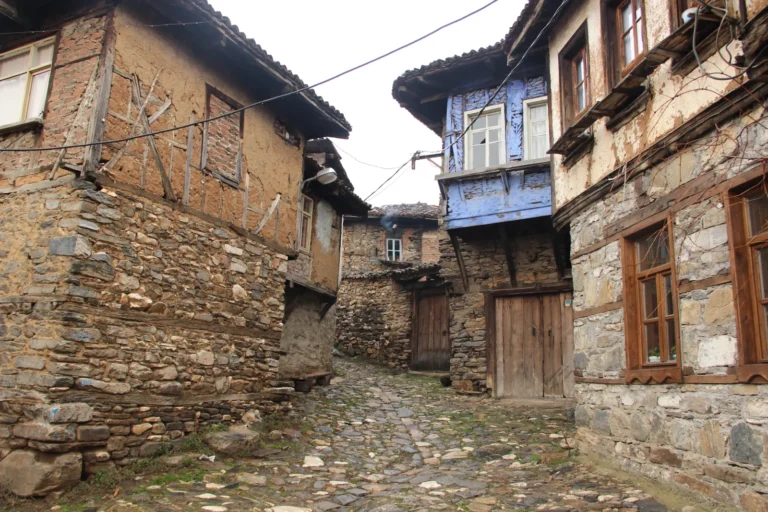
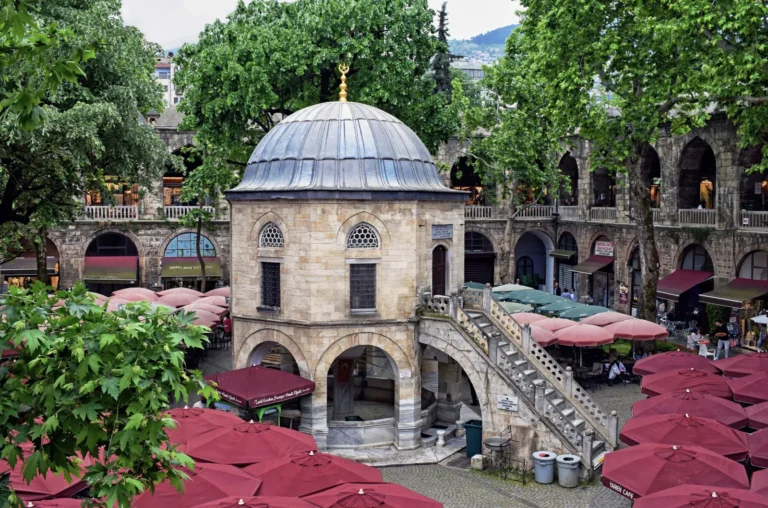
Combining with other visits: The Green Mosque and Green Tomb pair naturally with the Grand Mosque (Ulu Cami), Koza Han, and the historic Muradiye complex, all within a few kilometers of each other. A full day in Bursa can comfortably cover the major Ottoman sites, a walk through the old bazaar quarter, and a lunch of İskender kebab — the dish Bursa invented. Cumalıkızık, the UNESCO-listed Ottoman village, is a 15-minute drive east of the city and makes a rewarding morning or afternoon addition.
The Green Mosque and Green Tomb are not the largest or the most famous Ottoman buildings. They are, however, among the most beautiful — and they show you something that the imperial mosques of Istanbul, for all their scale, cannot: the moment when Ottoman art found its voice. The tiles in this small hillside mosque are the foundation on which the entire tradition was built.
If you would like to visit Bursa’s Ottoman heritage as a day trip from Istanbul — with a guide who can walk you through the tilework, the architecture, and the history at a pace that lets you actually see it — tell us what interests you and we will plan the day.