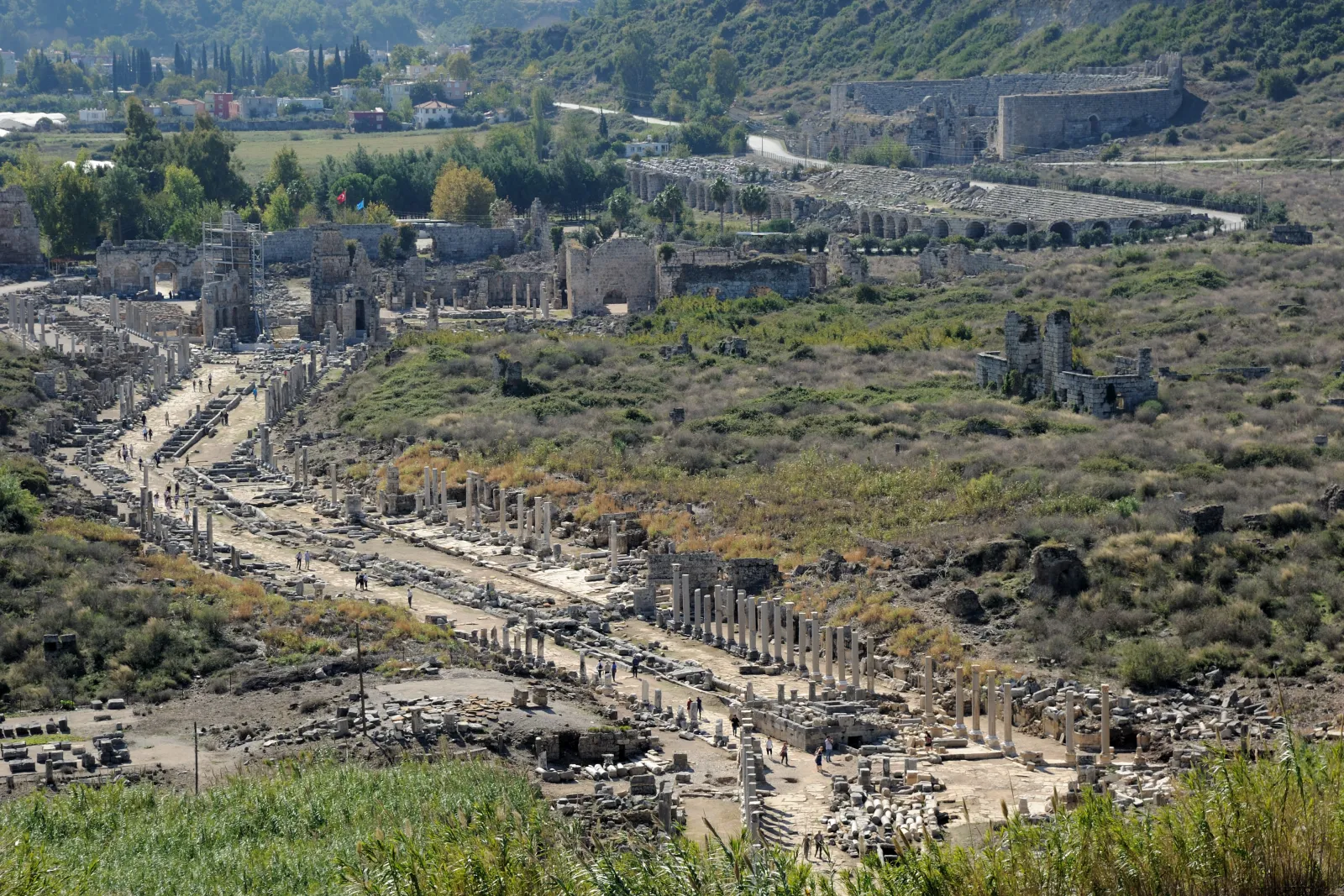
Eighteen kilometers east of Antalya, just off the highway toward Side, the ancient city of Perge spreads across a flat plain backed by low hills. It does not occupy a dramatic clifftop or a forested slope. There is no sea view. What Perge offers instead is something rarer: one of the most complete Roman urban layouts in Turkey, its street grid still legible after nearly two thousand years. You can stand at the southern gate and look north along the colonnaded main street — the nymphaeum fountain at the far end, the acropolis hill behind it — and understand how a Roman city was organized. The bones of the place are intact.
Perge was not a minor city. At its peak in the second and third centuries AD, it was the capital of the Roman province of Pamphylia, home to perhaps 100,000 people. The apostle Paul stopped here on his first missionary journey — Acts 13:13 mentions the city by name. The mathematician and astronomer Apollonius of Perga, who defined the mathematical terms for ellipse, parabola, and hyperbola, was born here in the third century BC. The city’s patron deity was Artemis Pergaia, whose temple — still unlocated — drew pilgrims from across the Mediterranean world.
What you walk through today is primarily the Roman-era city, built over earlier Hellenistic foundations, with some later Byzantine additions. The site is large but flat, which makes it accessible and easy to navigate. It is also less visited than Ephesus or Aspendos, which means you can often walk the colonnaded street without crowds.
The Hellenistic Gate and Towers
The approach to Perge begins at the Roman gate — a broad entrance flanked by towers — which leads into a horseshoe-shaped courtyard. Behind this, the earlier Hellenistic gate stands: two round towers, still rising to a considerable height, that date to the third century BC. These towers are among the best-preserved Hellenistic fortification elements in southern Turkey. Between the two gates, the courtyard was lined with niches that once held statues of the city’s founders and benefactors. Many of these statues were recovered during excavations and are now displayed in the Antalya Archaeological Museum — they are among the museum’s finest pieces.
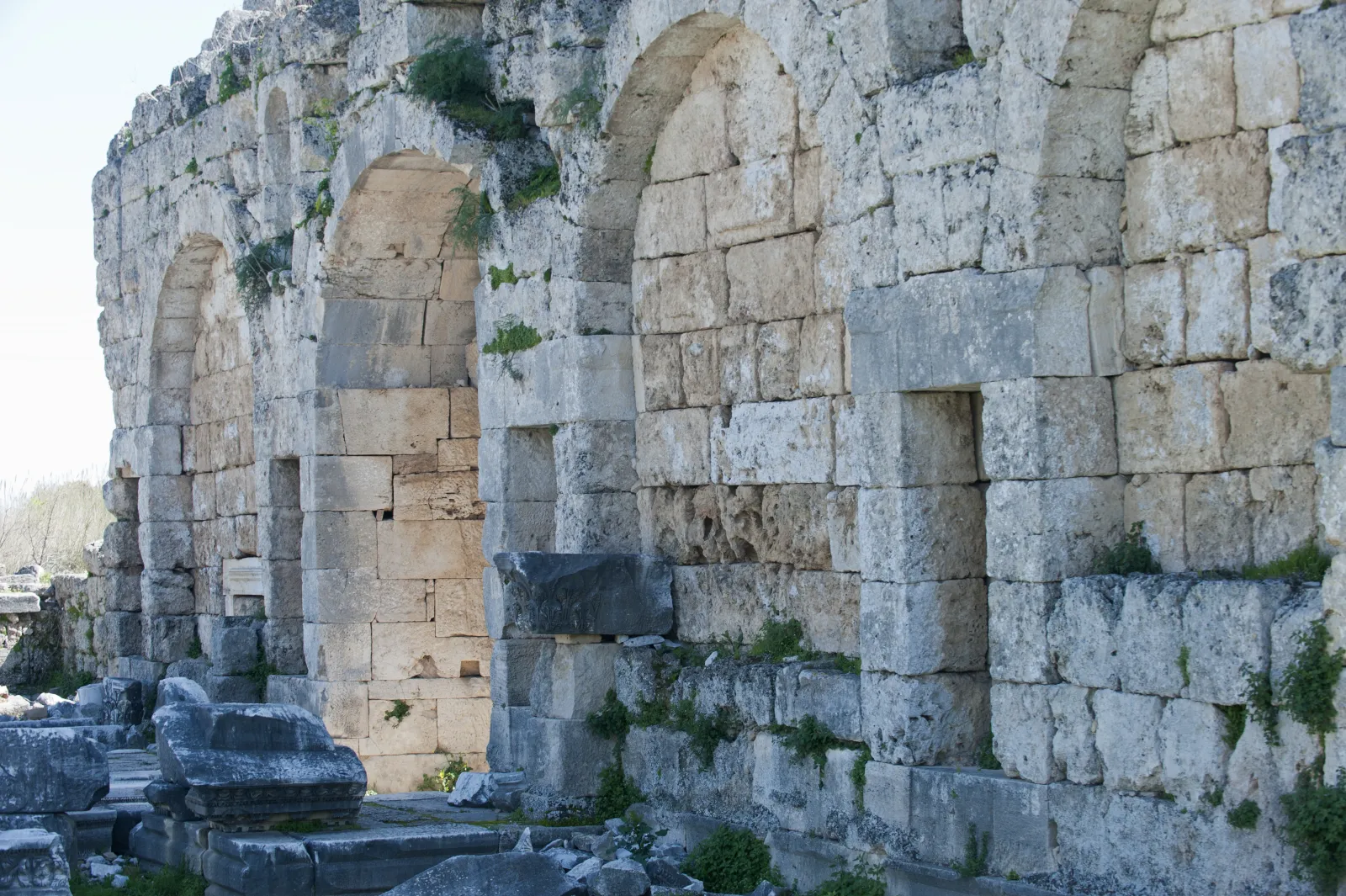
The layering here tells you something about Perge’s history: the city existed long before Rome. Founded, according to tradition, by Greek colonists after the Trojan War, it was already centuries old when Alexander the Great passed through in 333 BC. The Hellenistic gate predates the Roman additions by several hundred years. Rome did not build Perge from scratch — it enlarged and enriched an existing city.
The Colonnaded Street
The main street runs roughly north-south from the Hellenistic gate toward the acropolis hill. It is wide — about 20 meters — and lined on both sides with columns that once supported covered porticoes. Down the center runs a water channel, a narrow stone-lined canal that carried water from the nymphaeum at the northern end to the southern gate. The columns, many still standing or re-erected during restoration, give the street its defining character: a sense of scale that communicates civic ambition.
The shops and workshops that lined the street behind the porticoes are visible as a series of small rooms opening onto the covered walkway. This was the commercial heart of Perge — the ancient equivalent of a shopping street with covered sidewalks. The design is practical: the porticoes provided shade in Pamphylia’s hot summers and shelter from winter rain.
Halfway along the street, a monumental intersection marks the crossing of the main north-south and east-west streets — the cardo and decumanus of Roman urban planning. Perge’s grid is textbook Roman city design, and walking it gives you a tangible understanding of how these cities were organized.
The Stadium
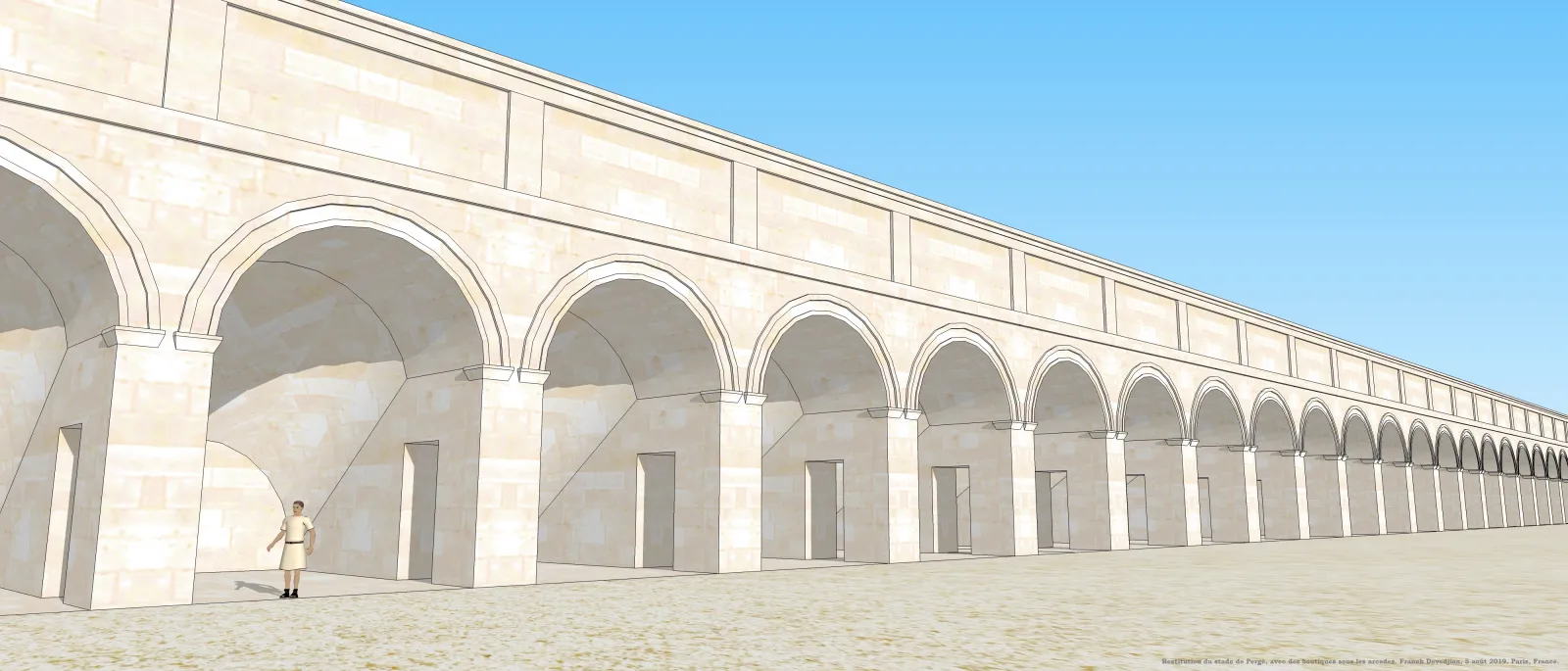
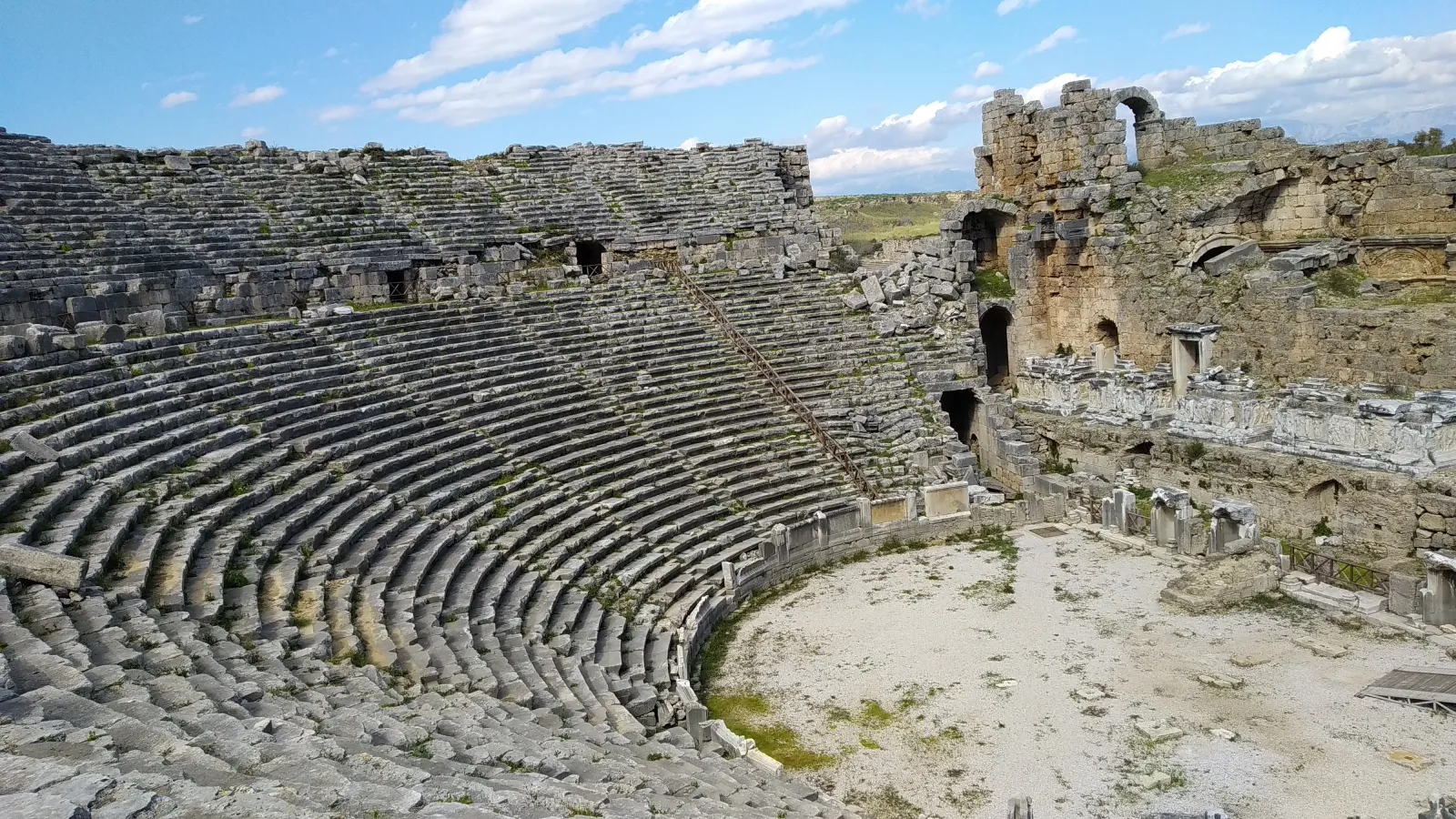
Perge’s stadium is one of the best-preserved in the ancient world. Built in the second century AD, it held approximately 12,000 spectators in rows of stone seating that rise along the hillside. The structure is 234 meters long and 34 meters wide. Beneath the seating rows, a series of barrel-vaulted chambers served as shops — their arched entrances still visible along the exterior. This was a common arrangement in Roman stadia: commerce funded entertainment, and spectators could shop on their way to the games.
The stadium hosted athletic competitions, not gladiatorial combat (that was the theater’s function in some cities, though Perge also had a dedicated theater). Walking through the vaulted chambers beneath the seats, you get a strong sense of the structure’s engineering — the weight of stone above, the careful distribution of forces through the arches.
The Roman Baths
Near the southern gate, the Roman baths complex covers a large area. The layout follows the standard Roman progression: frigidarium (cold room), tepidarium (warm room), caldarium (hot room). The hypocaust system — the raised floor through which hot air circulated to heat the rooms — is visible in several sections where the floor has collapsed or been excavated, exposing the small brick pillars (pilae) that supported it.
The baths were not just about hygiene. They were social centers — the Roman equivalent of a club or community center. Perge’s baths are large enough to suggest a city that invested heavily in public amenities, which aligns with the inscriptions and statues that record the generosity of wealthy citizens who funded these buildings.
The Nymphaeum and Acropolis
At the northern end of the colonnaded street, the monumental nymphaeum — a decorative fountain — once rose in two stories against the base of the acropolis hill. Water cascaded down the facade and into the channel that ran the length of the main street. The nymphaeum was Perge’s showpiece: elaborately decorated with statues, columns, and carved marble panels. Much of the sculptural decoration has been removed to the Antalya Museum, but the architectural shell gives you the scale.
Behind the nymphaeum, the acropolis hill rises — the original settlement site, occupied since at least the Bronze Age. The hill is accessible but the remains on top are limited and the climb is steep. The view from the top, however, gives you a perspective on the city’s layout that you cannot get from street level: the grid becomes visible, the stadium’s full length is apparent, and the relationship between the city and the surrounding plain becomes clear.
Perge and the Antalya Museum
A visit to Perge is significantly enriched by a visit to the Antalya Archaeological Museum, either before or after. The museum holds the sculptural wealth that was excavated from Perge — portrait statues, sarcophagi, relief panels, and architectural fragments that once decorated the gate courtyard, the nymphaeum, and the public buildings. The statues from the gate courtyard alone constitute one of the finest collections of Roman portrait sculpture in Turkey. Seeing the empty niches at Perge and then the statues that filled them at the museum (or vice versa) creates a connection between site and artifact that deepens both experiences. When I plan Perge with travelers, I always do the museum first — seeing the statues in isolation and then arriving at the gate courtyard where they once stood reorders the visit in a way the other direction cannot.
Practical Information
Getting there: Perge is 18km east of Antalya center, just north of the D400 highway toward Side. By car, the drive takes about 25 minutes from Kaleiçi. The site is signed from the highway. There is no direct public transit to the entrance, though the Aksu district is served by city buses — the walk from the main road to the site entrance is about 1.5km.
How much time: Plan for 1.5 to 2 hours to walk the full site at a comfortable pace. The site is flat, which makes walking easier than at many ancient sites, but there is limited shade — sun protection matters in summer.
When to go: Early morning or late afternoon, especially from May through October. Midday heat on the open plain is intense. Spring (March–May) and autumn (September–November) are ideal — comfortable temperatures and good light for photography.
Official resource: Antalya Museum — Ministry of Culture
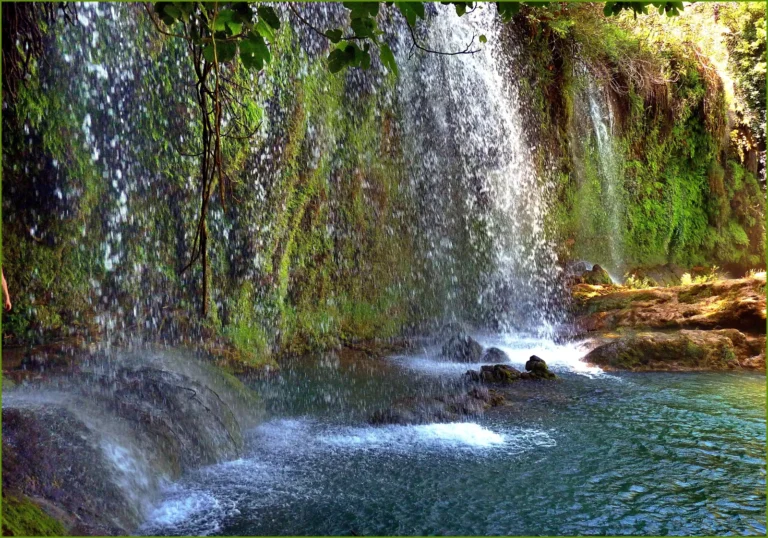
Combining with other visits: Perge pairs naturally with the Antalya Archaeological Museum (to see the statues from the site) and Aspendos (30 minutes further east). A full day combining Perge, Aspendos, and the museum covers the major Roman sites of the Antalya region. Add Kurşunlu Waterfall for a mid-day shaded break, or close the day in Kaleiçi.
Plan Your Antalya Visit
Perge is a city you read on the ground — its street grid, its water engineering, its stadium, its layered gates all tell a story that is easier to grasp when someone is there to translate the stones into narrative. If you would like to visit with a private guide who can connect the ruins to the history, tell us what interests you and we will shape the day around it.