You lower yourself into the water and your feet find something that is not the pool floor. It is round, smooth, and distinctly carved. You look down through the clear, slightly effervescent water and realize you are standing on a Roman column — a section of fluted marble that fell into this thermal spring roughly 1,400 years ago and has been lying here, underwater, ever since.
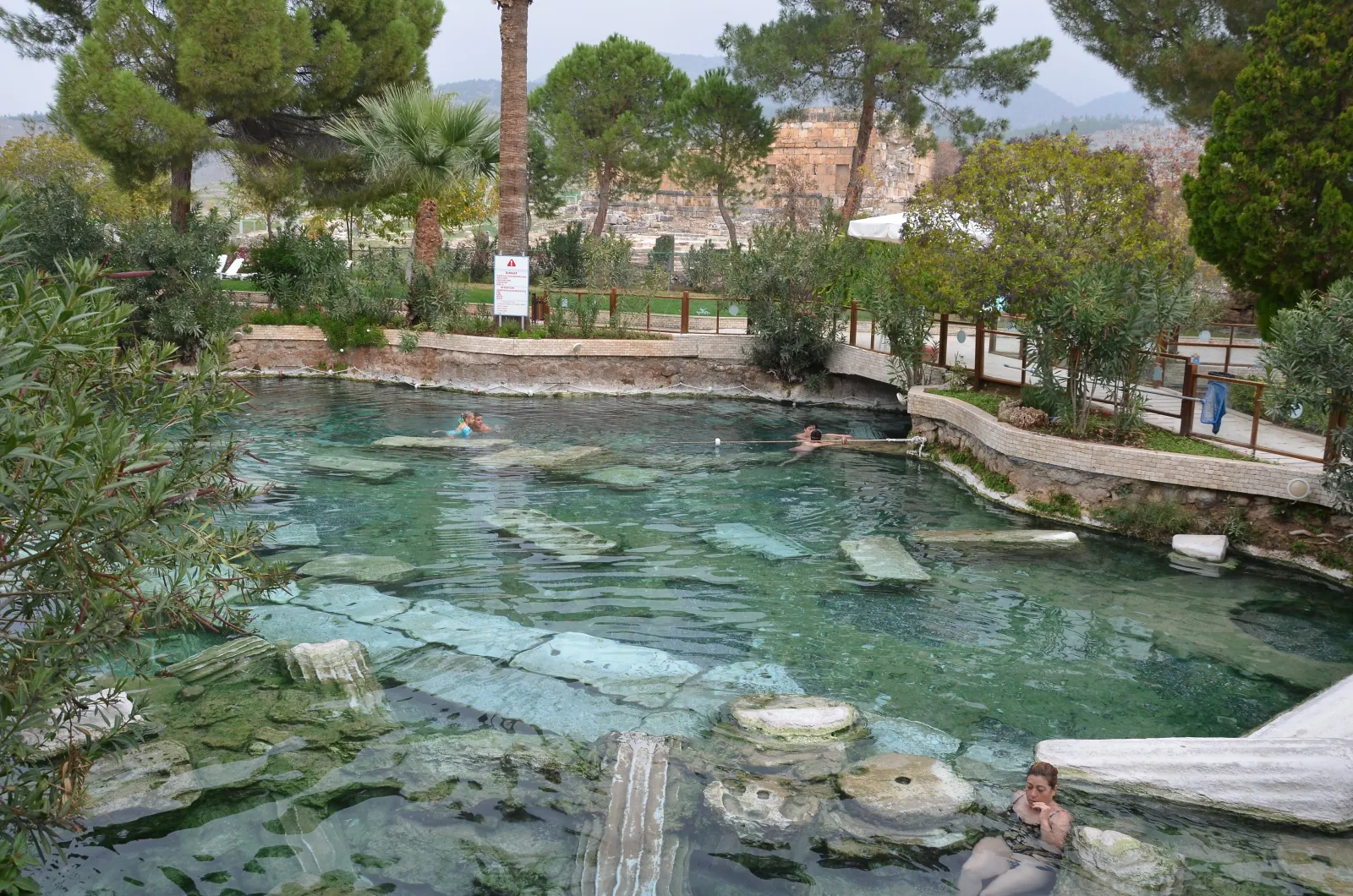
This is Cleopatra’s Pool — also called the Antique Pool — at the Hierapolis archaeological site in Pamukkale. It is a thermal swimming pool where the water is 36°C year-round, rich in dissolved minerals, and filled with the submerged ruins of buildings that collapsed during earthquakes in the 7th century AD. You swim among column drums, carved capitals, blocks of worked stone, and fragments of architectural decoration, all resting on the pool floor in the positions where they fell.
There is nothing quite like it anywhere else.
What You Are Actually Swimming In
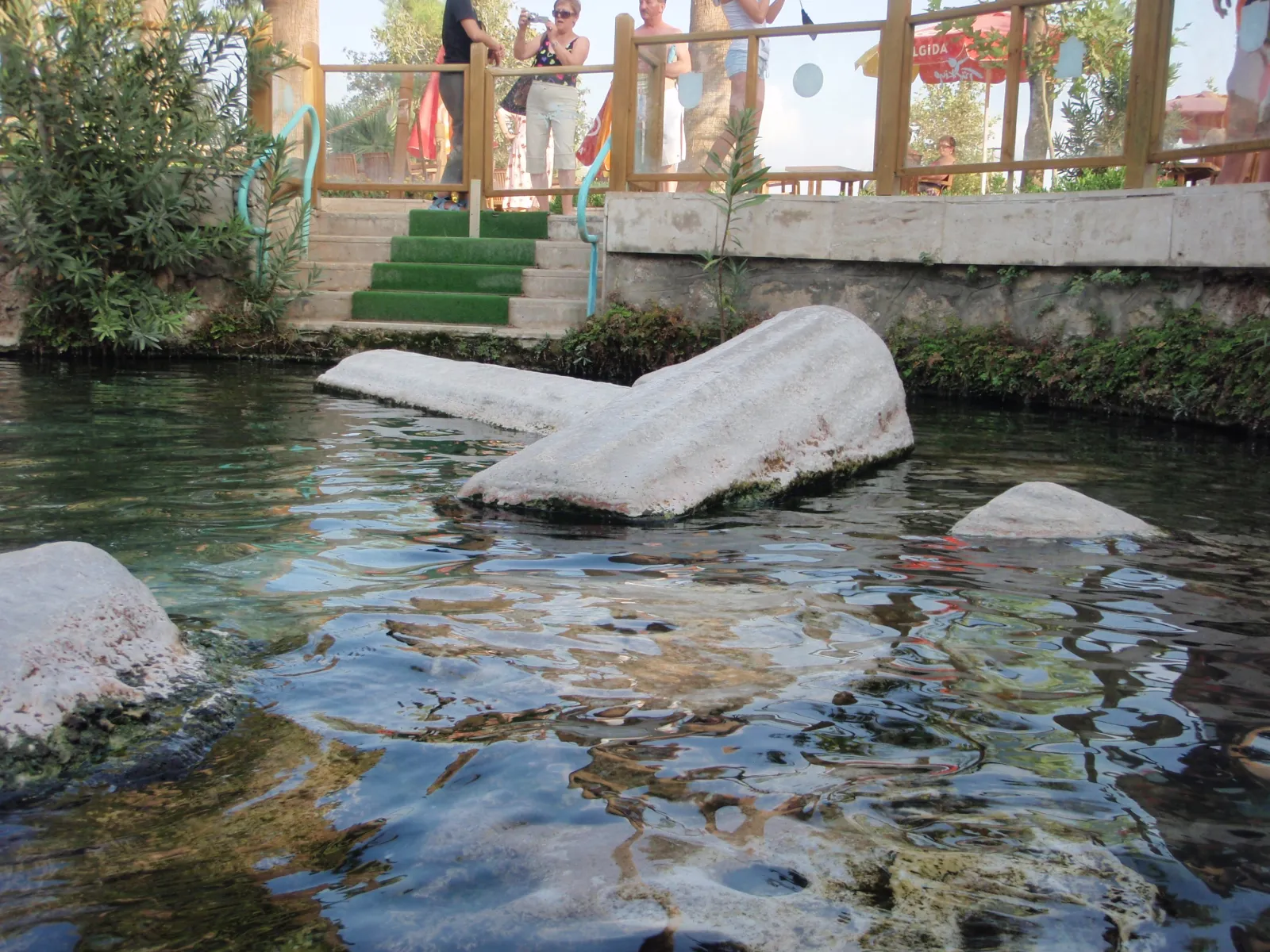
The pool is fed by the same thermal springs that created the Pamukkale travertines below — the white calcium carbonate terraces that cascade down the hillside and draw visitors from around the world. The water emerges from underground at approximately 36°C, saturated with calcium bicarbonate, sulfate, and carbon dioxide. The slight fizzing you feel on your skin is dissolved CO2 coming out of solution — the same process that, outdoors on the cliff face, deposits the white travertine that gives Pamukkale its cotton castle appearance.
The mineral content of the water has been analyzed extensively. It contains calcium, magnesium, bicarbonate, and sulfate in concentrations that place it in the category of thermal mineral water used historically for balneotherapy — bathing as medical treatment.
The Romans knew this. Hierapolis was, in significant part, a spa town. Wealthy and ailing citizens traveled here from across the empire to bathe in these waters, believing them curative. The city’s name — Hierapolis, “sacred city” — reflects the reverence attached to the springs.
The pool itself sits within the Hierapolis site, on the plateau above the travertines. The thermal spring that feeds it was likely used for bathing during the Roman period, though the current pool configuration is modern — the area was developed as a bathing facility in the 20th century. The ancient element is the submerged ruins.
When a series of earthquakes struck Hierapolis — the most devastating in 60 AD, with further destruction in the 7th century — several structures adjacent to the spring collapsed directly into the water. The columns, capitals, and carved stone blocks were never removed. They became part of the pool.
The Submerged Ruins
The ruins on the pool floor are not arranged or curated. They lie where they fell, which gives the underwater landscape a quality that is both chaotic and oddly beautiful. Column drums — cylindrical sections of marble, each about a meter in diameter and varying in length — rest at angles across the pool floor. Some lie parallel, as if a colonnade simply tipped over sideways. Others are scattered more randomly, half-buried in sediment.
Among the columns you can see carved capitals — the decorative tops of columns, in Corinthian or Ionic style, with their acanthus leaves and volutes still visible despite centuries of mineral deposition. There are also blocks of cut stone that were part of walls or foundations, and occasional fragments of decorative carving — cornices, moldings, pieces of entablature — that give a sense of how the original buildings were finished.
The mineral-rich water has coated many of the submerged pieces in a thin layer of calcium carbonate, giving them a pale, slightly crystalline appearance. This is the same process that builds the travertines: the dissolved minerals precipitate out of the cooling water and deposit on any surface they encounter.
The ruins are slowly, very slowly, being encased in stone. In a few more centuries, the column drums will be travertine-covered mounds. For now, they are still clearly recognizable as Roman architectural elements — and you can touch them.
You find yourself navigating between columns, resting your feet on carved marble, and occasionally discovering a piece of stone that your hand identifies as worked — a carved edge, a smooth face, a fluted surface — before your eyes confirm it through the slightly hazy water.
The clarity varies by time of day and season, but generally you can see the bottom and the ruins clearly enough to appreciate what you are swimming among.
The Cleopatra Question
The pool is named after Cleopatra VII, the last active ruler of the Ptolemaic Kingdom of Egypt. The legend — and it is a legend, not established history — holds that Cleopatra herself bathed in these waters during a visit to Anatolia, and that the thermal springs were a gift from Mark Antony.
The historical basis is thin. Cleopatra is known to have traveled in the eastern Mediterranean and there is a general association between Cleopatra and bathing in Roman-era sources. But there is no specific historical record placing her at Hierapolis, and the story likely originated as a local tourism narrative rather than historical fact.
This does not diminish the pool. The thermal spring is real. The Roman ruins are real. The experience of swimming in 36°C mineral water among 2,000-year-old marble columns does not require Cleopatra’s endorsement to be worth your time. The name has stuck because it is evocative, and because thermal pools across the Mediterranean have a long tradition of associating themselves with famous historical bathers. Cleopatra’s Pool at Pamukkale is the most successful example.
What the Experience Is Like
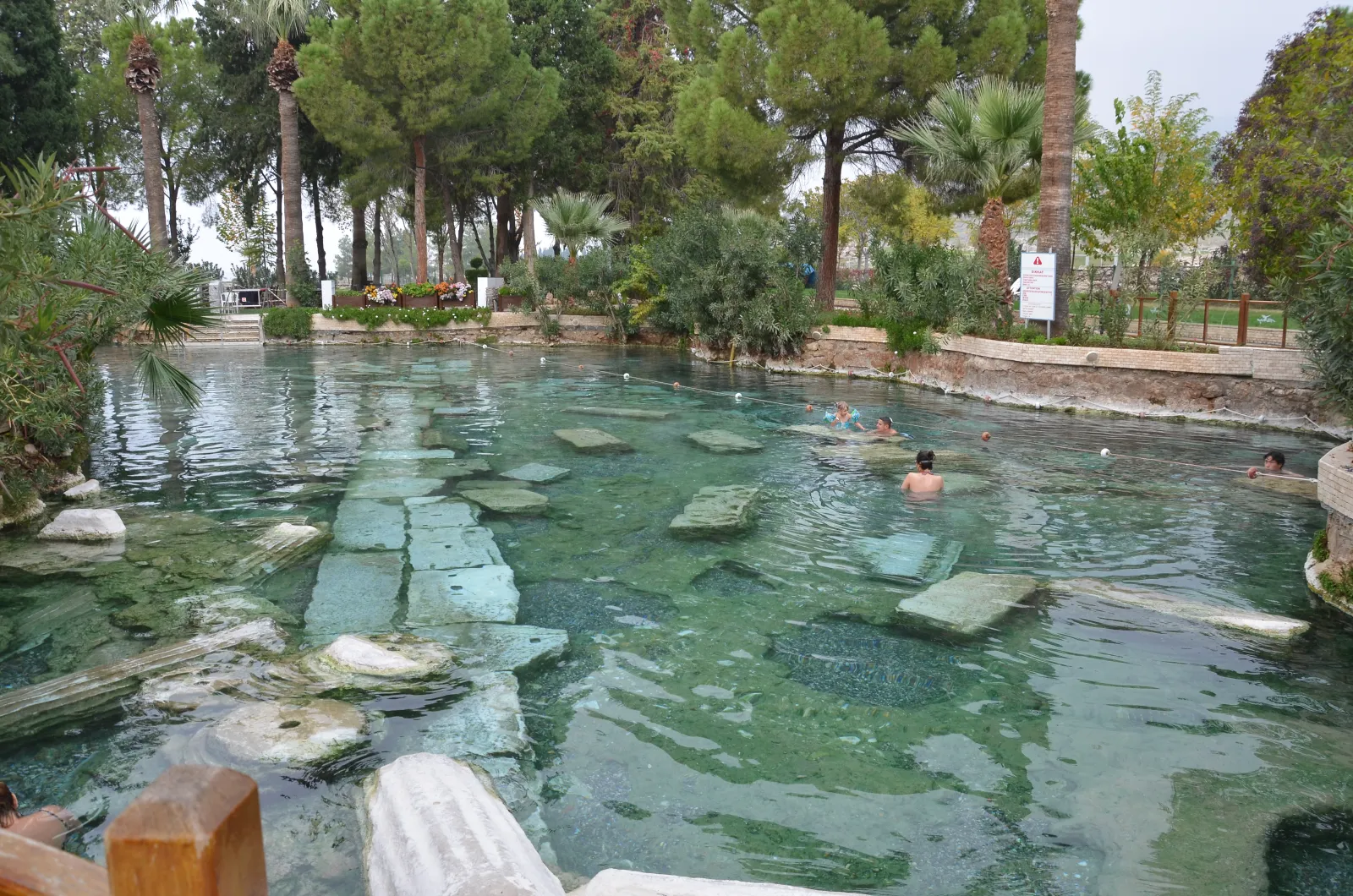
You enter the pool area through a facility that includes changing rooms, lockers, and showers. The pool itself is outdoors, roughly 50 meters long and irregularly shaped, following the natural contours of the thermal spring. The depth varies from about half a meter at the shallow edges to roughly three meters in the deeper central sections.
The water temperature is consistent: 36°C, which feels warm without being hot. It is roughly the temperature of a well-drawn bath, and after a few minutes your body adjusts completely. The dissolved minerals give the water a slightly silky quality — it feels different on your skin than chlorinated pool water, softer and with a faint effervescence from the CO2.
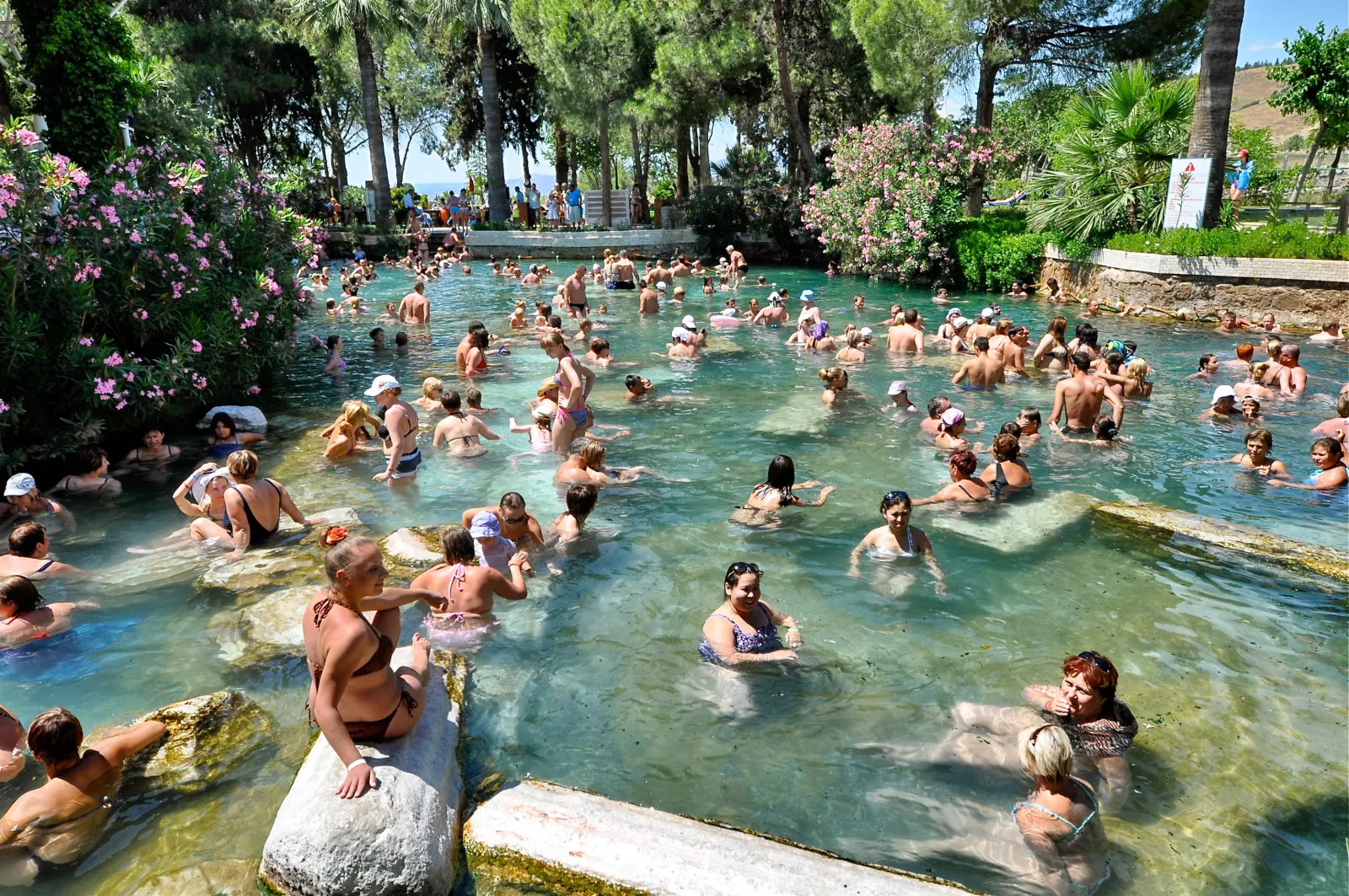
Most people spend 30 minutes to an hour in the water. When I bring travelers here, many of them tell me afterward that this was the moment of the trip they did not expect — that the pool felt less like a tourist attraction and more like a private discovery. The combination of warmth, buoyancy, and the mineral content creates a deeply relaxing physical state. Many visitors float on their backs, looking up at the sky above the Hierapolis plateau.
Others explore the submerged ruins, swimming slowly from column to column, running their hands along the carved stone. Children tend to find the underwater ruins endlessly interesting — the pool functions as a combination swimming hole and underwater archaeological site.
The pool is busiest between 11:00 AM and 2:00 PM, when the group tours arrive. Early morning — the pool opens at 8:00 AM — is quieter, and you have more space to swim and explore the ruins. Late afternoon, from around 4:00 PM onward, the crowds thin again. The water temperature does not change with the time of day.
The Hierapolis Context
Cleopatra’s Pool sits within the broader Hierapolis archaeological site — a Greco-Roman city founded around 190 BC that grew into one of the most important spa towns in the ancient world. The city’s relationship to the thermal springs was fundamental: Hierapolis existed because of the water.
The major ruins of Hierapolis surround the pool area. The Roman theater — holding 12,000 spectators, with its stage building and decorative friezes largely intact — is a ten-minute walk uphill. The Necropolis, with its 1,200 tombs spread across the northern hillside, extends beyond the city walls. The colonnaded main street, the Roman baths (now housing the Hierapolis Archaeology Museum), and the foundations of temples and civic buildings are all accessible from the pool area.
Combining Cleopatra’s Pool with the Hierapolis ruins makes for a natural day. When I plan a Pamukkale visit for travelers, I always include the pool — the ruins give you context for what you are swimming among, and the pool gives you a physical experience of the thermal water that drew people to this plateau in the first place. The Romans who built Hierapolis bathed in these same springs, in water of the same temperature and mineral composition. The pool connects you to that history in a way that looking at ruins from a distance cannot.
Below the Hierapolis plateau, the Pamukkale travertines — the white calcium carbonate terraces — cascade down the hillside. The travertines, the thermal springs, Cleopatra’s Pool, and the ruins of Hierapolis are all part of the same UNESCO World Heritage site, and they are all products of the same geological phenomenon: thermal water rising to the surface and depositing minerals as it cools.
Practical Information
Getting there: Cleopatra’s Pool is located within the Hierapolis archaeological site at the top of the Pamukkale travertines. You enter through the main Hierapolis gate (there is also an entrance from the base of the travertines, but the upper entrance is more convenient for the pool). Pamukkale is in Denizli Province, approximately 250 kilometers from Izmir and 190 kilometers from Antalya. The nearest airport is Denizli Çardak (DNZ), about 65 kilometers away. From Pamukkale village at the base of the hill, it is a 10-minute drive or dolmuş ride to the site entrance.
Entrance fees: Cleopatra’s Pool has a separate entrance fee from the main Hierapolis/Pamukkale site ticket. You need the site ticket to enter Hierapolis, and then an additional ticket for the pool. Prices are updated annually — check current rates before your visit. Children under a certain age (typically 6) enter the pool free.
What to bring: A swimsuit is essential. Bring a towel — rental towels are available but bringing your own is more comfortable. Water shoes or sandals that can get wet are helpful for walking on the submerged stone, which can be slippery. Sunscreen (reef-safe if possible), a hat, and drinking water round out the essentials. Lockers are available for valuables.
How much time: Plan for 45 minutes to an hour at the pool itself, plus time for changing. If you are combining with the Hierapolis ruins and the travertines (recommended), allow a full day — six to seven hours for the complete site.
When to go: The pool is open year-round. The water temperature is constant at 36°C regardless of season. Spring (April to June) and autumn (September to October) are the most comfortable for combining the pool with walking the Hierapolis ruins and travertines. Summer is hot — the pool becomes a welcome cool-down, but the ruins are demanding in midday heat. Winter visits are quieter, and swimming in warm thermal water while the air is cool has its own appeal.
Early morning (8:00 to 10:00 AM) is the best window: fewer people, calm water, and soft light that makes the underwater ruins easier to see. Midday is the most crowded. Late afternoon offers a second quiet window.
Combining with other visits: Cleopatra’s Pool is best experienced as part of a full Pamukkale and Hierapolis day. A well-sequenced visit: terraces first (early morning, before crowds), then Hierapolis ruins (theater, necropolis, colonnaded street), then Cleopatra’s Pool as a midday pause, followed by the Archaeology Museum in the afternoon. This pacing lets you arrive at each section when conditions are most favorable. Travelers combining regions often pair Pamukkale with Ephesus — the two sites are roughly four hours apart by road.
Cleopatra may or may not have bathed here. That does not matter. What matters is the water — 36°C, mineral-rich, clear enough to see the carved marble columns two meters below you — and the fact that it has been rising from this spot in the earth for thousands of years, drawing people to it for just as long. The Romans built a city around these springs. The earthquakes brought parts of that city down into the water. And now you can swim through the result, touching stone that was carved two millennia ago, in water that has not changed since it was carved.
Plan Your Pamukkale Visit
If you would like to visit Cleopatra’s Pool as part of a private Pamukkale day — paced so you have time in the water, time at the ruins, and time on the travertines without fighting the crowds — tell us what matters to you and we will plan the day.
Frequently Asked Questions
Is Cleopatra's Pool worth the extra cost?
For most visitors, yes. The experience of swimming in warm thermal water among submerged Roman columns is genuinely unusual — there is no equivalent elsewhere. It adds approximately an hour to your Pamukkale visit and serves as a natural midday pause between the travertines and the ruins. If you enjoy water and have even a passing interest in ancient history, the additional fee is well spent.
Can you touch the Roman columns in the pool?
Yes. The columns, capitals, and stone blocks on the pool floor are accessible — you can touch them, stand on them, and swim around them. The minerals in the water are gradually depositing a protective layer on the stone, and the ruins have been in the water for over a millennium. Normal, respectful contact is fine. Climbing on or attempting to move the stones is not permitted.
Is Cleopatra's Pool suitable for non-swimmers?
Yes. The pool has shallow sections (about half a meter deep) along the edges where you can wade and sit comfortably. The deeper central area (up to about three meters) is where most of the submerged columns are, so swimmers get more of the archaeological experience, but the thermal water and the setting are enjoyable at any depth. There are no lifeguards, so non-swimmers should stay in the shallower areas.
Did Cleopatra really swim here?
Almost certainly not, or at least there is no historical evidence confirming it. The name is a local tradition, likely developed for tourism, drawing on Cleopatra VII’s general association with bathing and indulgence in Roman-era sources. There is no specific historical record placing Cleopatra at Hierapolis. The pool’s appeal does not depend on the legend — the thermal water and the submerged Roman ruins are real and remarkable on their own terms.
What is the best time of year to visit Cleopatra's Pool?
The water temperature is 36°C year-round, so the pool itself is comfortable in any season. Spring and autumn offer the most pleasant conditions for combining the pool with walking the Hierapolis ruins and the travertines. Summer is hot, which makes the pool refreshing but the ruins tiring. Winter is quiet and atmospheric — swimming in warm water with cool air above you has a particular charm, and you may have the pool nearly to yourself on a weekday morning.
How is Cleopatra's Pool different from the Pamukkale travertine terraces?
The travertines are the white calcium carbonate terraces on the hillside — you walk barefoot across them in shallow, cool-to-warm water that flows down the slope. Cleopatra’s Pool is a deep thermal swimming pool on the plateau above, fed by the same springs but enclosed and warmer at a constant 36°C. The travertines are a landscape; the pool is a swimming experience among submerged Roman ruins. Most visitors do both in the same day — the travertines first, then the pool as a midday pause.