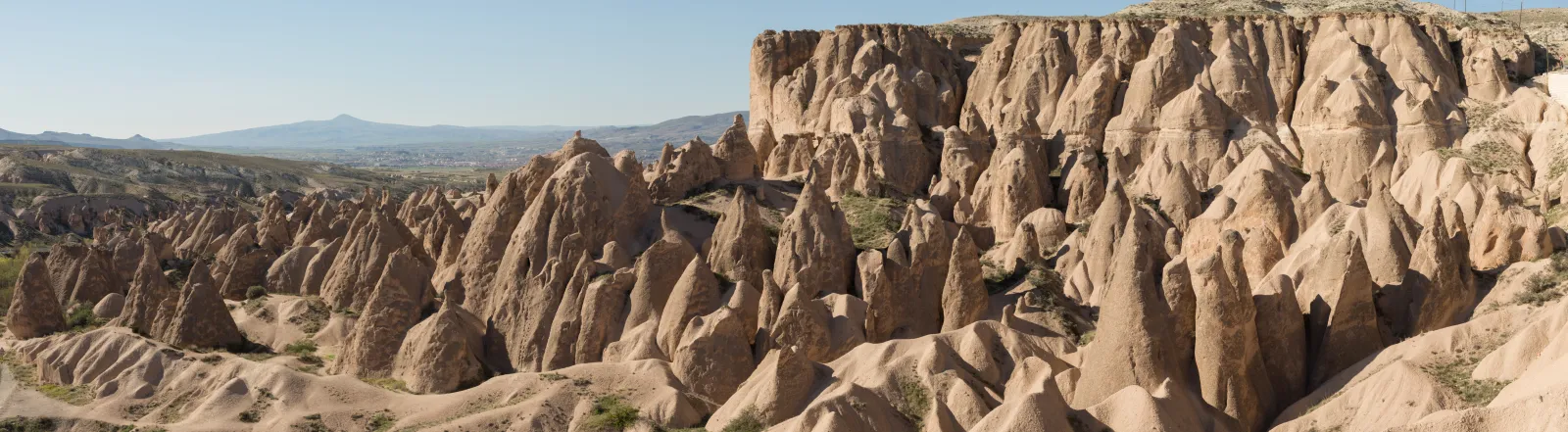
Devrent Valley has no churches. No frescoes, no underground cities, no carved-out homes. There is no human history layered into the rock here — no monks, no refugees, no vintners. What there is, instead, is pure geology: a field of volcanic tuff formations shaped by wind and water erosion into forms so suggestive that the valley’s other name, Imagination Valley, is the only label that fits.
You look at a rock and see a camel. You look at the next one and see a seal. The one after that is a dolphin, or Napoleon’s hat, or a kissing couple, or nothing at all — just a shape that erosion happened to produce and your brain happened to interpret.
The valley is small — you can walk through it in thirty to forty minutes — and it is the least historically significant stop on a Cappadocia tour. It is also one of the most memorable, because it demonstrates the process that created the entire landscape. Every fairy chimney, every cave dwelling, every rock-cut church in the Göreme National Park and Rock Sites of Cappadocia exists because volcanic tuff erodes in unpredictable, beautiful ways. Devrent Valley is where you see that process without the distraction of human intervention.
How the Shapes Form
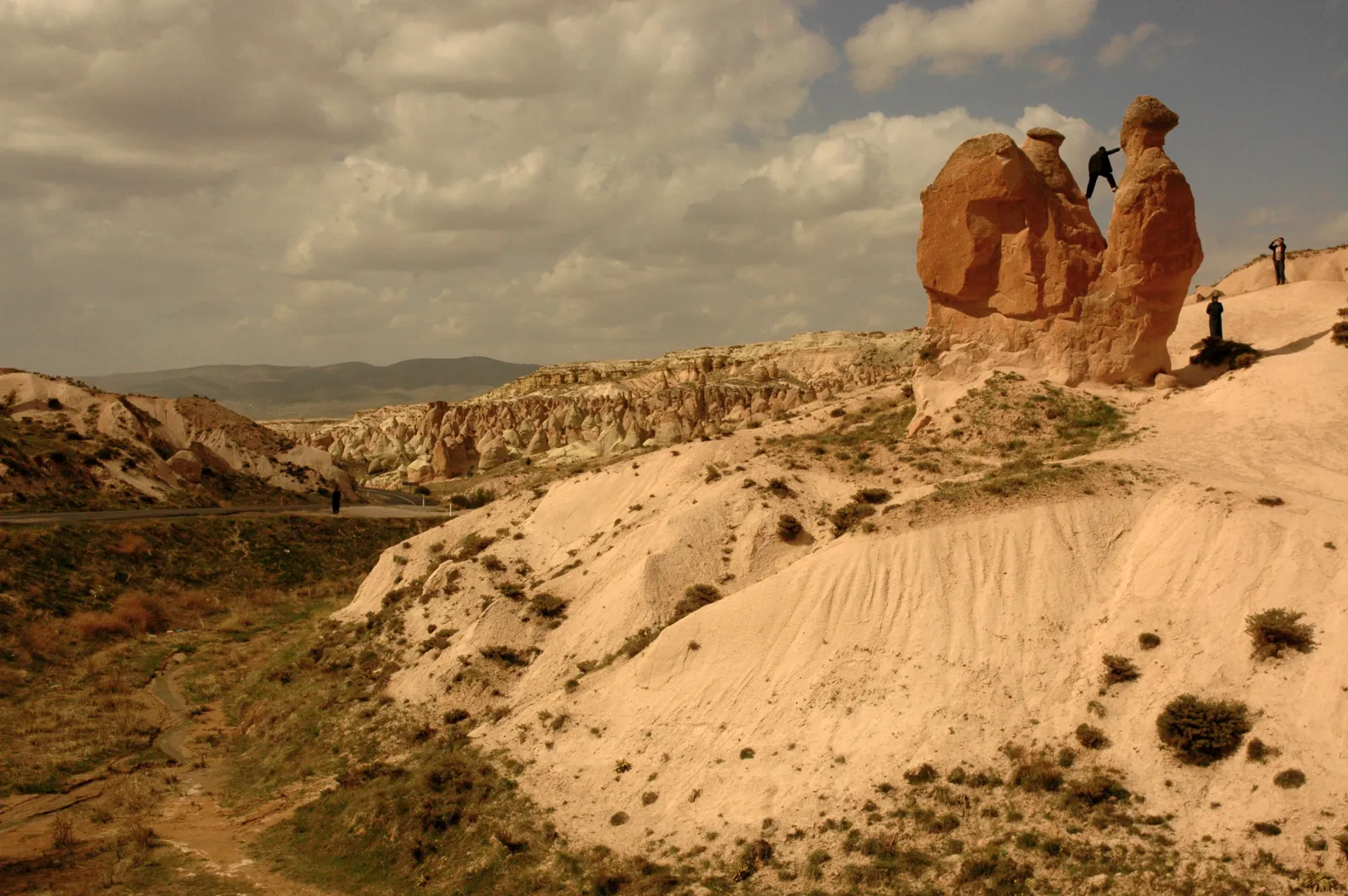
The formations in Devrent Valley are the product of differential erosion — the same process that creates fairy chimneys everywhere in Cappadocia, but expressed here in particularly varied and dramatic forms. The tuff layers deposited by volcanic eruptions millions of years ago have different densities and mineral compositions. Harder layers resist erosion; softer layers wear away. Where a cap of harder rock sits atop a column of softer tuff, the cap protects the column below, and a fairy chimney forms. Where the layers are more uniform, the erosion creates broader shapes — mushrooms, pillars, walls, arches.
In Devrent Valley, the layering is unusually complex, which produces formations that are more varied and more sculptural than the typical fairy chimney fields. Some formations have multiple caps at different angles. Others have been undercut into overhangs and balancing shapes that look structurally impossible but have been stable for millennia. The result is a landscape that looks designed — as if someone arranged the forms for visual impact — when in fact it is entirely the product of rain, wind, frost, and time.
The Named Formations
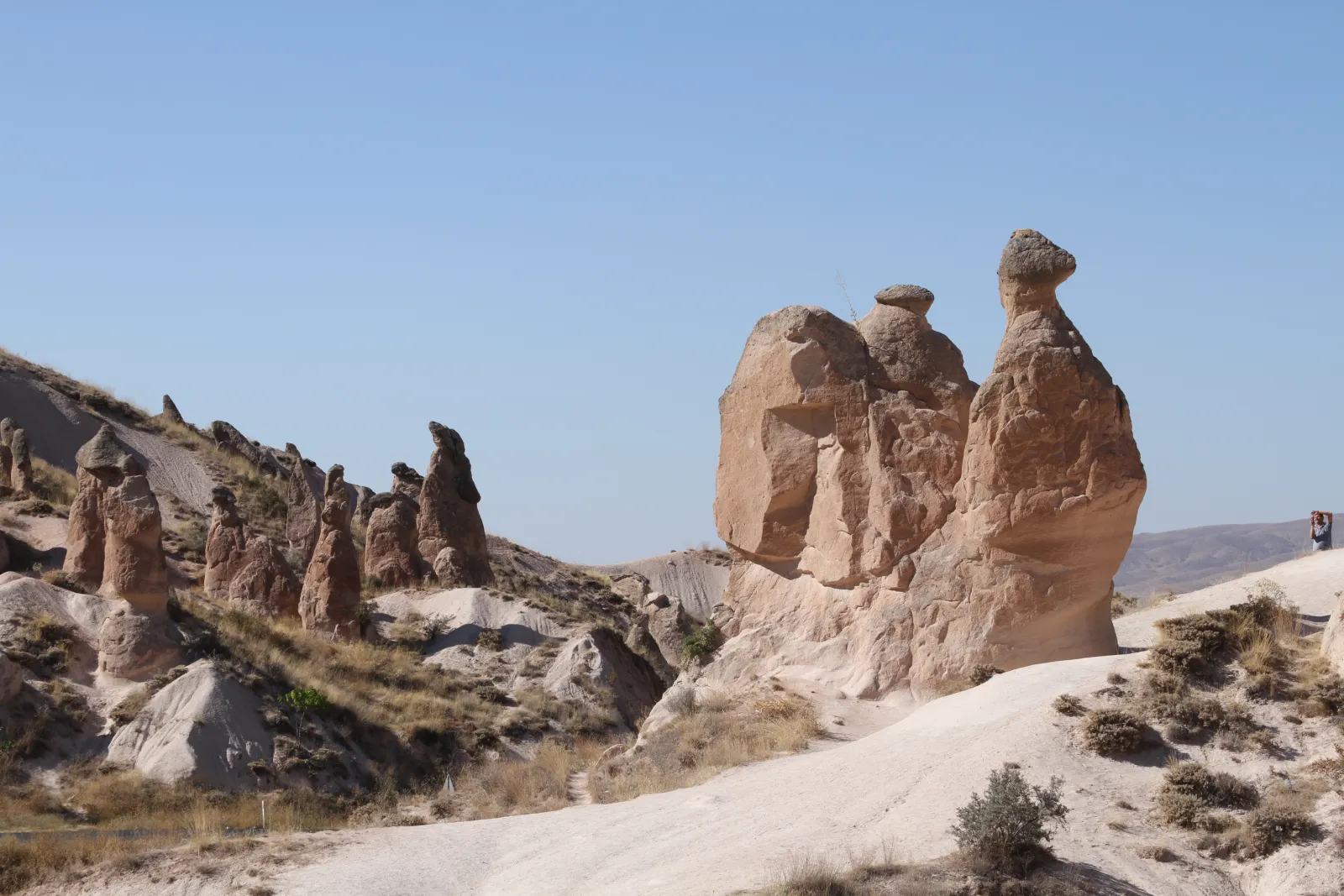
Guides and locals have named the most recognizable formations, and pointing them out is a standard part of any Devrent Valley visit:
The Camel is the most famous — a formation with a body, hump, neck, and head that genuinely looks like a camel in profile. It is the valley’s signature image and the formation most visitors photograph first. The resemblance is strong enough that it works without prompting.
The Seal sits near the valley entrance — a low, rounded formation with a shape that suggests a seal balancing on a rock.
The Napoleon Hat is a flat-topped formation with a profile that recalls the bicorne hat. This one requires slightly more imagination.
The Kissing Couple and The Dolphin are further into the valley — formations where the resemblance depends on your angle and your willingness to see what the name suggests.
The naming game is part of the experience. When I bring families here, children almost always find shapes that adults miss — and the suggestions get more creative as the walk continues. The valley is a natural Rorschach test, and there is no wrong answer.
Visiting
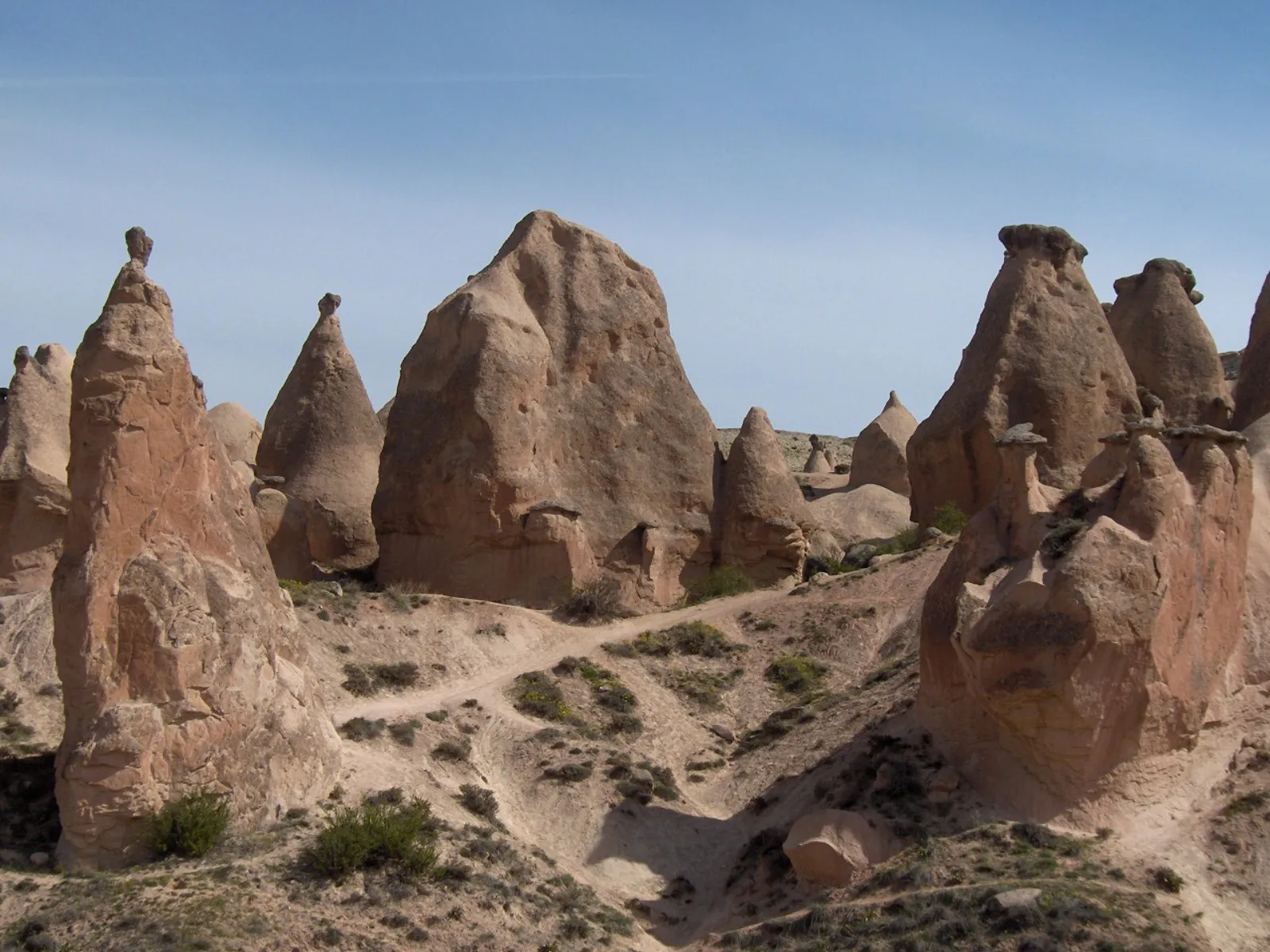
Devrent Valley is on the North Cappadocia touring route, typically visited alongside Paşabağ (Monks Valley), Avanos, and the Göreme Open Air Museum. It is the shortest stop on the route — thirty to forty minutes is typical — and the least physically demanding. The valley floor is relatively flat, with a marked path that loops through the main formation field.
Getting there: The valley is approximately ten minutes by car north of Göreme, on the road toward Avanos. There is a parking area at the entrance. Dolmuş service does not reach the valley directly — you need a car, a taxi, or a guided tour.
How much time: Thirty to forty minutes for the full walk through the formations. There is no café or facility at the valley — bring water.
When to go: Morning light is best for photography, when the low sun casts sharp shadows that accentuate the three-dimensional forms. The valley faces east, so morning visits get direct light on the formations. Afternoon visits work but the light is flatter.
Combining with other visits: Devrent Valley is almost always combined with other North Cappadocia stops. When I plan North Cappadocia itineraries, the standard route runs: Devrent Valley → Paşabağ → Avanos → Göreme Open Air Museum → Uchisar Castle, though guides adjust the order based on crowd patterns and the day’s conditions.
Plan Your Cappadocia Visit
Devrent Valley is thirty minutes of pure Cappadocian geology — no churches, no history, just the volcanic landscape doing what it does. If you would like to explore Cappadocia with a private guide who can explain the geology, point out the shapes, and connect this valley to the larger landscape, tell us what interests you and we will build the itinerary around it.
Frequently Asked Questions
What is Devrent Valley in Cappadocia?
Devrent Valley, also called Imagination Valley, is a field of volcanic tuff formations north of Göreme in Cappadocia. The formations have been shaped by erosion into forms that resemble animals, faces, and objects — the most famous is a rock that looks like a camel. Unlike other Cappadocian valleys, Devrent has no churches, cave dwellings, or historical structures — it is a purely geological landscape.
Why is it called Imagination Valley?
The name comes from the shapes of the rock formations, which suggest recognizable forms — a camel, a seal, a dolphin, Napoleon’s hat. Guides and visitors find shapes in the rocks the way you might find shapes in clouds. The exercise is subjective and playful, making this one of the more engaging stops for families and children.
How long do you spend at Devrent Valley?
Thirty to forty minutes is typical. The valley is small and the terrain is relatively flat. There is a marked path that loops through the main formation field. It is the shortest stop on the standard North Cappadocia touring route.
Is Devrent Valley worth visiting in Cappadocia?
Yes, particularly as part of the North Cappadocia route that also includes Paşabağ, Avanos, and the Göreme Open Air Museum. Devrent Valley offers the clearest demonstration of how Cappadocia’s geological landscape forms — differential erosion creating shapes from volcanic tuff. It is brief, easy, and visually distinct from the other valley stops.
Do you need a guide for Devrent Valley?
You can walk the valley independently, but a guide adds value by pointing out the named formations, explaining the geology of how they formed, and connecting Devrent to the broader Cappadocian landscape. The valley is typically included as one stop on a guided North Cappadocia day tour.
Is Devrent Valley suitable for children?
Yes — it is one of the best Cappadocia stops for children. The walk is short (thirty to forty minutes), the terrain is flat, and the game of finding shapes in the rocks keeps children engaged in a way that archaeological sites sometimes do not. There are no steep climbs or confined spaces. The camel formation is an immediate hit with younger visitors.