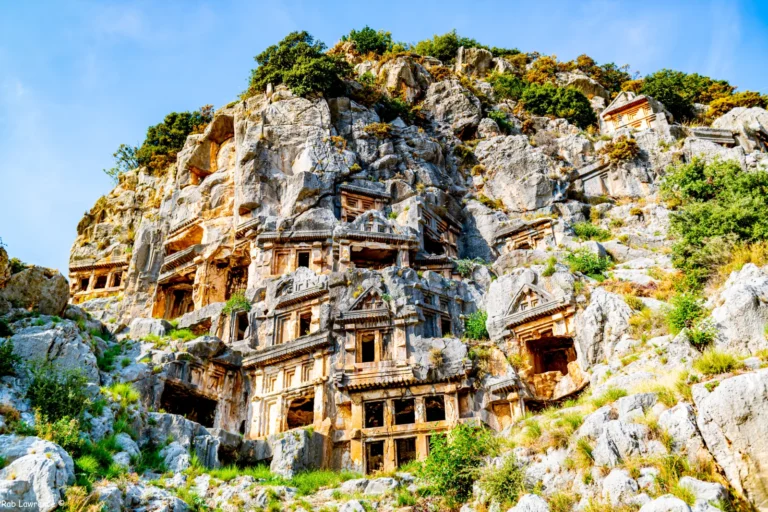
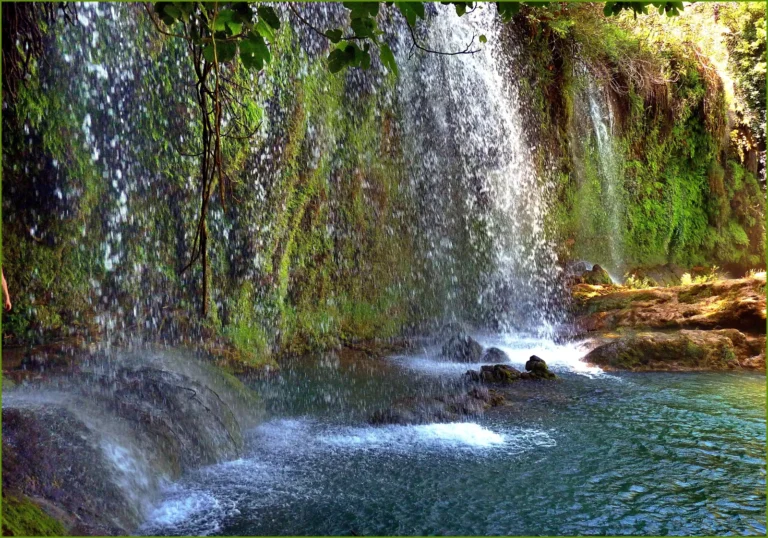
Most ancient cities in Turkey sit in cleared, excavated landscapes — stone against sky, ruins separated from nature by centuries of archaeological clearing. Olympos is different. Here, a Lycian-Roman city lies scattered through a dense river valley where trees grow through walls, roots wrap around carved stone, and the path to the ruins follows a stream to a beach. It is archaeology without the sterility of a manicured site — nature has not been cleared away to reveal the past; the past and the present forest coexist.
And then, 7 kilometers up the mountain behind the ruins, fire burns from the rock. Not a volcanic eruption. Not a human-made flame. Natural gas seeping through fissures in the serpentinite rock ignites on contact with air and has been burning — according to ancient accounts — for at least 2,500 years. The Greeks called this the Chimaera, naming the fire-breathing mythological creature after the very real flames they found on this hillside. The Lycians, who lived here, used the flames as a lighthouse visible from the sea.
Olympos sits on the coast approximately 80 kilometers southwest of Antalya and roughly 270 kilometers east of Fethiye, in the foothills of the Taurus Mountains where the Lycian coast meets the Pamphylian coast. It is reachable as a long day trip from the Fethiye region or as a stop on a broader Lycian coast itinerary.
The Ancient City
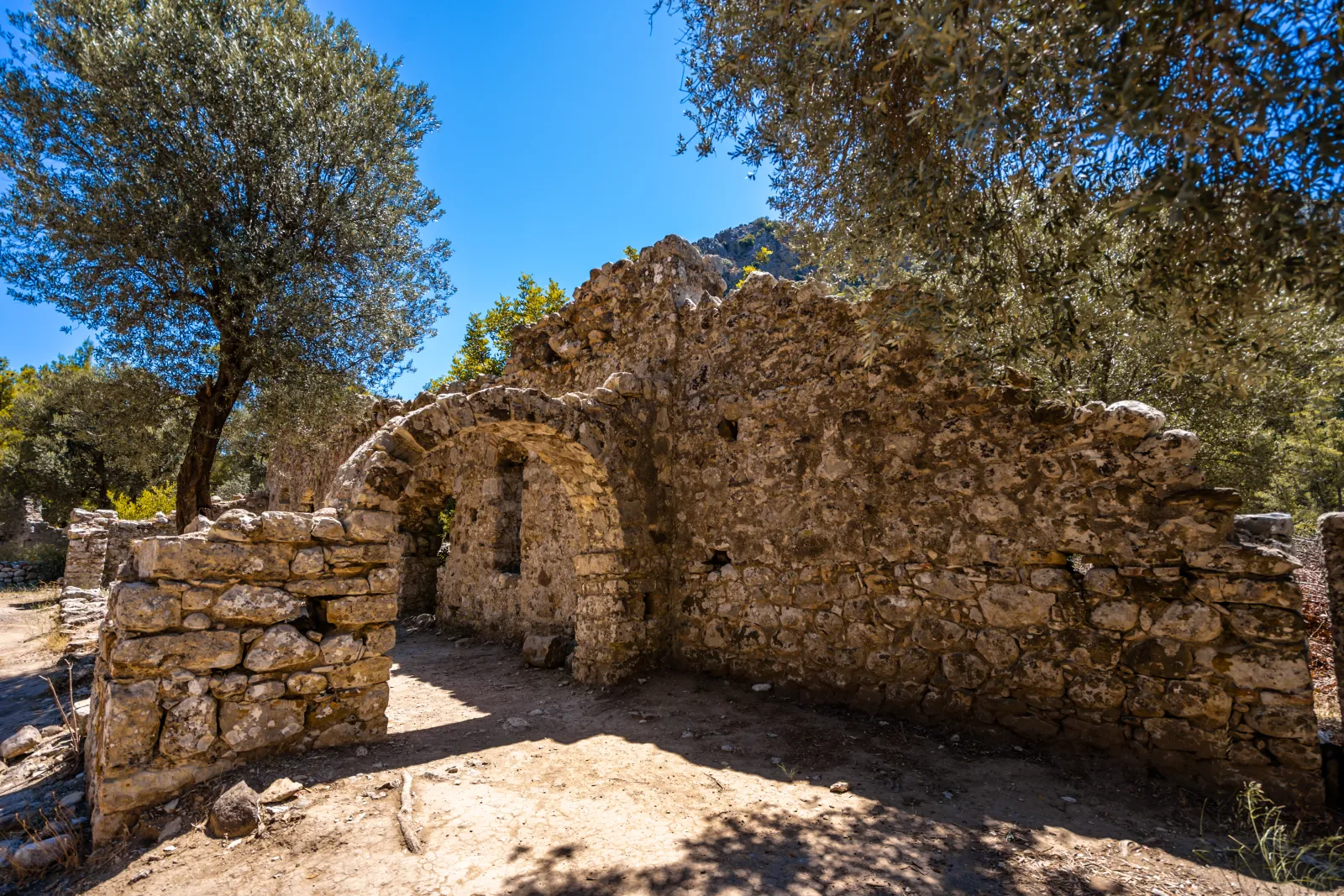
Olympos was a member city of the Lycian League, the confederation of city-states that governed this coast from roughly the 2nd century BC. The city’s name appears on Lycian League coins, indicating it was one of the six major cities with three votes in the league assembly — a mark of political significance. It later came under Roman, then Byzantine control, and was intermittently occupied by pirates, Venetians, and Genoese before being abandoned.
The ruins stretch along both banks of the stream that runs through the valley to the sea. On the south bank, the remains are denser: a temple doorway standing in a grove of laurel trees, a bath complex with visible hypocaust (underfloor heating) channels, sections of the city wall, and scattered sarcophagi. On the north bank, a Byzantine canal, bridge supports, and further residential structures emerge from the undergrowth.
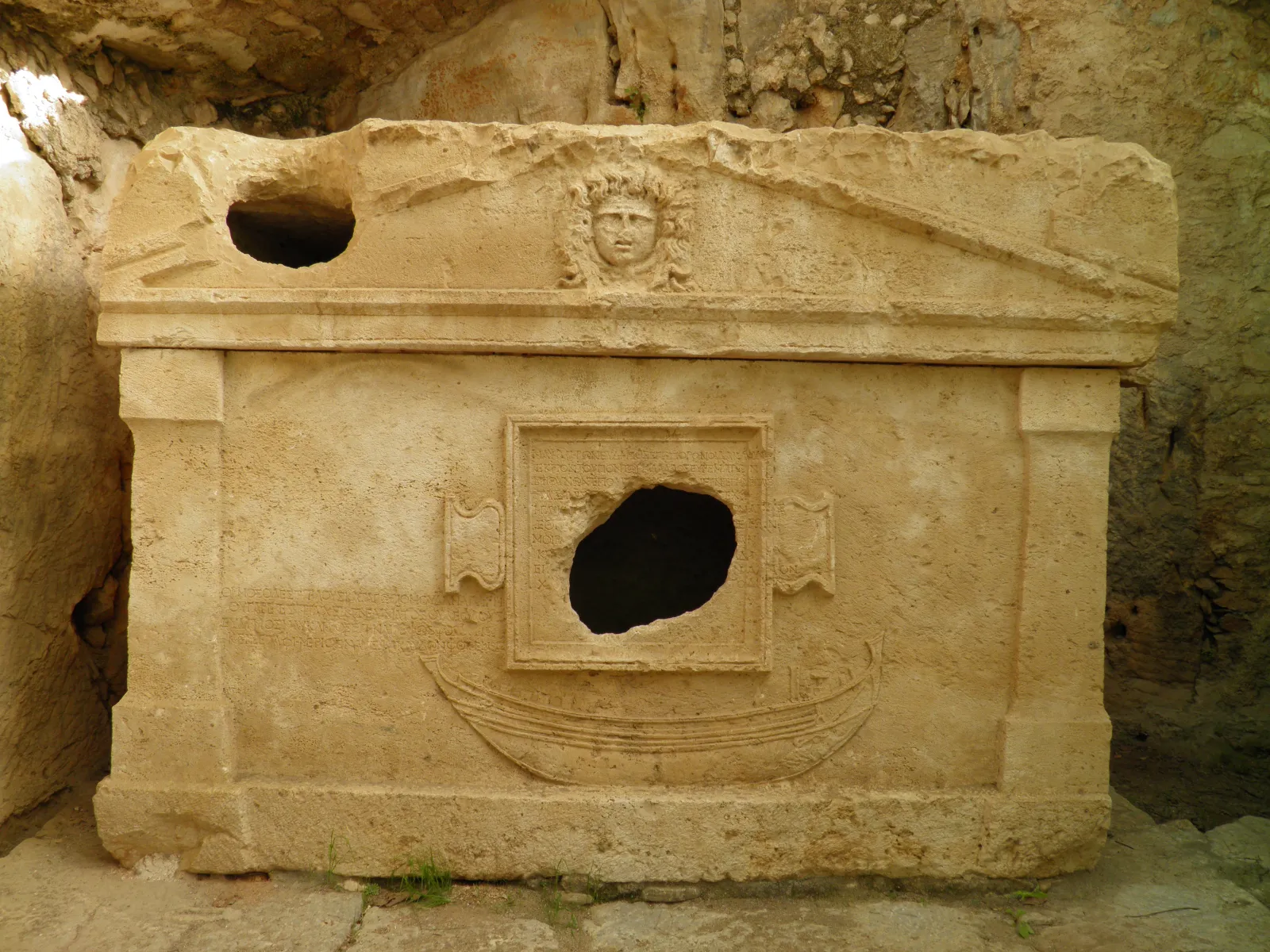
Walking the site is not like walking through Ephesus or Perge, where the civic layout has been excavated and labelled. At Olympos, you follow paths through the forest and stumble upon ruins in context — a carved lintel half-hidden by ivy, a column base surrounded by wildflowers, a sarcophagus lid lying among tree roots. The excavation has been selective, uncovering key structures while leaving much of the city in its forest setting. This approach is deliberate and, for many visitors, more evocative than a fully cleared site.
The temple doorway on the south bank is the most recognizable feature — a tall stone doorframe standing alone among trees, its lintel carved with an inscription. The temple was dedicated to Hephaestus (the Greek god of fire and metalworking), which makes geographical sense given the Chimaera flames on the mountain above. The connection between the god of fire and the natural fire burning from the rock was not lost on the ancients.
The theater is partially visible on the hillside but largely unexcavated, its seats buried under centuries of soil and vegetation. What you can see suggests a mid-sized venue — appropriate for a city of Olympos’s status in the Lycian League.
The Beach
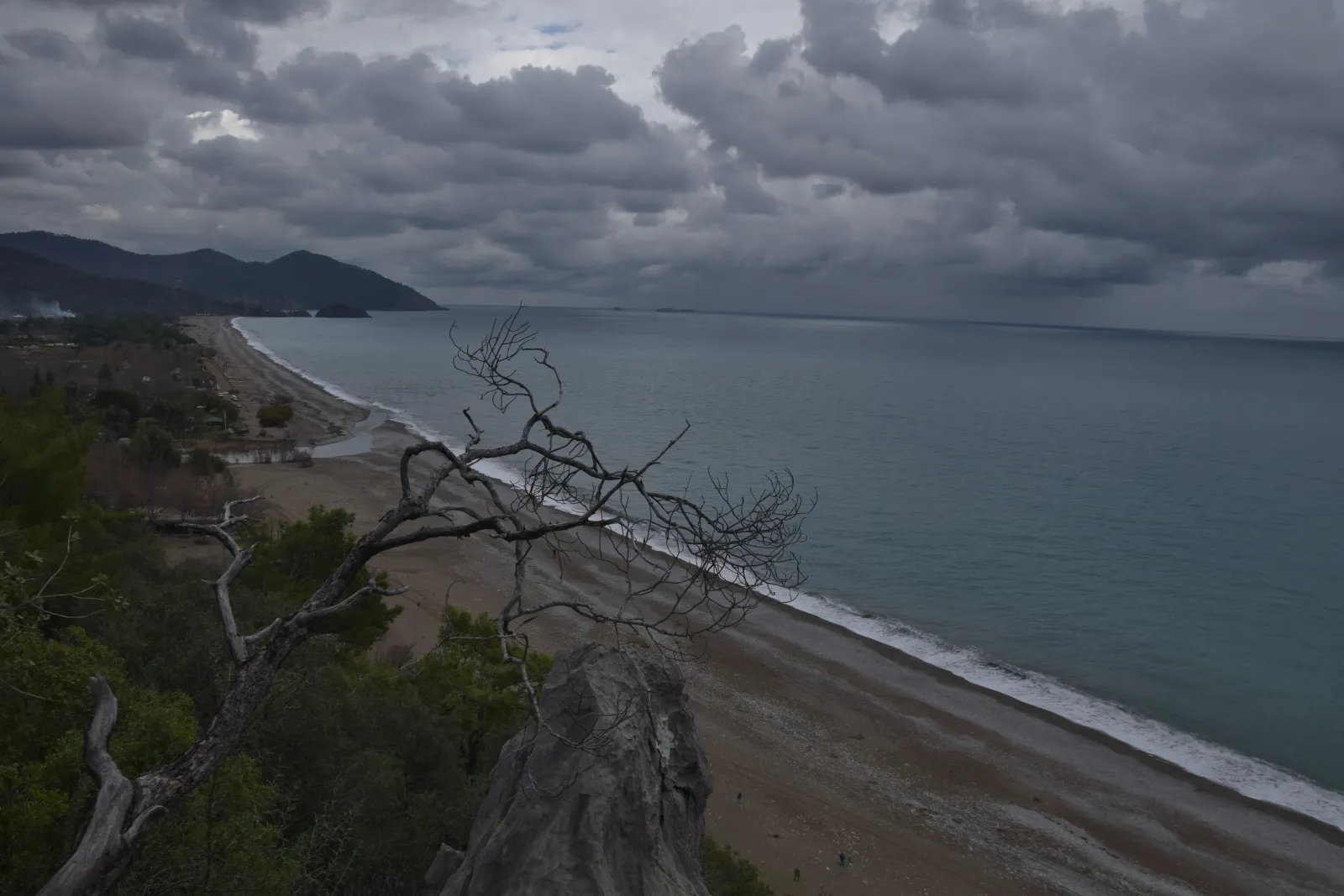
The stream valley opens directly onto Olympos Beach — a long stretch of pebble and coarse sand backed by the forested valley and flanked by rocky headlands. The beach is part of Olympos-Beydaglari National Park, and this protected status has prevented the development that has transformed many Turkish coastal beaches.
Loggerhead sea turtles (Caretta caretta) nest on Olympos Beach, and the beach is managed in part to protect their nesting sites. During nesting season (May through September), sections of the beach may be cordoned off to protect turtle nests, and nighttime beach access is restricted.
The swimming is good — the water is clear, deepening gradually from the pebble shore. The beach is less sheltered than a cove, so there can be waves on windy days, but in calm conditions the water is excellent for swimming and the setting — forest behind, rock headlands on either side, ancient ruins a five-minute walk inland — is hard to match.
Chimaera (Yanartas)
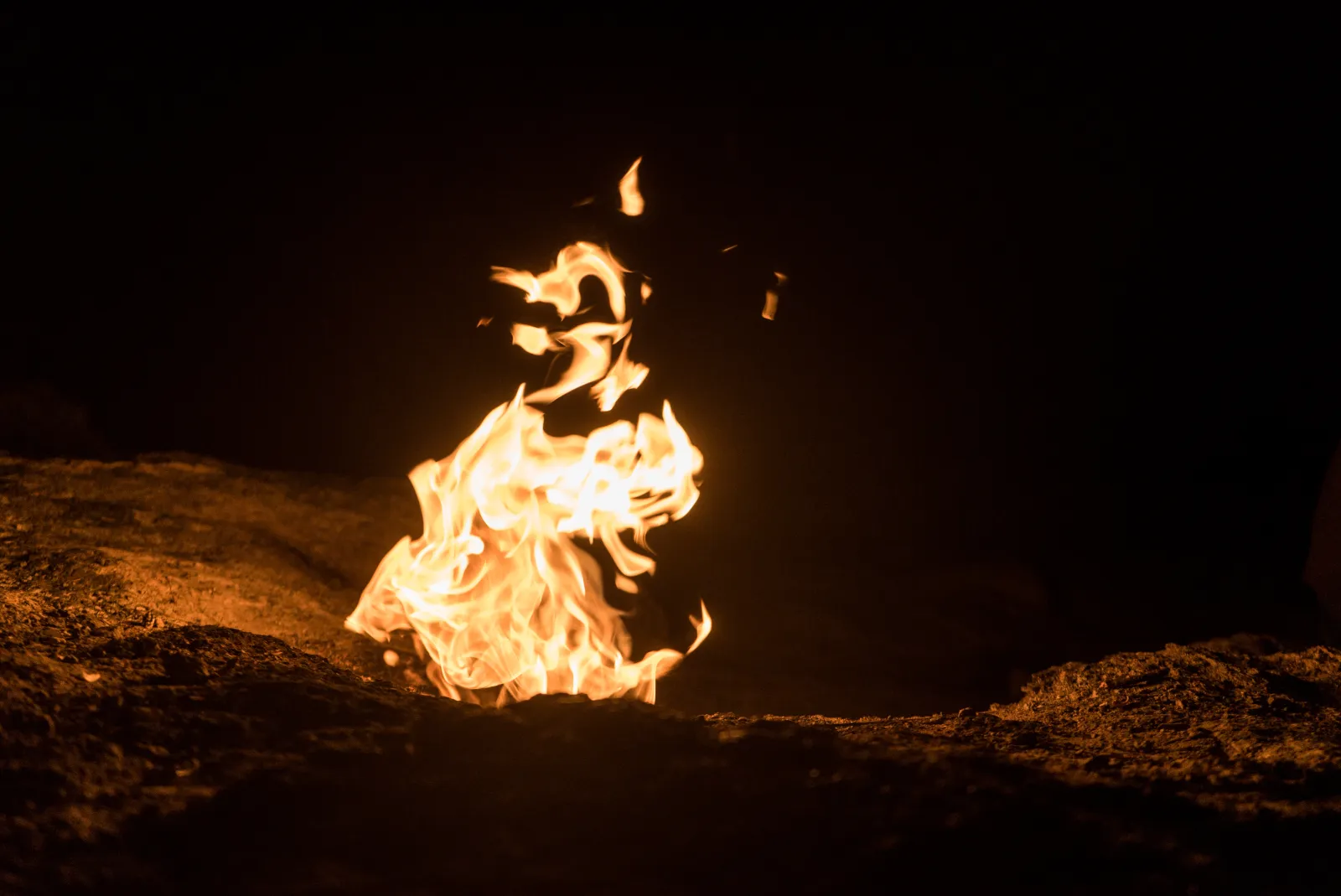
The Chimaera — called Yanartas in Turkish (literally “burning rock”) — is located about 7 kilometers from Olympos village, reached by a paved road and then a 20 to 30 minute uphill walk on a rocky forest trail. The trail climbs through pine forest to an open rocky area where flames emerge from fissures in the rock, some small and flickering, others large enough to heat a kettle (which visitors have been doing for centuries).
The flames are caused by natural gas — primarily methane with trace amounts of hydrogen — seeping through the rock. The gas is generated by a chemical reaction between water and iron-rich minerals in the earth’s crust (a process called serpentinization). What makes Yanartas distinctive is not the chemistry but the visibility: the flames burn continuously, are visible year-round, and have done so since antiquity. Ancient sailors used the flames as a navigation beacon. The myth of the Chimaera — a fire-breathing creature with a lion’s head, goat’s body, and serpent’s tail — is believed to have originated from or been reinforced by these flames.
Visiting at night is the most atmospheric experience. The flames are visible during the day but modest in sunlight — at night, a dozen or more points of fire burning from dark rock against a star-filled sky creates a scene that connects you directly to the ancient experience of this place. The walk up is manageable with a headlamp or flashlight, and the path is well-worn.
The main flame cluster is at an elevation of about 250 meters, with a smaller cluster higher up. The lower cluster is the easier to reach and has the most active flames. When I take travelers here, I always suggest the climb in the last hour of daylight — you reach the flames just as dusk turns the rocks blue, and the fire starts to read the way the ancients saw it.
Treehouse Culture
Olympos has a distinctive accommodation tradition: treehouse camps. Starting in the 1980s as simple backpacker lodges built in and among the trees near the beach, these camps became a defining feature of the Olympos experience. The original treehouses were genuinely rustic — wooden platforms in the trees with mattresses and mosquito nets. Today’s versions range from still-rustic to comfortable wooden bungalows that retain the treehouse aesthetic while offering proper beds, bathrooms, and electricity.
This accommodation culture gives Olympos a character different from other coastal destinations. Even visitors staying in the more comfortable options get the experience of waking in a forest, walking through trees to the beach, and returning to a wooded settlement rather than a hotel corridor. The camps typically include breakfast and dinner in the price, served at communal tables — a social format that has been part of Olympos hospitality for decades.
Practical Information
Getting there: Olympos is approximately 80km southwest of Antalya (about 1.5 hours by car) and roughly 270km from Fethiye (about 4 hours by car). The site is accessible from the coastal D400 highway — a turn-off leads down a 12km valley road to the village and ruins. From Fethiye, it is best visited as part of a multi-day Lycian coast itinerary or a long day trip.
How much time: Allow 2 to 3 hours for the ancient city and beach. Add 2 hours for the Chimaera visit (including the walk up and time at the flames). A full day covers both comfortably. An overnight stay allows you to visit Chimaera at night, which is the recommended experience.
When to go: Spring (April-May) and autumn (September-October) are ideal — mild temperatures for walking the ruins and hiking to Chimaera, fewer visitors than summer. Summer is hot, and the ruins’ forest shade helps, but the Chimaera hike in midday heat is unpleasant. Evening visits to Chimaera are best in any season. The beach is swimmable from May through October.
Entrance fees: Olympos archaeological site has an entrance fee (approximately 200-300 TL). The Chimaera / Yanartas has a separate entrance fee. Museum Pass Turkey covers the archaeological site.
Official resource: Turkish Ministry of Culture — Archaeological Sites
Combining with other visits: Olympos combines naturally with Phaselis (30km north — another Lycian coastal city with three harbors), which can be visited on the same day. The Lycian Way hiking trail passes through Olympos, and day sections can be walked in both directions. For visitors coming from Fethiye, a two-day trip visiting Demre/Myra, Kekova, and Olympos covers the major Lycian coast highlights.
Plan Your Fethiye Visit
Olympos offers a combination that no other site on this coast replicates — ruins in a forest, a protected beach, and flames that have been burning from the rock since before recorded history. If you want to include it in a Lycian coast journey from Fethiye, we can plan an itinerary that gives each element the time it deserves.