Hadrian’s Gate stands in the middle of a modern street in Antalya, flanked by apartment buildings and taxi stands, and people walk through it to get to the old town. They have been walking through it for approximately 1,900 years. The gate — three arched openings in white marble, each arch framed by Corinthian columns with carved capitals — was built in 130 AD to commemorate the visit of the Roman Emperor Hadrian to the city he ruled but had never seen. It was the formal entrance to Attaleia, the Roman city that became Antalya, and it remains the formal entrance to Kaleiçi, the walled old town.
The gate is the best-preserved Roman monument in Antalya and one of the most intact triumphal arches in Turkey. The three arches are each approximately six meters high. The marble facades — both the seaward-facing front and the city-facing rear — are decorated with carved coffers (recessed panels) in the arch soffits and Corinthian capitals on the flanking columns. Two towers bracket the gate, one Roman in origin and one Seljuk-era, and the city walls run from both sides, integrating the gate into the defensive circuit that protected the old town for centuries.
What You See
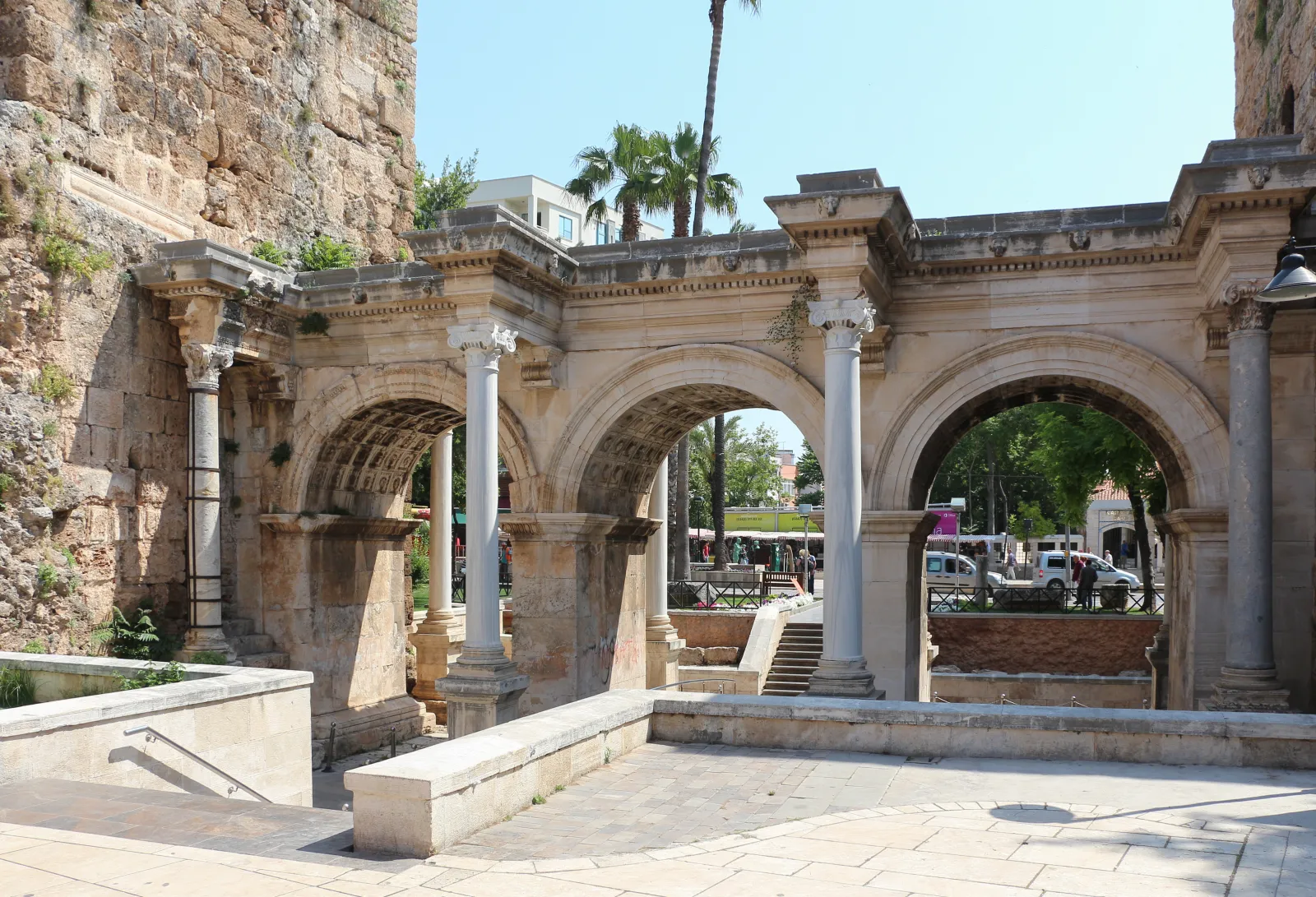
The marble is the first thing you notice — white, carved, and still crisp after nearly two millennia. The gate was buried beneath later construction for much of its history, which protected the stone from weathering and vandalism. When it was excavated in the 1950s, the marble was in remarkably good condition. The carved coffered ceilings of the three arches are the most detailed surviving element — geometric panels recessed into the stone, a decorative treatment you can see on Roman buildings across the empire.
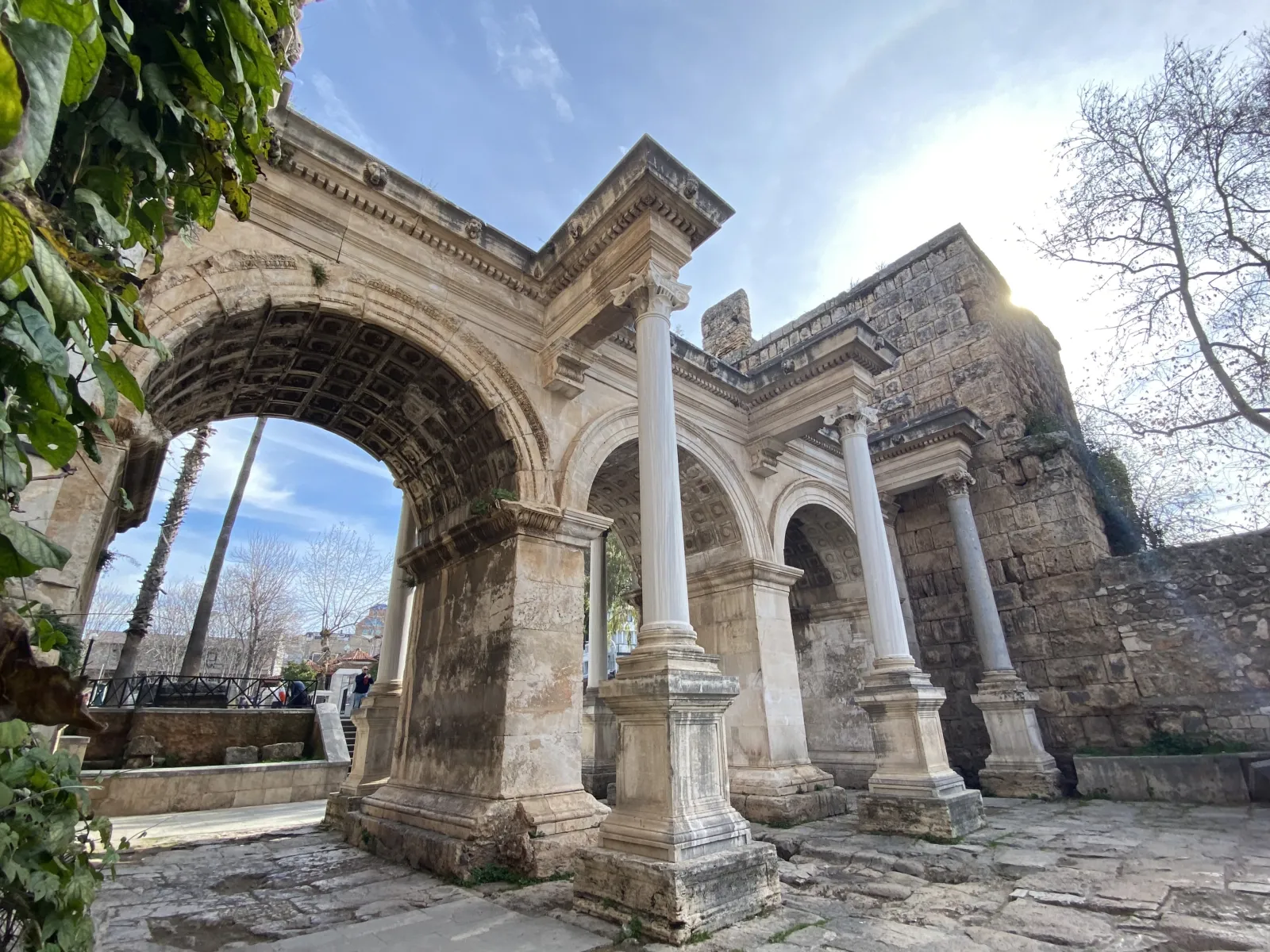
The Corinthian capitals on the flanking columns are standard high-imperial Roman work — acanthus leaves and volutes carved with the confident uniformity of a workshop that had been producing these forms for centuries. The columns themselves rest on pedestals that raise the capitals above the traffic flow — a practical decision that also elevated the decorative elements into the sightline of approaching visitors.
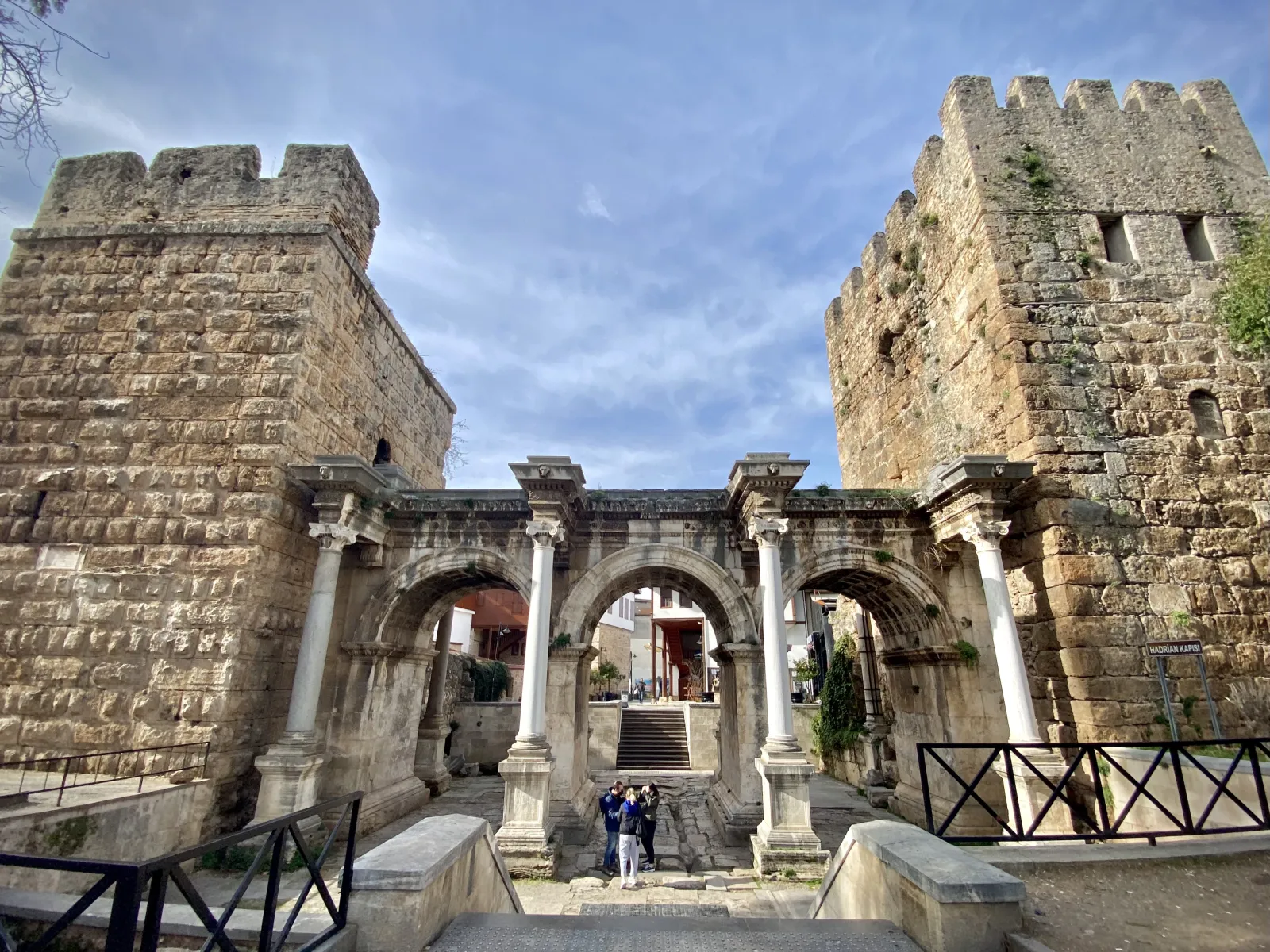
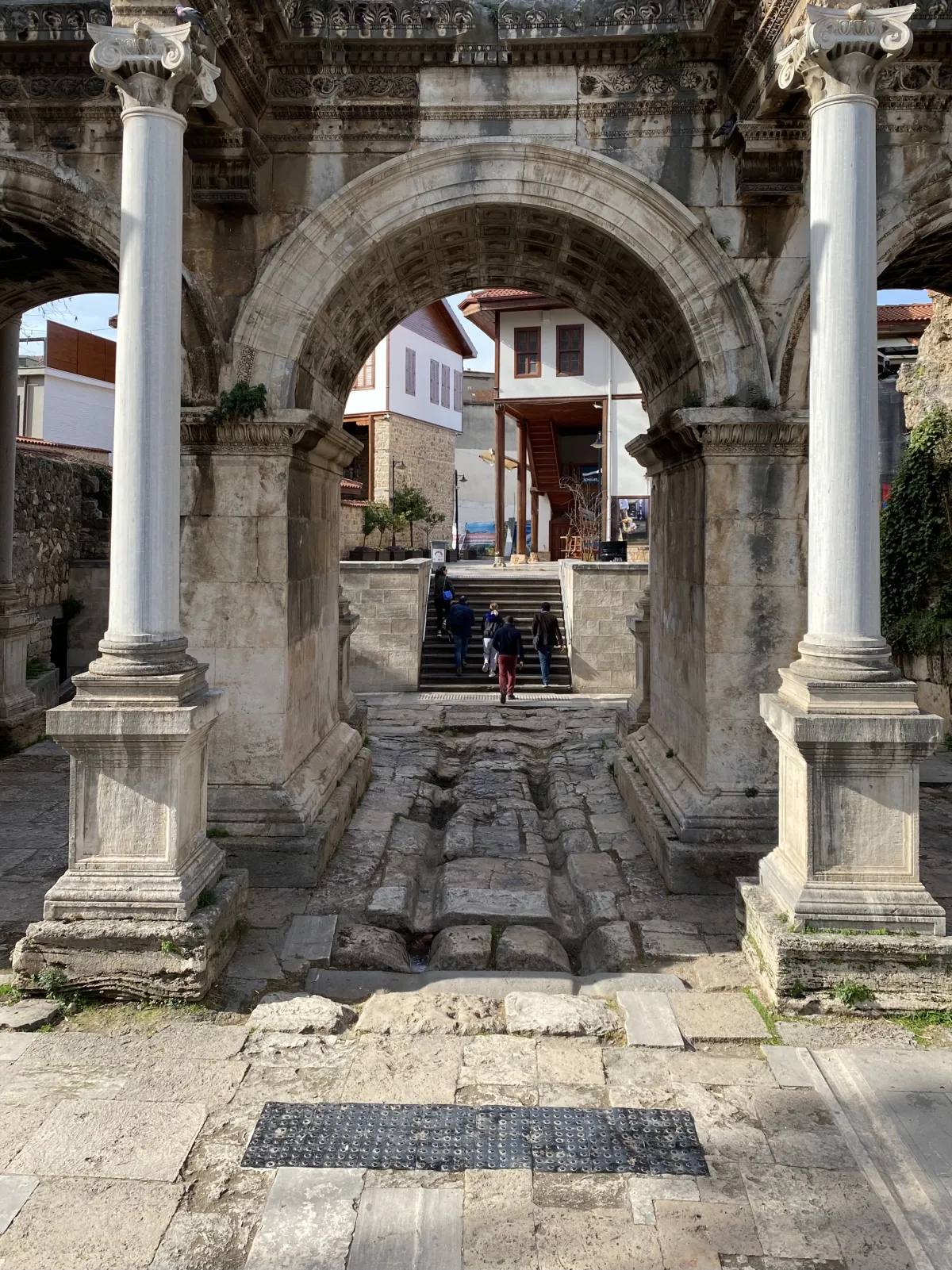
The gate originally had a second story — an attic level with inscriptions and possibly statuary — that has been lost. The foundations of the upper level are visible on the top surface. The inscriptions that survived identify the gate as a dedication to Hadrian and to the people of Attaleia. When I bring travelers here, I always ask them to step through the central arch and stop on the old-town side — the transition from modern boulevard to stone-paved lanes happens in a single stride, and the gate is the hinge.
Practical Information
Location: On Atatürk Caddesi, the main boulevard along the eastern edge of Kaleiçi. The gate is the primary entrance from the modern city into the old town.
How much time: Ten to fifteen minutes for the gate itself. Most visitors pass through it on their way into or out of Kaleiçi and pause for photographs.
Entry: Free and open at all hours — it is a functioning gateway on a public street.
Photography: The gate is best photographed from the street side (facing the old town through the arches). Morning light illuminates the marble facades. Evening light is warm but the gate falls into shadow from the flanking buildings.
Official resource: Antalya Museum — Ministry of Culture
Combining with other visits: The gate is the natural starting point for a Kaleiçi walk. Pass through it, descend into the old town, and reach the harbor in fifteen to twenty minutes. Combine with the Antalya Archaeological Museum for the city’s wider Roman context, or pair with Perge Ancient City and Phaselis for a full ancient-Antalya day.
Plan Your Antalya Visit
Hadrian’s Gate is a Roman triumphal arch that has been doing its job — marking the entrance to the city — for 1,900 years. If you would like to walk through it with a private guide who can connect the marble to the empire, tell us what interests you and we will shape the day around it.