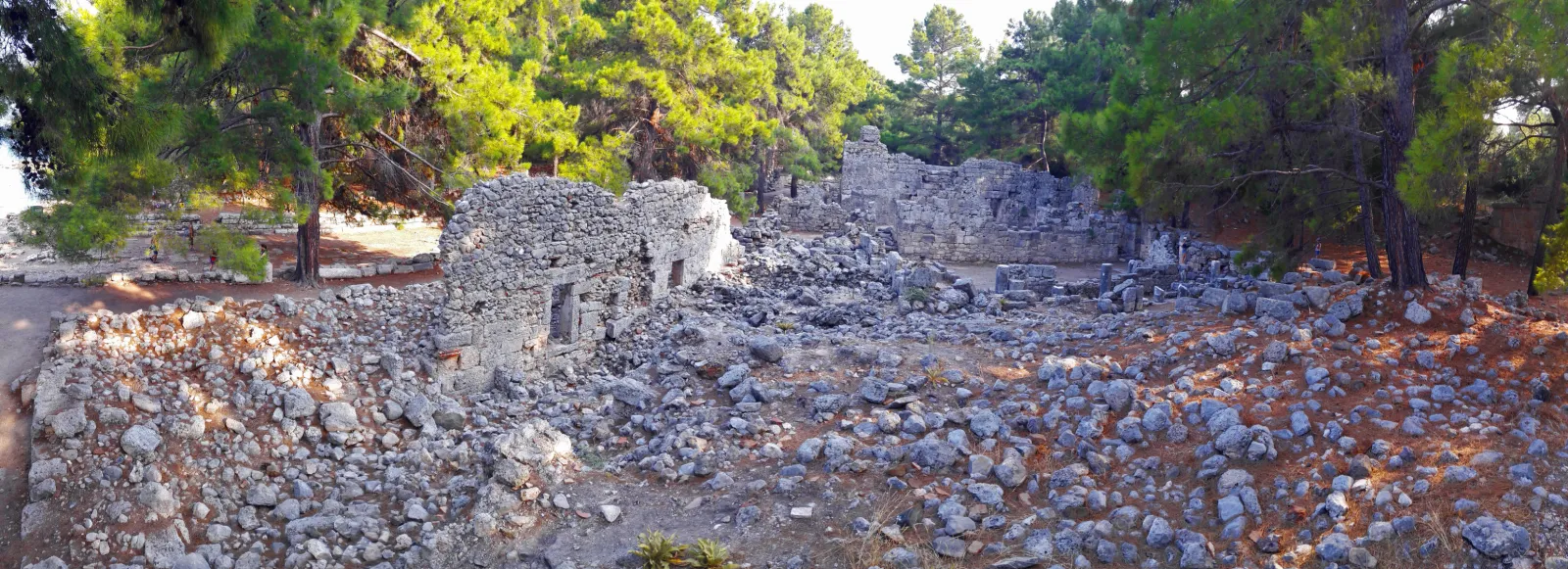
Most ancient cities in Turkey ask you to choose between history and landscape. You visit ruins on a dusty hillside, or you swim at a beach with no particular past. Phaselis does not ask you to choose. This Lycian-Roman port city occupies a forested peninsula between Kemer and Olympos on the western Antalya coast, and its ruins sit among pine trees that run down to three small harbors where the water is clear enough to see the bottom at five meters. You walk a Roman colonnaded street under a canopy of branches, pass a second-century aqueduct, reach a beach, and swim. The stones of the ancient harbor wall are underwater beside you.
Phaselis was founded in the seventh century BC by colonists from Rhodes — the same period as Side on the eastern coast. Its location on a narrow peninsula with natural harbors on three sides made it a successful trading port, and it grew wealthy on commerce between the Lycian coast and the wider Mediterranean. The city was occupied continuously through the Hellenistic, Roman, and Byzantine periods before being abandoned in the medieval era as the harbor silted up and trade routes shifted. Today, the ruins and the forest have merged into a single landscape — you cannot separate the built from the grown, and that integration is Phaselis’s particular quality.
The Three Harbors
Phaselis’s geography is defined by its three harbors — north, south (or main), and a smaller protected harbor to the southwest. The city’s commercial success depended on having sheltered anchorage regardless of wind direction: ships could always find a lee side. Today, the harbors have become beaches — small crescents of sand and pebble framed by the ruins of harbor walls and breakwaters.
The North Harbor is the largest and most popular for swimming. A crescent of coarse sand and small pebbles, backed by pine trees, with the remains of the ancient breakwater visible in the water. The beach is not developed — no loungers or umbrellas unless you bring your own — which is part of its appeal. You swim in water that is clear and calm, with the forested hills of the Taurus range rising behind you and the ruins of the city to your right.
The South Harbor (Main Harbor) was the city’s commercial port. It is smaller and more enclosed, with better-preserved harbor wall remains. The water here tends to be calmer. At the head of the harbor, the main street of the city begins its journey north.
The Southwest Harbor is the smallest and least visited — a quiet cove that gives you a sense of what the coastline looked like before tourism arrived.
The Colonnaded Street and City Center
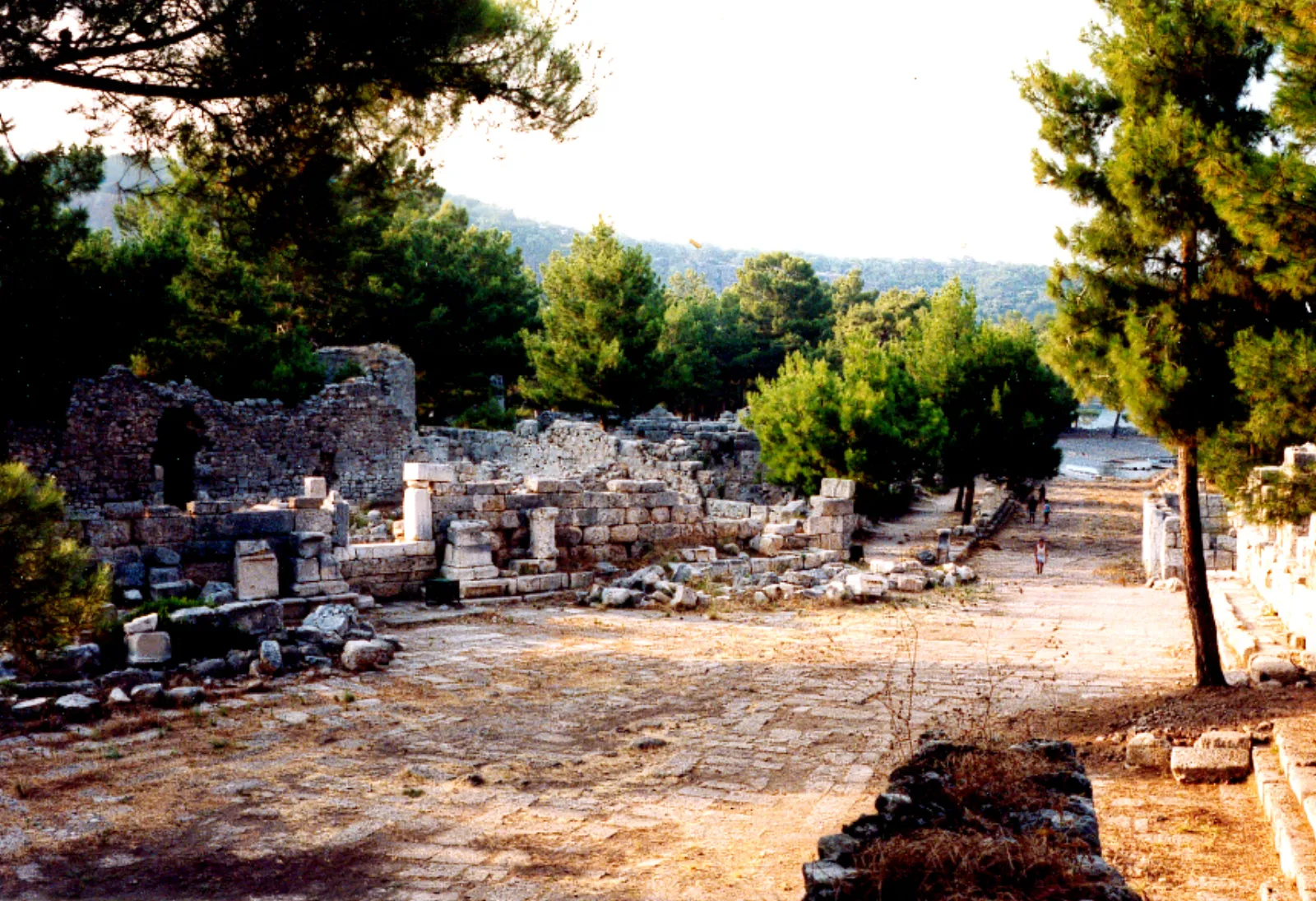
The main street of Phaselis runs approximately north-south, connecting the south harbor to the north harbor. It is wide — built to the standard of a Roman cardo — and was lined with columns on both sides, creating covered porticoes that shaded the shops and workshops opening onto the street. Sections of the column bases remain in place, and the paving is partly intact. What makes this colonnaded street different from Perge or Side is the setting: instead of open ground, the street passes through forest. Pine trees grow between the columns, their roots working into the ancient paving. Dappled light replaces the harsh sun of an exposed ruin field.
Along and near the main street, you pass several identifiable structures:
The Aqueduct: A Roman aqueduct brought water to the city from springs in the hills to the north. Sections of the aqueduct survive as a series of arches visible along the approach to the site and within the city itself. The engineering is straightforward Roman hydraulics — gravity-fed water carried on a masonry channel supported by arches where the terrain dipped.
The Theater: Phaselis’s theater is modest compared to Side or Aspendos — it seated perhaps 3,000 to 4,000 spectators — but its position in the hillside above the south harbor gives it a view of the sea. The seating rows are partially preserved, and the general form is clear. The theater looks out over the harbor and the coastline beyond.
The Baths: Multiple bath complexes have been identified along the main street, reflecting the Roman emphasis on public bathing. The largest, near the south harbor, preserves the typical room sequence (frigidarium, tepidarium, caldarium) and some of the heating infrastructure.
The Agora: An open square near the center of the city served as the marketplace and public gathering space. The agora’s boundaries are defined by remaining wall foundations.
Swimming at Phaselis
This is what makes Phaselis unusual among Turkish ancient sites: you can explore Roman ruins in the morning and swim in the ancient harbor in the afternoon. The north harbor beach is the primary swimming spot, and the water quality is excellent — clear, clean, and sheltered by the peninsula from open sea swells. The beach is pebbly rather than sandy in most areas, so water shoes or sandals are helpful.
There are no formal beach facilities within the archaeological site. No beach bars, no lounger rental, no changing rooms at the harbor beaches (though basic facilities exist near the site entrance). This absence of development is what keeps Phaselis’s coastline feeling like a discovery rather than a resort. You bring water, a towel, maybe a picnic, and you swim in the harbor of a city that has been welcoming visitors by sea since the seventh century BC.
The combination of swimming and archaeology is particularly appealing in summer, when walking through exposed ruins at midday can be exhausting. At Phaselis, the forest canopy provides shade along the walking paths, and when the heat builds, the water is steps away. It changes the rhythm of the visit — alternating between history and the sea. When I bring travelers here on a hot day, I suggest walking the street in the morning, swimming at the north harbor around 11, and then taking lunch under the pines before a second, shorter walk — it keeps everyone comfortable and turns a three-hour visit into an afternoon people remember.
Alexander the Great at Phaselis
Phaselis has a notable historical footnote: Alexander the Great wintered here in 334-333 BC during his campaign across Anatolia. The citizens of Phaselis welcomed him — wisely, given the alternative — and presented him with a golden crown. The city served as his base while he planned the next phase of his eastward march. Plutarch records that Alexander, who admired Homer, was particularly pleased to find that Phaselis claimed connections to the Trojan War era. A statue base inscribed with Alexander’s name was found at the site.
Practical Information
Getting there: Phaselis is approximately 60km southwest of Antalya city center, between Kemer and Olympos on the coastal road (D400). By car, the drive takes about 50 minutes to an hour. The site is signed from the highway, and a road leads down to the entrance and parking area. Dolmuş service from Kemer passes near the turnoff, but the walk from the highway to the site entrance is about 1km.
How much time: Plan for 2 to 3 hours to walk the ruins, swim at the north harbor beach, and enjoy the forest setting. If you are combining history and a longer beach visit, a half-day is comfortable.
When to go: Late spring through early autumn for swimming (May–October). The site is pleasant year-round for walking, though summer midday can be warm even with the tree cover. Morning visits are quieter; the site gets busier in the afternoon as beach visitors arrive.
Entrance fee: Phaselis is a protected archaeological site with an entrance fee (Museum Pass is accepted). Hours are typically 8:00 AM to 7:00 PM in summer, shorter in winter.
Official resource: Antalya Museum — Ministry of Culture
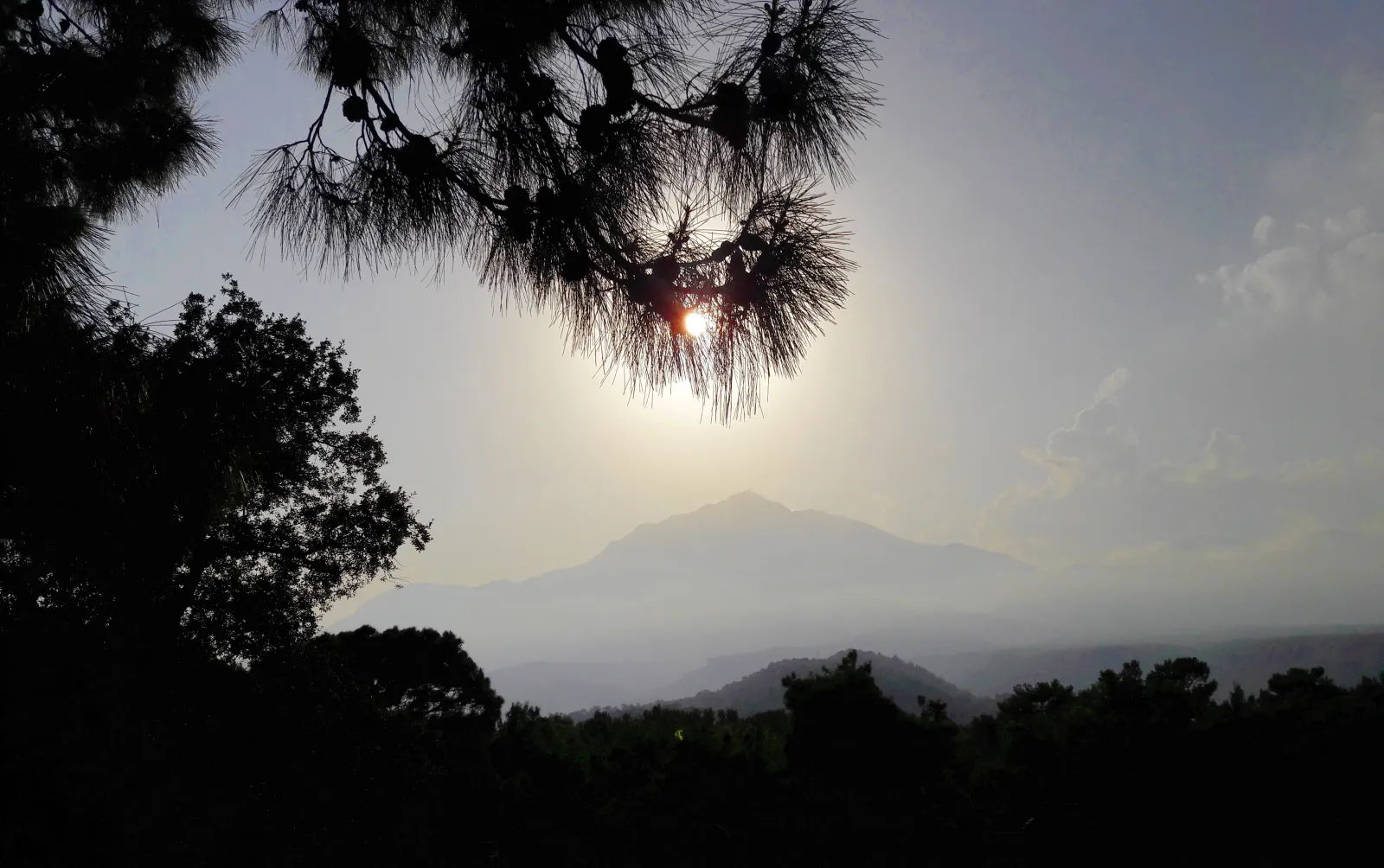
Combining with other visits: Phaselis combines naturally with Olympos and Chimera (the eternal flames, Yanartaş) further south — a full day along the Lycian coast. The cable car to Tahtalı Mountain (Olympos Teleferik) is also nearby, offering panoramic views of the coastline including the Phaselis peninsula. For travelers based in Antalya city, pair with Perge and Kaleiçi as alternative directions of the same region.
Plan Your Antalya Visit
Phaselis is one of those rare places where you do not have to choose between the ancient world and the natural one — they occupy the same ground. If you would like to visit with a guide who can tell you the story of the colonnaded street while the pine trees shade it, and then swim in the harbor afterward, tell us what interests you.