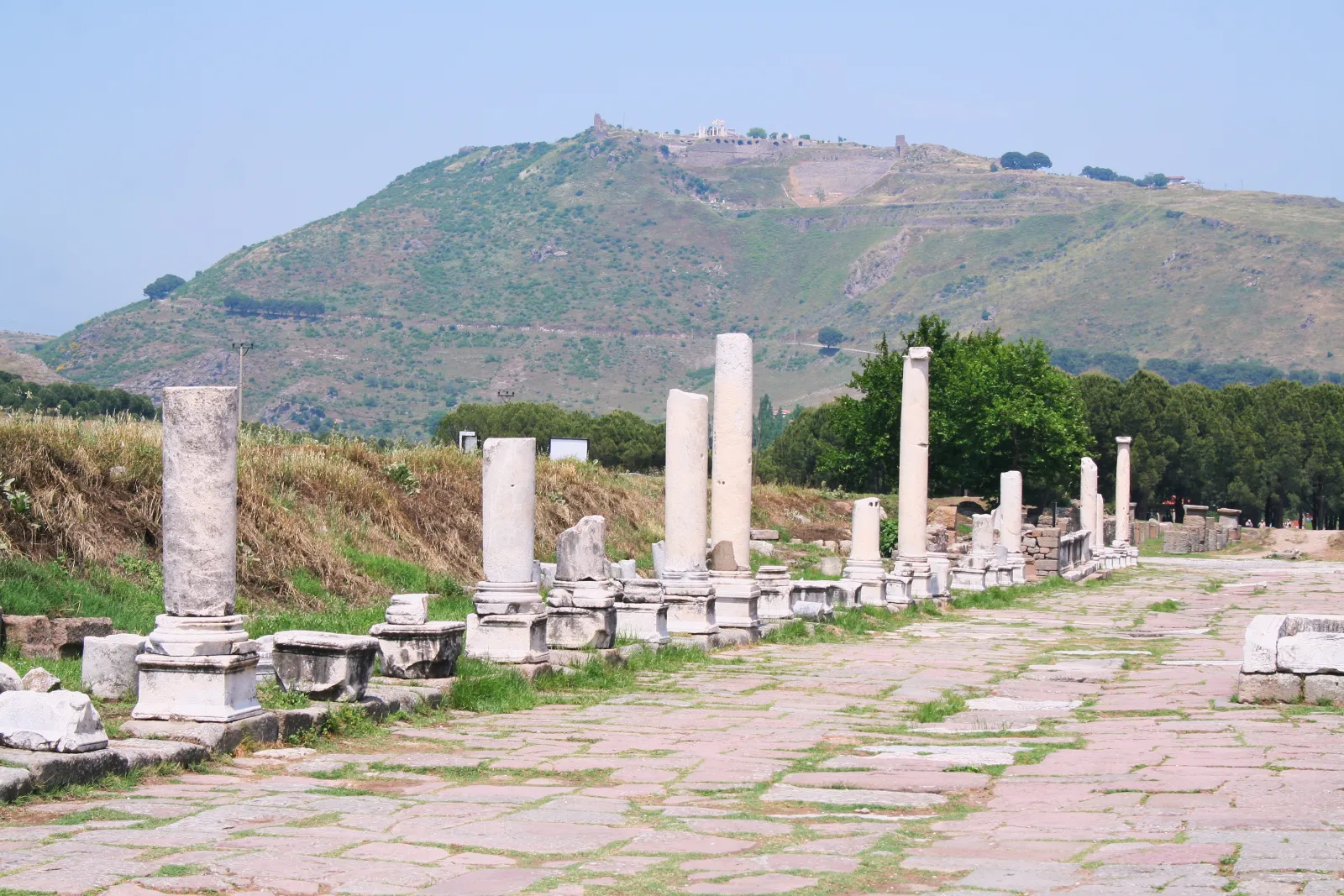
Pergamon sits on a hilltop 335 meters above the modern town of Bergama in western Turkey, and the first thing the altitude tells you is ambition. This was a city that wanted to be seen — and to see everything around it. The Acropolis of Pergamon, one of the most dramatically positioned ancient sites in the Mediterranean, holds the remains of a kingdom that, for two centuries (roughly 281-133 BC), rivaled Alexandria as a center of learning, art, and medical innovation. The library here held 200,000 volumes. The theater, carved into the steepest hillside the architects could find, seated 10,000 people at an angle that makes modern spectators grip the stone. The Great Altar of Zeus, now in Berlin’s Pergamon Museum, was one of the masterpieces of Hellenistic sculpture. What remains on the hilltop is the skeleton of a city that punched well above its weight.
Below the Acropolis, in the valley, the Asklepion — Pergamon’s healing center — operated as both hospital and spa, treating patients with water therapy, herbal medicine, dream interpretation, and the particular Roman faith in the therapeutic power of mud baths. Galen, the most influential physician in Western medicine after Hippocrates, was born in Pergamon in 129 AD and trained at the Asklepion before moving to Rome. The connection between the hilltop library and the valley hospital — between knowledge and practice — defined the city.
The Acropolis
The Acropolis is reached by cable car from the modern town of Bergama (a five-minute ride) or by a winding road that climbs the hill’s western face. The ruins spread across the summit in a series of terraces — the royal palaces, the library, the temples, the theater, and the military installations all arranged along a ridge with views in every direction.
The Theater
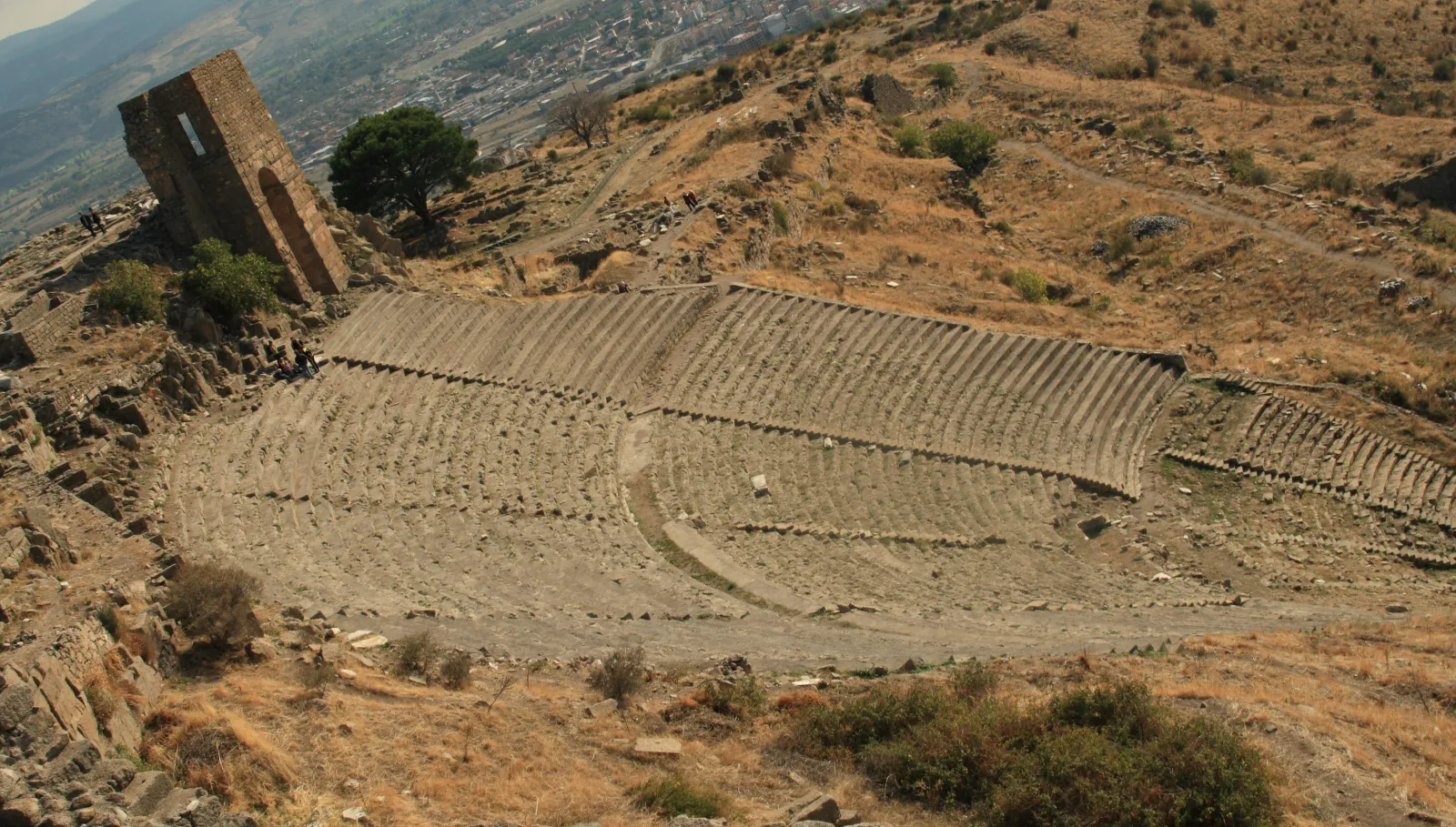
The Theater of Pergamon is the site’s most dramatic single feature: 10,000 seats carved into a hillside so steep that the rake (the angle of the seating) is approximately 36 degrees — the steepest of any theater in the ancient world. The seats rise from a narrow terrace above a near-vertical drop. Sitting in the upper rows, the plain of Bergama spreads out 300 meters below your feet. The effect is vertigo-inducing and was certainly intentional: the builders chose this specific slope to maximize both the view and the theatrical impact.
The theater was not built into a natural bowl, as most Greek theaters were. It was carved into the western face of the ridge, and the stage building (which would have been temporary, made of wood) was assembled on a narrow terrace at the base of the seating. The acoustics, despite the unusual geometry, are excellent — the stone and the hillside collaborate to focus sound upward.
The Library
The Library of Pergamon was the second-largest in the ancient world, after Alexandria, holding approximately 200,000 scrolls. The rivalry with Alexandria was direct and competitive: when Egypt, fearing Pergamon’s growing intellectual prestige, embargoed the export of papyrus, Pergamon developed parchment (pergamena — the word comes directly from the city’s name) as an alternative writing material. The innovation gave the library independence from Egyptian supply chains and gave the world a writing surface that lasted longer than papyrus.
The library building, on the upper terrace, is largely ruined — the walls survive to a low height, and the interior arrangement is known from excavation plans rather than visible remains. A statue of Athena (patron of wisdom) stood in the reading room. Mark Antony reportedly gave the entire collection to Cleopatra as a gift, transferring 200,000 volumes to Alexandria — if the story is true, the gift was one of the largest intellectual transfers in ancient history.
The Great Altar of Zeus
The foundations of the Great Altar are visible on the Acropolis terrace — a large rectangular platform that once supported a monumental altar decorated with a 113-meter frieze depicting the battle between the gods and the giants (the Gigantomachy). The frieze — muscular, dynamic, emotionally intense — is considered one of the high points of Hellenistic sculpture.
The altar itself, however, is in Berlin. German archaeologists excavated and removed it in the 1870s-1880s under an agreement with the Ottoman government, and it has been displayed in the Pergamon Museum in Berlin since 1930. The absence is felt at the site — the foundations point to something that should be here but is not. Turkey has requested the altar’s return; Germany has not agreed.
The Asklepion
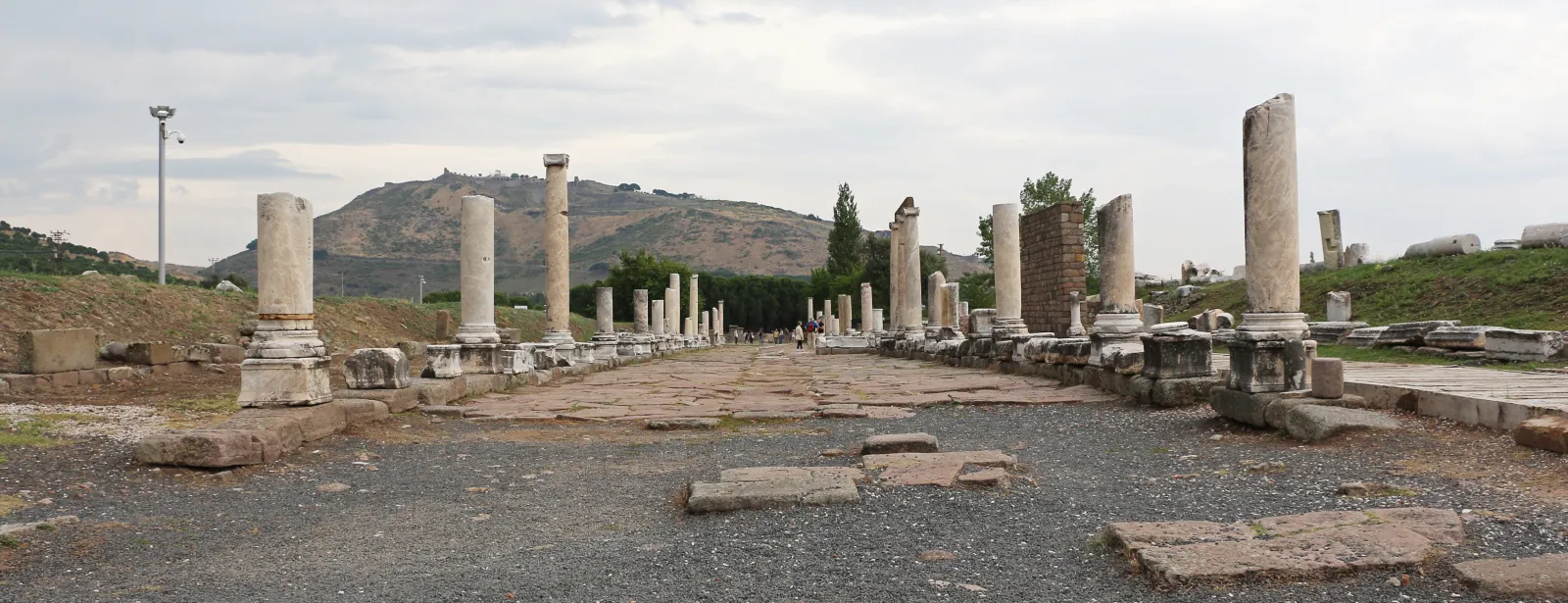
The Asklepion sits in the valley below the Acropolis, approximately two kilometers from the hilltop — a separate site with its own entrance. It functioned as a healing center from the fourth century BC, reaching its peak under the Romans in the second century AD.
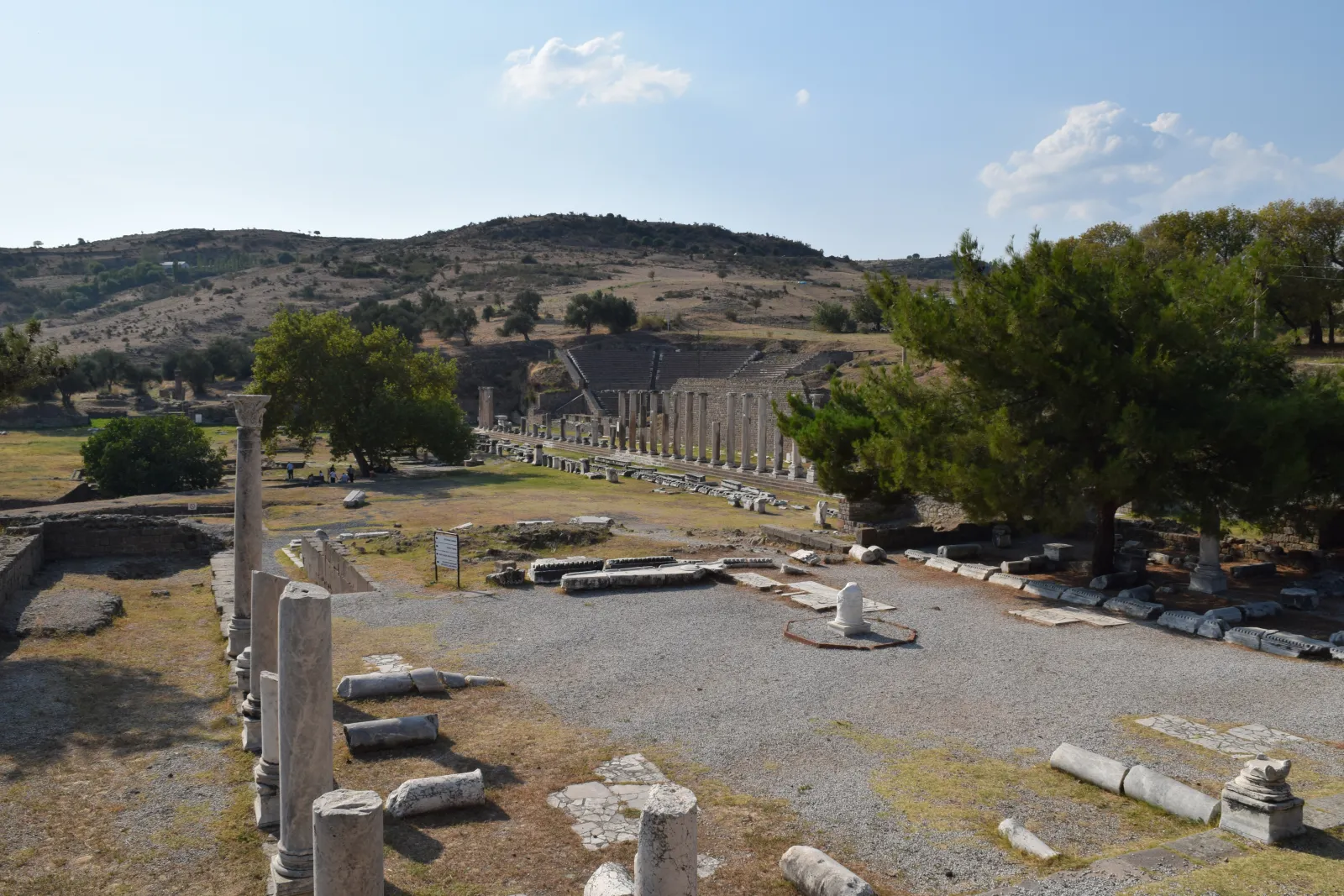
The approach is through a colonnaded Sacred Way — a 820-meter processional road that connected the city to the healing center. The Asklepion complex includes a central courtyard, treatment rooms, a theater (3,500 seats, used for therapeutic entertainment), a library, and a treatment tunnel through which patients walked while water sounds and whispered suggestions were piped through hidden channels in the walls — an early form of sensory therapy that combined hydrology with psychology.
Treatments included:
- Mud baths and thermal springs — the mineral-rich water was central to the therapeutic program
- Dream interpretation — patients slept in designated rooms and reported their dreams to priests, who prescribed treatments based on the content
- Herbal medicine — prepared from local plants
- Exercise and diet — prescribed regimens tailored to individual conditions
- Theater and music — believed to have therapeutic value
The Asklepion was not mystical quackery (though some elements look that way from a modern perspective). It was the best medical thinking of the ancient world, practiced in a purpose-built facility, and it produced results — including training the physician Galen, whose anatomical and pharmaceutical writings dominated Western medicine for 1,500 years. When I bring travelers to Bergama, I always suggest seeing the Asklepion first and then climbing to the Acropolis — it puts the practical knowledge before the monumental display, which is the order in which Pergamon’s reputation was built.
Practical Information
Getting there: Bergama is approximately 110 kilometers north of İzmir, accessible by car or bus. The Acropolis cable car departs from the town center. The Asklepion is a separate site about two kilometers from the Acropolis base. Most visitors arrive on guided tours from İzmir, Kuşadası, or on multi-day itineraries from Istanbul.
How much time: The Acropolis takes one to one and a half hours, including the cable car. The Asklepion takes forty-five minutes to an hour. Together, allow approximately three hours.
The cable car: Runs regularly during site hours. The ride takes five minutes and delivers you to the summit. The alternative — driving or walking up the hill — takes longer and is less practical for most visitors.
When to go: Morning is best for the Acropolis — the sun is behind you when facing the theater, and the hilltop catches a breeze that the valley below does not. The Asklepion is sheltered and comfortable at any time. Spring and autumn are ideal seasons.
Official resource: UNESCO — Pergamon and its Multi-Layered Cultural Landscape
Combining with other visits: Pergamon is typically combined with Troy (a few hours to the north) in a multi-day itinerary. The standard route — Istanbul → Gallipoli → Troy → Pergamon → Ephesus — covers four of Turkey’s most important archaeological sites in three to four days. See our Istanbul–Cappadocia–Ephesus planning guide for multi-city context.
Plan Your Visit
Pergamon is the city that invented parchment, trained Galen, and carved a theater into a cliff face — and then lost its altar to Berlin. If you would like to visit with a private guide who can connect the hilltop ruins to the healing center below and the history between them, tell us what interests you and we will build the itinerary around it.