The Temple of Hadrian is not the largest structure at Ephesus. It is not the most famous — that distinction belongs to the Library of Celsus and the Great Theater. But it may be the most refined. A small temple facade on Curetes Street — the main promenade through the ancient city — the Temple of Hadrian presents four Corinthian columns supporting an arched entablature, with a semicircular lunette above the doorway bearing a relief carving of Medusa. The proportions are precise. The carving is delicate. The scale is human — you stand before it and feel addressed rather than overwhelmed. In a city of monumental ambition, this temple achieved something quieter: elegance.
The temple was built around 138 AD and dedicated to the Emperor Hadrian, though its formal dedication also included Artemis and the city of Ephesus itself. Hadrian visited Ephesus in 128 AD, and the city commemorated the visit with this temple and other civic improvements. The structure functioned as a prostyle temple — columns across the front, no surrounding colonnade — with a small cella (inner room) behind the facade. It was a street-facing monument, designed to be seen and admired from the promenade, and its position on Curetes Street placed it in the daily path of the city’s entire population.
The Reliefs
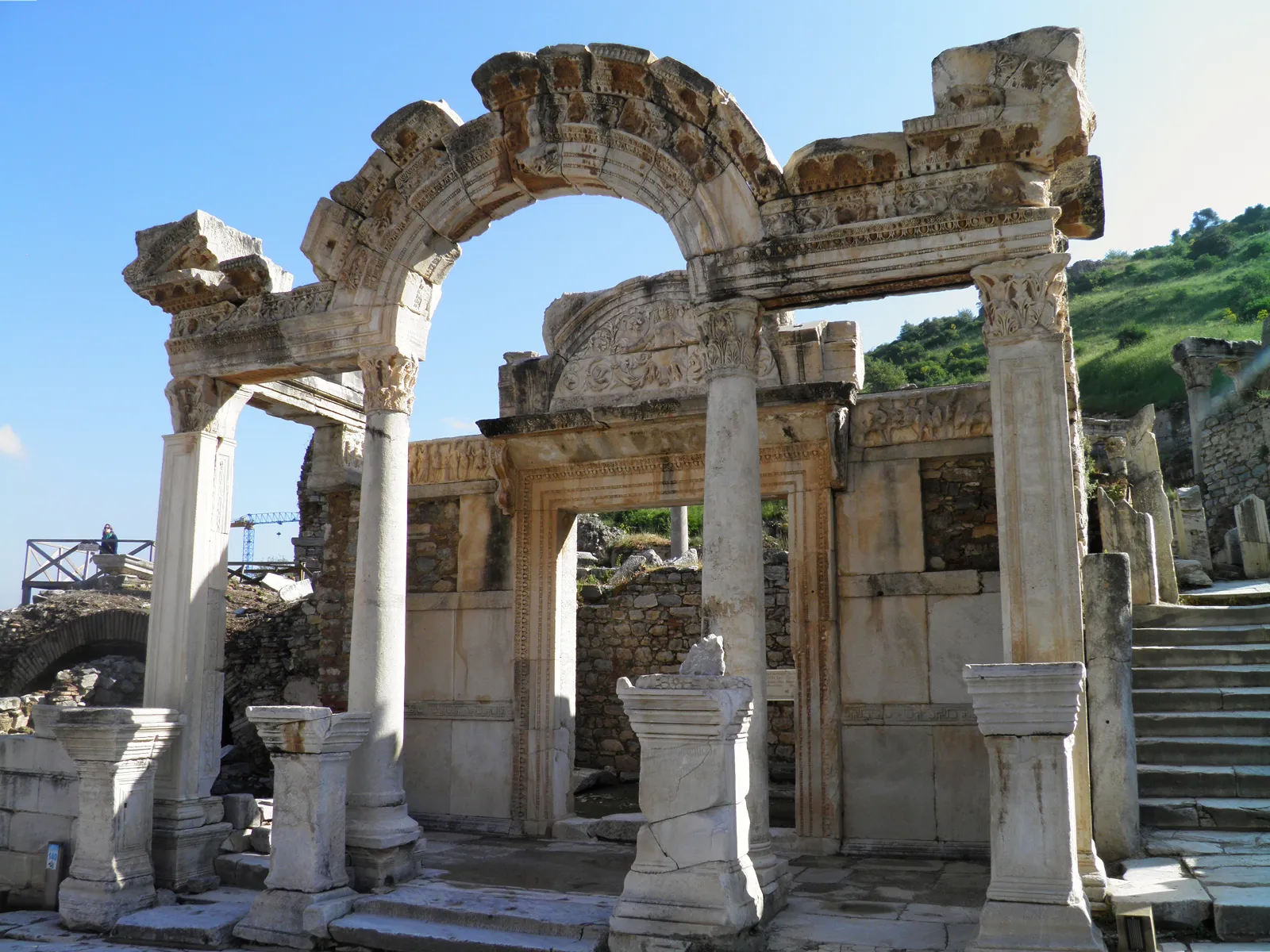
The temple’s artistic value is concentrated in its relief carvings, which have been studied, drawn, and photographed since the earliest excavations.
The Medusa relief occupies the lunette above the main doorway — a carved head of Medusa surrounded by acanthus leaves and scrollwork. The face is not the terrifying Gorgon of the archaic period but the softer, almost melancholic Medusa of Roman art — a protective figure rather than a monstrous one. In the Roman context, Medusa’s face on a temple doorway served an apotropaic function: turning away evil. The carving quality is high — the detail of the hair, the symmetry of the face, the integration with the surrounding foliate ornament.
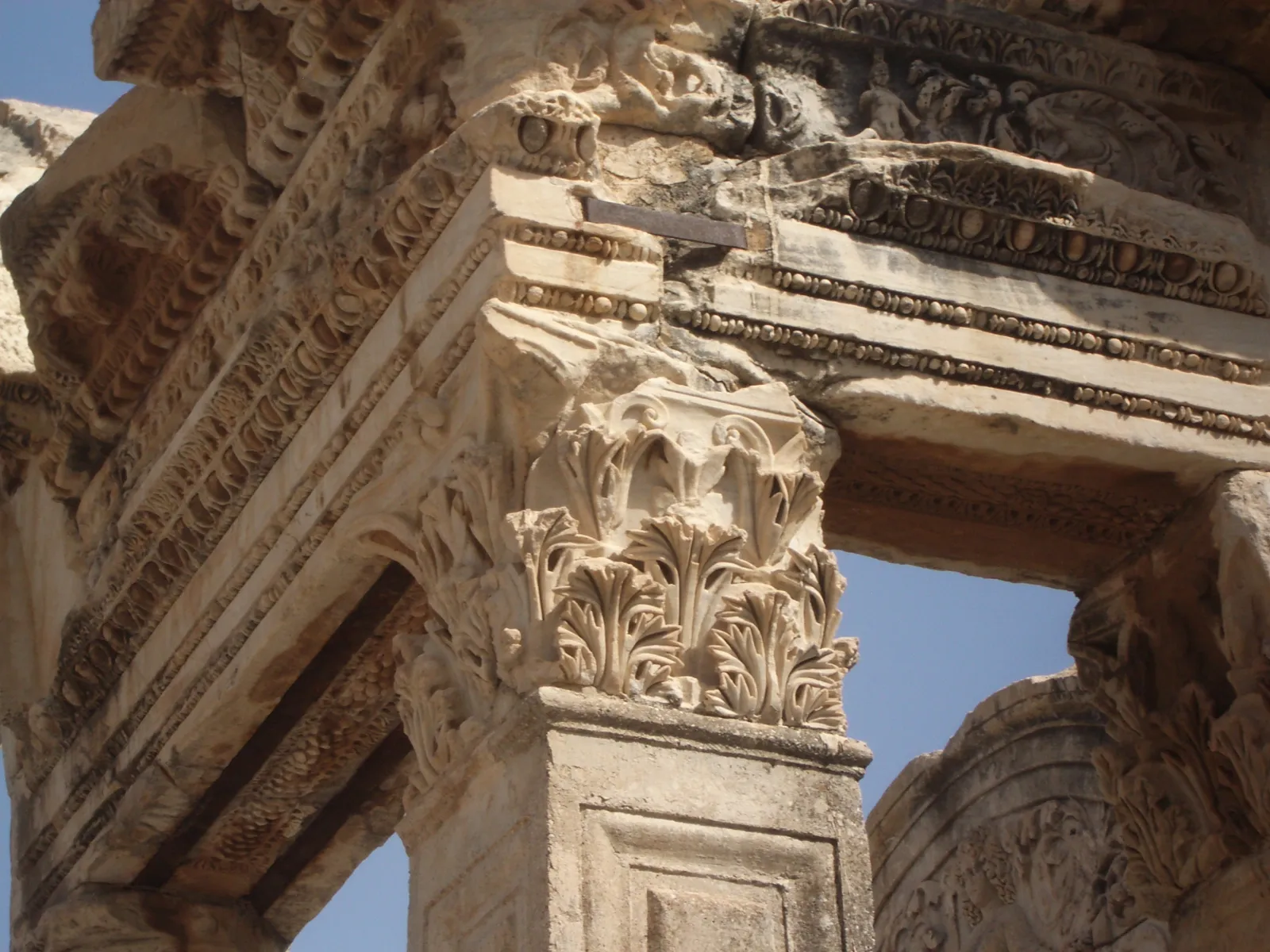
The inner arch carries a second relief depicting a female figure — variously identified as Tyche (the city’s fortune goddess), Medusa, or an Amazon — flanked by animals and foliage. This figure stands at the threshold between the public facade and the inner sanctum, a liminal position that reinforced the transition from civic space to sacred space.
The frieze panels on the architrave depict scenes from the founding mythology of Ephesus — Androklos hunting a boar (the legendary founder of the city, following an oracle’s instruction to build where a boar led him), the Amazons, and figures associated with Dionysus. These panels are among the most important narrative reliefs surviving from Roman Ephesus.
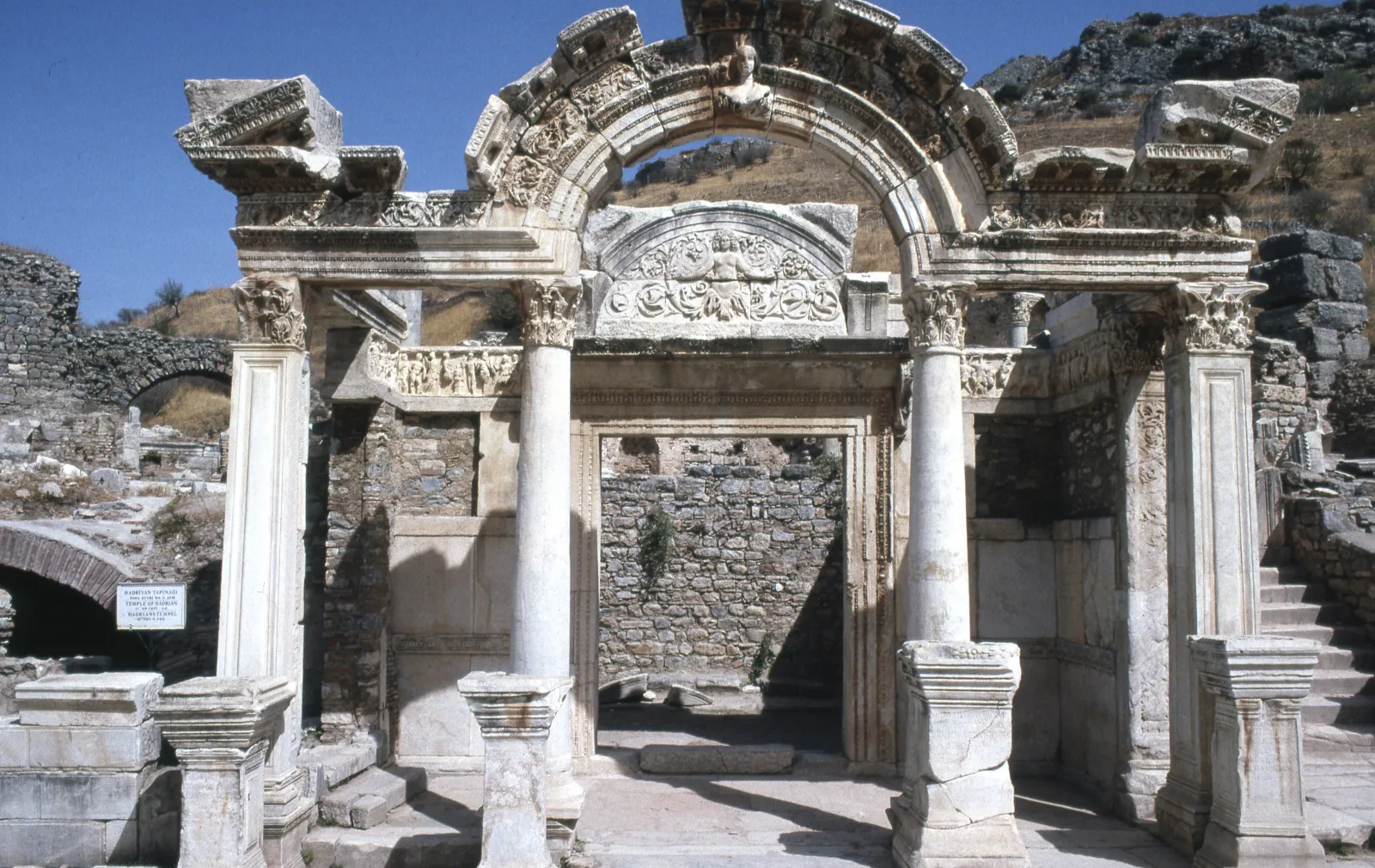
The reliefs currently on the temple are replicas. The originals were removed for conservation and are displayed in the Ephesus Museum in Selçuk, where they can be examined at close range and in controlled conditions. The replicas on site are accurate in form, and the visual effect of the temple is preserved.
Curetes Street Context
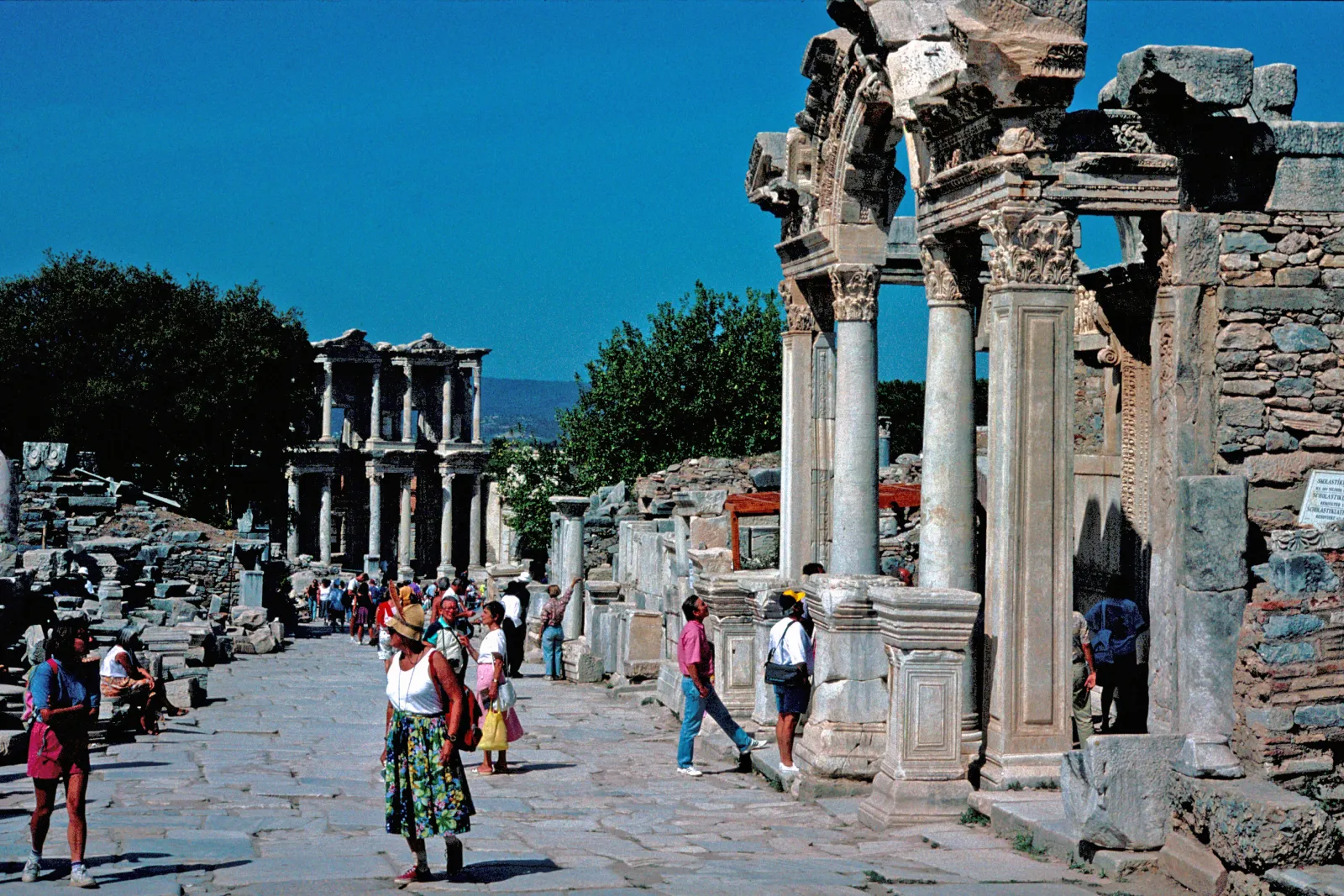
The Temple of Hadrian stands on the north side of Curetes Street, the principal street of Roman Ephesus, which runs from the Library of Celsus uphill to the Magnesia Gate. The street was paved in marble and lined on both sides with public buildings, monuments, fountains, and shops. Walking Curetes Street is like walking a Roman main street — the density of architecture per meter is extraordinary.
The temple is flanked by other structures of the same period: the Scholastica Baths (a large Roman bath complex, rebuilt in the fourth century), the public latrines (a remarkably well-preserved example of Roman communal sanitation), and a row of tabernae (shops) that served the street’s commercial function. Across the street, the Terrace Houses — multi-story Roman villas with mosaic floors and frescoed walls — show how the wealthy lived immediately behind the public facades.
This concentration means you encounter the Temple of Hadrian not in isolation but as part of a streetscape — one monument among many, competing for attention with the Library of Celsus down the hill, but holding its own through the quality of its proportions and its carving. When I bring travelers here, I ask them to stand directly in front of the facade for a minute before looking up — the scale is so human that the proportions do not register until you match your body to the columns.
Practical Information
Location: On the north side of Curetes Street, approximately halfway between the Library of Celsus and the upper (Magnesia) gate. Inside the Ephesus archaeological site, included in the general admission ticket.
How much time: Ten to fifteen minutes at the temple itself. The context of Curetes Street — the surrounding buildings, the Terrace Houses (separate ticket), the baths, and the latrines — extends the experience significantly.
Photography: The temple is one of the most photographed structures at Ephesus. Morning light (the facade faces generally south) provides even illumination. Midday light creates strong shadows in the relief carvings, which can be dramatic or harsh depending on your preference. Late afternoon gives warm tones.
The originals: To see the original relief panels, visit the Ephesus Museum in Selçuk (approximately three kilometers from the site). The museum provides close-up access and interpretive context that the site cannot.
Official resource: Ephesus Archaeological Museum — Ministry of Culture
Combining with other visits: The Temple of Hadrian sits on Curetes Street and is always visited as part of the wider Ephesus walk. Pair with the Temple of Artemis in Selçuk and the House of the Virgin Mary for a full day. For multi-city planning, see our Istanbul–Cappadocia–Ephesus planning guide.
Plan Your Ephesus Visit
The Temple of Hadrian is fifteen meters of carved stone on a two-thousand-year-old street — proof that Roman Ephesus valued precision as much as scale. If you would like to walk Curetes Street with a private guide who can read the reliefs, explain the mythology, and connect the temple to the city around it, tell us what interests you and we will build the day around it.